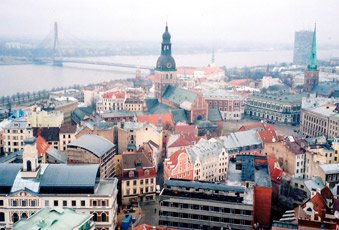
Riga, Latvia:
This is Riga old town, seen from the tower of the 'Petera
Baznica' church.
Riga
is a great place to visit, with
more of a 'big city' feel than Vilnius
or
Tallinn. There are two basic options for
travelling from the UK to Riga: overland by
train via Brussels,
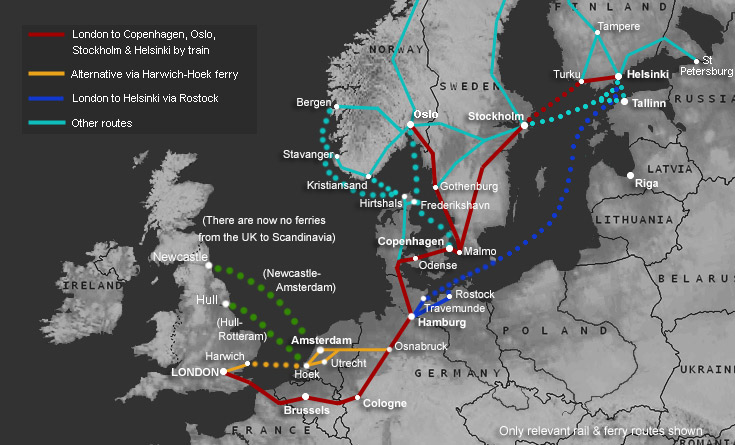
Berlin, Warsaw, & Vilnius, or by train & ferry, travelling from London to Stockholm, then the
overnight cruise ferry to Riga or
the daily overnight
cruise ferry to Tallinn in Estonia and a bus on to Riga.
If you feel like a
relaxing sea voyage, you can travel from
London to Riga via Stockholm. The journey takes 3
nights, and is a great adventure. You get a day in
Stockholm, too. There's a choice of
routes from London to Stockholm: You can travel
overland by Eurostar and connecting trains via Cologne or Hamburg & Copenhagen, or you can
travel via DFDS Seaways cruise ferry from Harwich to Esbjerg
in Denmark, then intercity train to Copenhagen and the
sleeper to Stockholm. The DFDS Seaways option is a
good choice and is shown below. For details of other
options between London and Stockholm, see the London to Sweden
page. Once in Stockholm, there are direct
overnight ships to Riga every day, or you can catch
the daily overnight ship to Tallinn and bus it from Tallinn
to Riga.
London ► Riga
(via direct cruise ferry from Stockholm)
Day 1, travel from London to Harwich by train, leaving London Liverpool
Street at 14:18 and arriving Harwich 1 hour 25 minutes
later. Harwich International station is right next
to the ferry terminal. The train runs hourly, but
this departure gives plenty of time to catch the ferry.
Please double-check times at
www.nationalrail.co.uk.
Sail from
Harwich to Esbjerg in Denmark aboard DFDS 'Dana
Sirena'. DFDS sails from
Harwich 3 or 4 days a week at 17:45, arriving in Esbjerg at
13:00 the next
day. See
www.dfds.co.uk
for sailing dates. A range of comfortable private
cabins is available, complete with private shower and
toilet. Take a taxi or bus to the
railway station, bus number 5 runs from the port to the
station every 20 minutes.
Day 2, travel from Esbjerg to
Copenhagen by modern air-conditioned InterCity
train, leaving Esbjerg town station at 15:41 and arriving in
Copenhagen at 18:49. The journey is about 175
miles, right across Denmark. You can check times
for your date of travel at
http://bahn.hafas.de.
Day 2 evening, travel from
Copenhagen to Stockholm overnight, leaving Copenhagen
by frequent Öresund link local train at 21:12 arriving Malmö
at 21:46 (these Copenhagen-Malmö local trains run every 20 minutes). A sleeper train leaves Malmö at
22:38 daily except Saturdays
arriving Stockholm Central station at 06:30 next morning (day 3). You
now have a free day in Stockholm. The sleeper
train has seats, couchettes (6 bunk) and sleepers (1 & 2 bed
rooms with washbasin). Alternatively,
spend the night in Copenhagen and head for Stockholm the
next day. Regular high speed tilting 'X2000' trains link Copenhagen with
Stockholm, check train times at
http://bahn.hafas.de.
Alternatively,
travel from London to Stockholm by Eurostar & sleeper train
via Brussels & Cologne with daily departures, see the London to Sweden
page
Day 3, a Tallink cruise ferry sails overnight from Stockholm every
day at 17:00, arriving at Riga passenger port
at 11:00 the next morning (day 4 from London). See
www.tallink.lv or
www.tallink.se to confirm sailing times & fares.
Map of Riga showing ferry terminal.
London ► Riga (via
Tallinn)
See
the London to Estonia page for
details of the journey from London to Tallinn.
From
Tallinn, there are Eurolines bus departures at 10:00, 13:15,
15:00 19:00 daily, each taking about 5 hours. For
example, the ship from Stockholm arrives in Tallinn at
10:00. The 13:15 bus from Tallinn bus station calls at
Tallinn port at 13:25, and arrives in Riga (bus station) at
18:50. See www.eurolines.ee
and www.eurolines.lv
for the full timetable, fares, and an e-mail contact for
booking. These two Eurolines websites
show different buses, so be sure
to visit both!
Map of Riga.
On board DFDS
Seaways "Dana Sirena" Harwich-Esbjerg...
Crossing the North Sea with
DFDS Seaways aboard the Dana Sirena...
Commodore class cabin
with double bed, TV, shower & toilet. Yes,
that's an ice bucket on the table with a half bottle
of sparkling wine....
Sirena class cabin
with TV, shower, toilet & minibar.
On board
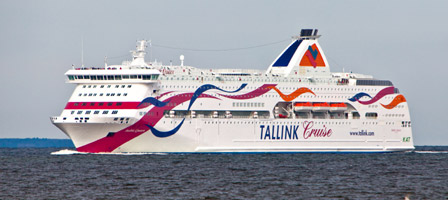
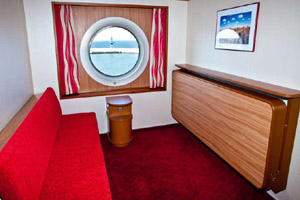
the Tallink cruise ferry from Stockholm to Riga...
Above:
There's a range of comfortable cabins is available
on the daily Tallink ferry from Stockholm to Riga, plus bars
and restaurants.
Above: Sunset as
the ferry to Riga leaves Stockholm. Photo
courtesy of Alistair Weaver.
Riga ► London (via direct cruise ferry to Stockholm)
Day 1, sail
from Riga to Stockholm by daily overnight cruise ferry. See
www.tallink.lv or
www.tallink.se. The ferry normally sails from Riga
daily at 17:30 arriving Stockholm at 09:30. Spend day 2 exploring Stockholm.
Day 2, travel from Stockholm to
Copenhagen overnight, leaving Stockholm
Central station at 22:23 by sleeper train and arriving Malmö at 06:17 next
morning, daily except Saturdays. A connecting local
train leaves Malmö every 20 minutes, with one at 06:42 arriving Copenhagen at 07:17.
The sleeper train has seats, couchettes (6 bunk) and
sleepers (1 & 2 bed rooms). Alternatively, on many days there is a high
speed X2000 train leaving Stockholm at 06:21 and
arriving Copenhagen at 11:33, allowing you to spend
the night in Stockholm and travel next day (day 3) to make a
same-day
connection to Esbjerg for the ferry to England.
Check times and days of running at
http://bahn.hafas.de.
Day 3, travel from Copenhagen to
Esbjerg by modern air-conditioned InterCity train, leaving Copenhagen at
12:30 and arriving Esbjerg at 15:26. You can
check times at
http://bahn.hafas.de. Take a bus or taxi to
the ferry terminal, bus number 5 runs from the station
to the port every 20 minutes.
Day 3 evening, sail from Esbjerg to Harwich
aboard DFDS 'Dana Sirena', leaving Esbjerg ferry
terminal at 18:45 three or four times a week, usually on
Tuesdays, Thursdays & Saturdays, arriving Harwich at 12:00
next day. See
www.dfds.co.uk
for sailing dates.
Day 4, travel from Harwich to London
by train, leaving Harwich
at 12:33, change at Manningtree and arriving London Liverpool Street at
13:55.
The train service runs hourly, you can check
times at
www.nationalrail.co.uk.
Alternatively,
travel from Stockholm to London by Eurostar & sleeper train
via Copenhagen, Cologne & Brussels with daily departures,
see the London to Sweden
page
Riga ► London
(via Tallinn)
You will need to leave Riga on the 07:20 or 10:50 bus for
Tallinn to be sure of catching the 18:00 ship back to
Stockholm. Both these buses call at Tallinn port
before arriving in Tallinn central bus station. See
the London to Estonia page for
details of the return journey from Tallinn to London.
How much does
it cost?
London to
Harwichby train costs £24 return or £21.50 one-way.
Advance reservation isn't necessary, just buy tickets at the
station on the day of travel. Alternatively, if you
book with DFDS Seaways by phone, they can sell you a
London-Harwich train ticket with your ferry ticket for a
special price of £10 one-way or £20 return.
Harwich to
Esbjerg by ferry starts at around £158 return for two people
sharing a 2-bed cabin with private toilet and shower (= £79
each) or £147 return for one person with sole use of a
cabin. To
check sailing dates, times and fares for different types of
cabin, visit
www.DFDS.co.uk.
DFDS
Seaways now has an airline-style pricing system so prices
vary, book early and avoid peak times to get the cheapest fares. Children under 16 travel at
reduced fare. Unfortunately, DFDS
won't now let solo passengers share cabins, the whole cabin
must be booked.
Esbjerg to
Copenhagen by train costs 297 Kr (£27) one way, 594 Kr
(£54) return for adults, or 149 Kr (£14) each way for
children and seniors over 65. Advance reservation is
possible but not necessary, and tickets can be bought at the
station on the day at those prices. Alternatively,
DFDS can sell you a train ticket with your ferry ticket, at
the same prices.
Copenhagen to
Stockholm by sleeper train costs SEK 760 (£56) one-way
or SEK 1520 (£112) return per person travelling in 6-bunk
couchettes, or SEK 1170 (£87) one-way, SEK 2340 (£174)
return per person travelling in a 2-bed sleeper.
Stockholm to
Riga by ferry:
The fare depends on cabin type and season. Fares
start at around £25 one way, £50 return. Check fares
and book online at
www.tallink.lv or
www.tallink.se.
How to buy
tickets...
Step 1:
Buy your Harwich-Esbjerg ferry tickets online at
www.dfds.co.uk
(no booking fee)
or by calling DFDS Seaways on 0871 522 9955, although there's a £20 fee for phone bookings.
Phone lines are open 09:00-17:30 Mondays-Fridays,
09:00-17:00 Saturdays, closed Sundays.
You can buy
your London-Harwich & Esbjerg-Copenhagen train tickets at
the station on the day of travel. No reservation is
necessary, and there's no price advantage in buying tickets
in advance. But if you want to save queuing at the
ticket office, you can buy
the London-Harwich ticket online at
www.nationalrail.co.uk and the Esbjerg-Copenhagen ticket
(with seat reservation) at
www.dsb.dk,
the Danish Railways website. This is in Danish, but
it's not difficult to work out how to use it if you're
familiar with the way such booking systems work. You
pay by credit card then print out your own ticket.
remember that Copenhagen in Danish is 'Kobenhavn'.
Alternatively, if you book by phone,
DFDS can add both UK and Esbjerg-Copenhagen tickets to your ferry fare, including
making a seat reservation on the Esbjerg-Copenhagen train.
Ask DFDS about special cheap train fares from other UK
stations to Harwich, too.
Step 2:
Buy the Copenhagen-Malmö-Stockholm sleeper tickets online at
either www.sj.se
(no booking fee, see this
step-by-step advice on using it) or
www.bokatag.se. You buy online and pick up your
tickets from the
SJ ticket machines at Copenhagen station. Bookings open 90 days before departure. A ticket for
the connecting Copenhagen-Malmö local train can easily be
bought at the ticket office for a few krone, when you get to
Copenhagen.
The advantage of this route
is that it may be a bit faster (but not much!). The
disadvantage is that UK rail agents can only book you as far
as Warsaw, but can't book the leg from Warsaw to Vilnius or
the bus from Vilnius to
Riga. You will need to buy tickets when you
get to Warsaw and Vilnius, although this won't be a
problem.
Travel from Vilnius to Riga by bus or train. There are
a number of bus services daily, see www.eurolines.lv,
or you can travel by local train with a change and overnight
stop in Daugavpils, see
here for details. There used to be an overnight
train every other day from Vilnius to Riga, but this was
withdrawn in January 2004.
Riga ► London
(via Warsaw)
Travel
from Riga to Vilnius by bus or train. See www.eurolines.lv
for details of the several daily buses.
Or travel by local train with a change and overnight
stop in Daugavpils, see here for
details.
You
can book this journey from London as far as Warsaw through
Deutsche
Bahn's UK office on 08718 80 80 66 (lines
open 0900-1700 Monday-Friday, no booking fee) or www.europeanrail.com
on 020 7619 1083 (£20 booking fee, but can have more
time to help).
Then book the Warsaw-Vilnius train at the station in Warsaw
when you get there. Then book the
Vilnius to Riga bus when you get
to Vilnius.
On the
return journey, book the Riga-Vilnius bus at Riga
bus station, and the Vilnius-Warsaw train
at either Vilnius station. Deutsche Bahn
can, of course, reserve the rest of your return journey from
Warsaw back to London.
Trains link
Riga with many Latvian towns, including Daugavpils (4 trains
daily, 3-4 hours),
Krustpils, Lugai,
Tukums & Jelgava. The official Latvian Railways
website is www.ldz.lv.
Click 'English' at the top, then
'Passenger traffic'. There's now also a Latvian
passenger trains website,
www.pv.lv
(click 'ENG' middle left for the English version). However, the best source of times and fares for both trains
and buses within Latvia is
www.118.lv,
which also has an English version.
Sadly, there are
now no direct Riga-Vilnius trains at
all. At least the Communists knew how to run a
railway! The Riga to Vilnius journey is now much
faster and more frequent by long-distance bus, see the
section below. However, if you prefer to travel by
train, no problem: You can use a daily local train
from Vilnius to Daugavpils in the evening,
stop overnight in a hotel at Daugavpils, then travel by
local train Daugavpils-Vilnius next morning. Being an
evening train-hotel-morning train arrangement, it's quite
time-effective even if slower than the bus.
Evening
day 1, travel from Riga to Daugavpils by train, leaving Riga main station at 17:25
and arriving Daugavpils 21:07. The fare is around 3.60 Lats
(£4 or 5 euros).
Morning
day 2, travel from Daugavpils to Vilnius by once-daily international train
leaving Daugavpils at
06:07 and arriving Vilnius at 08:29. The fare is about 20 Lats (£25 or
28 euros). Simply buy a ticket at the station on the
day as this train cannot be pre-booked.
See the
Lithuania page
for details of the northbound service.
The site to
confirm Latvian train times Riga-Daugavpils is
www.ldz.lv
(Click 'English' then 'passenger traffic'), the site to
confirm Lithuanian train times Daugavpils-Vilnius is
www.litrail.lt (click 'EN' for English, then 'Passenger
transportation').
Traveller Russell Goddard
went this way between Vilnius & Riga, and also used the
Eurolines coach service between Riga & Tallinn: "While not unpleasant, the coach was a distinctly soulless
experience, lacking the character of the trains. The coaches
are a way of getting people from A to B with a minimum of
bother, which I'm sure is a plus in many people's books, but
as someone who travels as much for the sake of the journey
itself, I was glad I'd gone by train from Vilnius to Riga
via Daugavpils rather than taking the coach all the way from
Vilnius to Tallinn! In Tallinn itself, the bus station is
inconveniently located some distance from the city centre,
while the rail station is right on the edge of the old town
- if only it had a decent international service!"
Riga ► Vilnius by bus...
If you'd rather travel by bus, as in this case it is
certainly more frequent and faster, there is a regular Eurolines bus service from Riga to
Vilnius, with several departures daily, fare about 12-14 Lats (£14-£16 or $22), journey time 4-5 hours. See
www.eurolines.lt or
www.luxexpress.eu.
At last some
good news from the Baltic States! As from August 2011,
Latvian and Estonian railways have co-ordinated their
timetables and it's possible once more to travel between
Riga and Tallinn on a fairly comfortable and cheap daily
train service, with one simple change of train at Valga on
the border. It must be stressed that both the Latvian
and Estonian trains are local services rather than anything
fancy, and it takes a few hours longer and is less frequent
than the bus (the train service runs only once a day), but
it's cheap, easy to use, and you may find it an interesting
and more enjoyable alternative to a long bus ride.
Riga ►
Tallinn
Tallinn
► Riga
Local
train service
Daily
Local
train service
Daily
Riga station
depart
13:15
Tallinn station
depart
06:46
Valga (on Latvian train)
arrive
16:35
Valga arrive (on Estonian train)
arrive
11:35
Valga (on Estonian train)
depart
16:47
Valga depart (on Latvian train)
depart
11:44
Tallinn station
arrive
21:49
Riga station
arrive
15:03
Fares:
Riga to Valga costs just 3.75 Lats (£4.50 or 5 euros) for
the 168 km. Valga to Tallinn costs only 8.95 euros
(£8.20)
How to buy
tickets: There's no need to reserve, indeed you can't.
Just turn up at Riga station, buy a ticket to Valga and get
on the train. You'll need to buy the Valga-Tallinn
ticket when you get to Valga, if necessary on board the
Estonian train.
How to
check these times and fares: You can check times
for the Latvian train times and fares at www.ldz.lv,
click 'English' then 'Passenger traffic'. You can
check the Estonian train times and fares at
www.edel.ee. Click
'Eng' top right for English, then use the journey planner.
For a timetable in .pdf format, leave it in Estonian and click
'Sõiduplaanid ja-hinnad'. For a network map, again use
the Estonian version and click the 'Raudteekaart' map
graphic on the left.
The
modernised interior of the Latvian Riga to Valga
train.
Photo courtesy of Jan paček
The Riga to Valga
train, a classic Soviet-era design. Photo courtesy of Jan
paček
Riga ► Tallinn by bus...
There is a regular
Eurolines bus service between Riga & Tallinn, taking about 5½
hours, with regular departures through the day.
See
www.luxexpress.eu or
www.eurolines.lt. A couple of other bus companies
(Ecolines & Hansabus) operate on this route too.
There is a comfortable and safe daily
sleeper train from Riga to Moscow, the 'Latvijas Express', with
1st class 2-berth sleepers & 2nd class 4-berth sleepers.
In summer there's an additional daily sleeper train, the 'Jumala',
leaving a little later. To check train
times, see
www.poezda.net.
Riga ►
Moscow
Moscow
► Riga
"Latvijas Ekspress"
Daily
May-Sept
"Latviajas Ekspress"
Daily
May-Sept
Riga
depart
16:20
18:10
Moscow (Leningradski)
depart
19:10
21:02
Moscow (Leningradski)
arrive
09:41
12:16
Riga
arrive
10:05
12:15
Fares:
Riga to Moscow costs around 60 euro in a 4-bed sleeper if
bought at the station.
This train does NOT go through Belarus.
To check train times and book online in either direction,
use the Real Russia
booking system here. Real Russia charge a 15-23%
mark-up over ticket office prices, included in the prices
they show. For journeys starting in Riga you'll need
to have tickets sent to you at a small extra charge as the
e-ticket option doesn't work for departure from Vilnius,
only for departures from Moscow.
Above
left:
A comfortable 2-berth sleeper on the 'Latvijas Ekspress'
Riga to Moscow train, with 2 lower bunks. Note the
tablecloth, serviettes, and various goodies available
for purchase.
4-berth sleepers are similar to 2-berth ones, but with
two upper bunks as well. The Riga to St Petersburg train
has similar sleepers. Above right: Through the
countryside, en route from Riga to Moscow Photos courtesy of
John Walton.
Riga ► St Petersburg by train...
There is a
comfortable and safe daily overnight sleeper train from Riga
to St Petersburg, the 'Baltiya', with 2-berth and 4-berth
sleepers.
Riga ►
St Petersburg
St
Petersburg
► Riga
"Baltija"
Daily
"Baltija"
Daily
Riga
depart
19:30
St Petersburg (Vitebski)
depart
22:08
St Petersburg Vitebski)
arrive
09:08
Riga
arrive
09:35
Riga to St Petersburg costs around
50 euro in a 4-bed sleeper if bought at the station. This train does NOT go
through Belarus.
To check train times and book online in either direction,
use the Real Russia
booking system here. Real Russia charge a 15-23%
mark-up over ticket office prices, included in the prices
they show. For journeys starting in Riga you'll need
to have tickets sent to you at a small extra charge as the
e-ticket option doesn't work for departure from Vilnius,
only for departures from St Petersburg.
Make
sure you take a good guidebook. For the independent traveller,
this means either the Lonely Planet or the Rough Guide. I
personally prefer the layout of the Lonely Planets, others prefer the
Rough Guides. Both books provide a similarly excellent level of
interesting background and practical information. You won't
regret buying one of these! My own book, an essential handbook
for train or ferry travel to Europe
based on this website called "The
Man in Seat 61", was published in June 2008, and
is available from Amazon.co.uk with shipping worldwide.
The
Thomas Cook European timetable
has train & ferry times for every country in Europe plus currency
& climate
information. Published since 1873, it costs £13.99.
It's essential for any serious traveller
and an inspiration for armchair travellers. Still
not convinced you need one? More information
on what the Thomas Cook Timetable contains. You can
buy the latest monthly edition online at
www.thomascooktimetables.com with worldwide delivery or
buy it in person from any UK branch of Thomas Cook (ask at the
bureau de change), or from W H Smiths in Victoria or Kings
Cross stations in London.
Or
buy the twice-yearly independent traveller's edition with
laminated cover from Amazon.co.uk:
Winter/Spring 2011/12 edition (Dec 2011 to June 2012) or
(when available)
Summer/Autumn 2012 edition (June to Dec 2012)
The Thomas Cook Rail Map of
Europe is the best and most comprehensive
map of train routes right across Europe, from Portugal in the
west to Istanbul, Moscow & Ukraine in the east, from Finland
in the north to Sicily & Crete in the south. High speed
&
scenic routes are highlighted. Highly recommended!
Buy online
at
www.amazon.co.uk
(worldwide delivery).
See an extract from
the map.
Find
a hotel
in Riga or anywhere else in Latvia, Lithuania or Estonia...
Personal recommendations: The
Radi un Draugi Hotel is a clean, comfortable boutique
hotel in the heart of Riga old town, from about £48 per night
for a double.
www.hotelscombined.com
is probably the best hotel search system I've seen, a free search tool
which checks all the main hotel booking sites (Opodo, Expedia,
Booking.com, Hotels.com, AsiaRooms, Travelocity, LateRooms and
others) to find the cheapest hotel rates. Set up in
2005, it's probably the best place to start for booking any
hotel online in any country, worldwide.
Other hotel sites worth trying...
www.tripadvisor.com
is the place to find
independent travellers' reviews of all the main hotels.
www.booking.com is my own preferred hotel booking system
(Hotels Combined being a search/comparison system). It
has a simple interface, a good selection in most countries
worldwide, useful online customer reviews of each hotel, and
decent prices, usually shown inclusive of unavoidable extras
such as taxes (a pet hate of mine is systems that show one
price, then charge you another!).
Backpacker hostels...
If you're on a tight budget,
don't forget the hostels. For a dorm bed or an
ultra-cheap private room in backpacker hostels in most
European cities use
www.hostelbookers.com.
Travel insurance & health card...
Get travel insurance, it's essential...
Never travel without insurance from a
reliable travel insurer, with at least £1m or preferably £5m medical cover. It should also cover loss of
cash (up to a limit) and belongings, and cancellation. An annual
multi-trip policy is usually cheaper than several single-trip
policies even for just 2 or 3 trips
a year (I have an annual policy myself).
Don't expect travel insurance to bail you out of every missed
connection, but European international rail conditions of
carriage (known as the 'CIV') contain consumer protection
provisions that entitle you to travel forward by the next
available train if you miss a connection because of a delay to
the first train, irrespective of who operates which train, and
even if your ticket is in theory train-specific and
non-changeable.
Feedback from using
insurance for rail & ferry travel is always welcome. Here are some suggested insurers.
Seat61 gets a small commission if you buy through these
links.
If you're a
UK citizen travelling in Europe, you should apply for a free
European Health Insurance Card, which entitles you to free or
reduced rate health care if you become ill or get injured in
many European countries, under a reciprocal arrangement with
the NHS. This replaced the old E111 forms
as from January 2006. The EHIC card is available from
www.ehic.org.uk. It doesn't remove the need for
travel insurance, though.
Get a spare credit card, one designed for foreign travel with no currency
exchange loading & low or no ATM fees...
It costs nothing to take out an extra credit card.
If you keep it in a different part of your luggage so you're
not left stranded if
your wallet gets stolen, this is a form of extra travel insurance in itself. In addition,
some credit cards are significantly better for
overseas travel than others. Martin Lewis's
www.moneysavingexpert.com/travel/cheap-travel-money explains which
UK credit cards
have the lowest currency exchange commission loadings when you buy something
overseas, and the lowest cash withdrawal fees when
you use an ATM abroad. Taking this advice
can save you quite a lot on each trip compared to using your
normal high-street bank credit card! You can save money on ATM charges and exchange rates using a
Caxton FX euro currency Visa Card, or indeed the
multi-currency 'Global Traveller' Visa Card,
find out about these cards & sign up here.
Get an international SIM card
to save on mobile data and phone calls...
Mobile phones can cost a fortune to use abroad, and if you're
not careful you can return home to find some huge bills
waiting for you. I've known people run up over £1,000 in
data charges just by leaving their iPhone connected during a
simple trip to Europe. However, if you
buy a global SIM card for your mobile phone from a company
such as
www.Go-Sim.com you can slash the cost by up to 85% and
limit any damage to the amount you have pre-paid. Go-Sim
cuts call costs in 175 countries worldwide,
and you can receive incoming calls and texts for free in 75 countries. It's pay-as-you-go, so no nasty bills
when you get home. It also allows cheap data access for laptops
& PDAs. A Go-Sim account and any credit on it doesn't
expire if it's not used between trips, unlike some
others, so a Go-Sim phone number becomes your 'global phone
number' for life.