Morocco

   Egypt

   Tunisia

A beginner's guide to

Train travel in Senegal & Mali . . .

How to travel by train from Dakar to Bamako...

   Home     Site map     Search site     Links     Railpasses     Buy train tickets     Buy ferry tickets    Book a hotel     What's new    About me    E-mail    Guestbook

Africa

Middle East,

Caucasus

   Iran
  Israel
  Jordan
  Syria
  Turkey
  Caucasus

Asia

America

Australasia

Australia
New Zealand

London to China
& Japan by
Trans-
Siberian
Railway


London to Central Asia & China via The Silk Route


London to India overland
by train


London to Australia without flying


London to

the USA by Queen Mary 2 Trans-Atlantic


Eurail & European
Railpass guide


Explore Europe by train with an
InterRail pass


Taking your car by train:
Motorail


Holidays
by train


Ski holidays
by train


Eurostar,
the train from London to Paris


All about the real Orient Express


The luxury Venice Simplon Orient Express


Switzerland's
scenic train:
Glacier
Express


Switzerland's
Bernina
Express


Auckland to
Wellington
by train:
Overlander


NZ's most
scenic train:
TranzAlpine


Across the
USA on
Amtrak's
California
Zephyr


Canada's Rockies by train:
The Rocky Mountaineer


Bridge on the
River Kwai


Singapore to
Bangkok by
luxury train:
The Eastern
& Oriental
Express


Britain's most scenic route:
The West Highland Line


Scotland's own
cruise train:
The Royal Scotsman


Buy train tickets & passes online at the seat61
Rail Shop


Buy ferry tickets online at the seat61
Ferry Shop


Book hotels online at the seat61
Hotel Shop


Resident in France?  Try www.seat61.fr


Comments?  Feedback?  Need help?

Email the Man in Seat Sixty-One! 


Sign the
guestbook


Disclaimer, copyright & privacy policy.

Webhosting by Ultraspeed

Thank you for visiting my site...


Country information

Train operator:

Transrail (a Canadian consortium which has taken over the Senegalese & Malian railways).


Time zone & dialling code:

GMT  all year.  Dialling code for Senegal +221, Mali +223.

Currency:

£1 = 748 Senegal CFA Francs (both Senegal & Mali).  Currency converter

Tourist information:

Tripadvisor Senegal page   Health & vaccinations

Check travel advice at www.fco.gov.uk

Visas:   UK & many  EU citizens don't need a visa to visit Senegal.  UK & most other western nationalities require a visa to visit Mali.

Page last updated:

4 January 2012.


Dakar to Bamako

 Current situation for 2012...

The Dakar-Bamako train is definitely NOT RUNNING at the moment, and all passenger service has now stopped completely, except for Kayes-Bamako, and shows no sign whatsoever of resuming anytime soon.  A thrice-weekly Kayes-Bamako train is currently running, see below.  By all means check the situation locally, and if you have any updates please e-mail me.

For the record, way back in 2003 trains stopped running because of the condition of the track. Operation of the railway was handed to a Canadian company which started working to improve things.  In 2005, a weekly express was reinstated from Dakar to Bamako and back, which in 2007 was reduced to running every 8-9 days rather than weekly due to yet more engineering work on the line, and to not set schedule.  This continued until summer 2009.  At this stage, the train was starting from the Gare de Hann, 3km out of Dakar, and not from Dakar station itself.  In summer 2009, all train service from Dakar stopped running again, and that is the current status in 2011.

The timetable shown below is the last reported official timetable from way back in March 2005.

It was reported that second hand carriages from India and some new locomotives were due to be delivered in late 2006, and that the Indian government had approved a loan to buy 1 loco and 12 new coaches for the Dakar-Bamako train, due to enter service in 2007.  Some of these second hand Indian coaches did arrive and are running between Kayes and Bamako. 

In summer 2010 there was a report that the Indian carriages were being refurbished and a train from Dakar to Bamako might start in early 2011, but as this is Africa, nothing happened!


 Dakar ► Bamako


 Bamako ► Dakar

   See note C

(running)

See note A

Cancelled

  See note B

Cancelled

 See note D

(running)

Dakar * -  10:00  Saturday Bamako  09:15  Wednesday  07:15 Mon, Wed, Sat
Thies -  12:15  Saturday Kati  10:25  Wednesday xx:xx Mon, Wed, Sat
Diourbel -  15:28  Saturday Diamou  00:55  Thursday xx:xx Mon, Wed, Sat
Guinguineo -  16:56  Saturday Kayes  03:45  Thursday  22:00 Mon, Wed, Sat
Kaffrine -  18:40  Saturday Kidira (frontier)  08:25  Thursday -
Tambacounda -  03:25  Sunday Tambacounda  13:00  Thursday -
Kidira (frontier) -  08:20  Sunday Kaffrine  21:05  Thursday -
Kayes 07:15 Tues, Thurs, Sun  13:35  Sunday Guinguineo  22:55  Thursday -
Diamou xx:xx Tues, Thurs, Sun  16:40  Sunday Diourbel  00:12  Friday -
Kati xx:xx Tues, Thurs, Sun  07:12  Monday Thies  03:35  Friday -
Bamako 22:00 Tues, Thurs, Sun  08:15  Monday Dakar *  05:55  Friday -

* Until it stopped running completely in summer 2009, the Dakar-Bamako train was starting from the Gare de Hann, 3km from Dakar station, and not from Dakar station itself.  This arrangement started in 2007, continued through 2008 and was still the case as at January 2009.  Not all taxi drivers seem aware of where the Gare de Hann is!

Note A:  EXPRESS.  Cancelled indefinitely.  Before being cancelled completely it ran every 8-9 days, no longer on any specific day of the week.  Dakar station can tell you the next departure a few days beforehand.  The train has 1st class couchettes (4-berth compartments), 1st & 2nd class seats & bar-restaurant car.

Note B:  EXPRESS.  Cancelled indefinitely.  Before being cancelled completely it ran once a week, leaving Bamako every 8-9 days and not now on any specific day of the week.  1st class couchettes (4-berth compartments), 1st & 2nd class seats and bar-restaurant car.

Note C:  This train is still running in 2010.  Runs 3 times a week, on Tuesdays, Thursdays, Sundays.  It's composed of second hand Indian carriages.  See the traveller's report below.

Note D:  This train is still running in 2010.  It runs on Mondays, Wednesdays, Saturdays only, it's composed of second hand Indian carriages.  See the traveller's report below.

xx:xx = train stops at this station, but please check times locally.

Dakar to Bamako is 1,230 km (768 miles).  There is currently no train service between Dakar and St Louis.

What are the trains like?

It's currently not running at all, but for the record, this was what the train was like: 

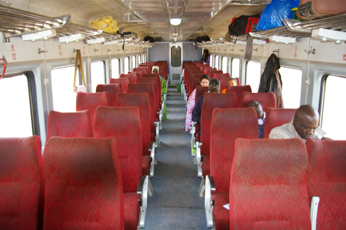
The Dakar-Bamako 'Express' (previously known as the 'Mali Express' or sometimes known locally as the 'Mistral International') has 1st & 2nd class seats plus 1st class couchettes with 4-bunk compartments.  It also has a bar-restaurant car selling drinks, snacks and inexpensive meals.

Previously, when the service was twice weekly, one set of Dakar-Bamako coaches was provided by the Mali Railways, the other by the Senegalese Railways, both originally bought second hand from French Railways.  The Senegalese train was considered to be the significantly better train, with stainless steel coaches that allegedly once operated the Paris-Nice 'Mistral'.  However, it seems to be the Mali coaches that now operate all departures.

You will need to get your passport stamped at each border post.  It may be taken by an official on the train, but you have to collect it yourself by going to the police office at the border, although you may not be told this.  If your passport is taken, ask where and when you have to go to collect it.

Expect a final arrival at your destination anything from 4 to 12 hours late!

Dakar station   Dakar-Bamako train:  1st class couchette car
Above:  Inside Dakar station... Photo courtesy of Hans Vulink.   Above:  Dakar-Bamako 1st class couchette car...  Photo courtesy of Hans Vulink.
     
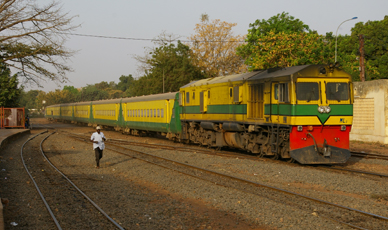
Couchette compartment on the train from Dakar to Bamako   The train from Senegal to Mali about to leave the Gare de Hann, just outside Dakar.
Above:  Inside a grubby 1st class couchette compartment!  Photo courtesy of Wendy Ball.   Above:  The train to Mali ready to leave the Gare de Hann.  Photo courtesy of Wendy Ball.

Travellers' reports...

Traveller Iain Bisset took the Kayes-Bamako train in Spring 2010:

We took it from Kayes to Bamako on a Sunday, the tickets were for sale the day before at the station and cost 7000 CFA. These may have been local prices but the stay were friendly and offered us these tickets straight off. They said to be there at 07:00 for an 07:15 departure but it left two hours late just after 09:00. The train passes through some beautiful scenery with rock formations like the Dogon country but uninhabited. There lakes, waterfalls and small villages whose lifeblood and commerce seems to be this train line. There was plenty of opportunity to buy food and drink at various stops and we arrived into Kita at around 18:00 with the night approaching. Kita was the biggest town with the most food and drink options for the break, after Kita someone got on with some freshly cooked meat for sale but we had just bought and eaten bread and mayo, damn! There's a comical number of ticket checks particularly given that we were the only Toubabs on the train. The conductor was friendly and spoke a bit of English, wanting to practice it with us. He bought some fish at one stop and hung them up by the bathroom for the remainder of the journey. We didn't try the toilets actually but the train was spacious, clean and comfortable (not so clean by the time we got off). The tickets have a seat number on and the train is fairly empty from Kayes because it is so much faster and only marginally more expensive (10,000 cfa) to take the bus. But who would do that?! We arrived into Bamako at midnight where share taxis waited to transport people to different parts of the city. An amazing experience and well worth a day of anyone's life. A real insight into a non touristic part of the country.

Traveller Wendy Ball used the Dakar-Bamako train in May 2008:

"I had a remarkable 45 hour journey on this train in May 2008. The spectacular views, and slow way of moving through vast plains of West Africa were not undermined by the inevitable discomfort of travelling on a very old, dirty train. This is not a journey for the faint hearted nor for those who appreciate creature comforts.  But it is a brilliant experience for those who are open to adventure. If travelling in May (or the hot season) be prepared for extreme heat.  Following the advice on the Seat61 website, I visited the main Dakar rail station to learn of the next departure to Bamako. The handwritten notice in the window highlighted it would be departing the next day.  I booked my seat (1st Class couchette) immediately, with no trouble or queuing. The ticket cost CFA51700. The following day, the taxi driver (eventually) managed to find the Gare de Hann. The station building is very small. Passengers waited around under a tree - it was here I met two other travellers who also held non-West African passports.  I bought a mattress being sold by vendors at the station (CFA2000). I was very glad I did!  On boarding the train, I found my cabin, fitted the mattress and covered it with the large cotton wrap/fabric which I carried everywhere. I had arrived with plenty water, muesli bars, some French bread and a load of bananas. These supplies were useful - as I never did find a restaurant car.  There was a small informal bar selling soft drinks - supplies were cold, but ran out within 24hrs.  Most people bought food when the train stopped in towns. I had been warned of thieves operating during these stops so as I was travelling alone I decided not to leave the train during the stop. I did however buy fruit and ice from vendors outside the windows. To signal the end of a stop, the whistle would usually blow, and the train would simply start moving very slowly while people would run to catch it! The cabins had four bunks. The first night I shared mine with a mother and child, the second night I had a top bunk to myself.  Getting into the top bunk required tremendous agility as there was no ladder.  There were also very few lights that worked in carriage, so my torch came in handy.  It was easy (and good) to hang my mosquito net. For passport control, an inspector took our passports, and many hours later the three of us were instructed to go to a cabin in another coach to be interviewed.  This was fairly straightforward, except for the leap across the gap between coaches.  For the passport interview, I was glad one of my companions was a fluent French speaker - both his gender and command of language seemed an advantage.  I spent most of my waking time gazing for hours out of the windows (which didn't close) enjoying the breeze (when it wasn't too warm) and the expansive view.  We arrived in Bamako happy, exhausted and craving cold water!"

Travellers Bruno Lima and Bianca travelled on the Dakar-Bamako train in July 2007:

"The train left on Wednesday, July 11.  We walked up to the Dakar train station on Tuesday morning (July 10) and there was a hand-written note on the glass announcing the departure on Wednesday, July 11 at 13:00. It didn't seem like there was a set schedule at all.  We bought the tickets the day before at Dakar main station, and the station attendant told us it would depart from the Gare de Hann and the journey would take 36 hours. The train departed only 1 hour late, only to stop 500 meters later for about 3 hours. The total trip took 54 hours after numerous unexplained stops and break-downs.  The views were incredible, but the heat made the journey a bit uncomfortable when the sun was up high.  Only 2 of the 1st class cabins had lights, and a couple of the cabin doors were not working, so the doors were just propped against the frame.  Our cabin and berth numbers were written on the tickets, but once the trains pulls up at the station, the numbers don't mean anything as people just grabbed whatever berth they could.  So it's best to be early on the train to chose a cabin with a working door.  The "1st class" car and cabins are quite dirty, as is the rest of the train.  Vendors at the station sell cheap new mattresses for the couchettes, which are a good idea, since the foam padding and sheet provided seemed like they had never been washed.  Travellers should also buy drinking water in Dakar for the whole trip, as none was sold in the restaurant car.  Despite some of the discomfort brought by the heat, overall the trip was unforgettable, an incredible experience and a great way to see a bit of West Africa."

Traveller Hans Vulink reports on a trip on the Dakar-Bamako train in July 2004:

"We took the train from Dakar to Bamako on Saturday July 10th.  It was scheduled to leave at 13:00 but actually left at 16:00, and took 44 hours.  It stopped a lot but not but not because the train or the track was broken.  You can get the tickets the day before.  The ticket window opens at 9 in the morning - we were there at 10 and there was a very long queue.  The trick is let your wife get the tickets, as women have a separate queue which is much shorter.  It still took us 2 hours to get the tickets.  My wife bought tickets for 4 people so we ended up with only 4 people in one wagon-lits compartment.  The Africans invite a lot of friends in their compartments so it can get very crowded..! The train is old, dirty, there is no water in the toilets but the restaurant serves three decent meals a day and cold beer..!  And the atmosphere is great, the Africans were very nice.  And with the wagon-lits is comfortable, except when you have to close the windows because of the rain when the upper berths get very hot.  The border crossing was easy.  You give them your passport and some time later they call your name and you get it back.  After the border the locomotive is changed to a Mali one.  The price for the 1st class ticket was 34250 CFA and for the bed 17140 CFA."

Dakar-Bamako train.  Photo courtesy of Hans Vulink.   Dakar-Bamako train.  Photo courtesy of Hans Vulink.

Fares...

Children under 3 travel free, 3-9 pay half fare, 10 and over pay adult fares.

One-way fare: 1st class couchette 1st class seat 2nd class seat
Dakar to Bamako: 51,700 CFA (GBP58 / US$ 81)    35,250 CFA (GBP36 / USD51)    25,500 CFA (GBP27 / USD38) 
Dakar to Kayes: 33,000 CFA (GBP58 / US$ 55)    ?    ? 
Bamako to Kayes:   - 7,000 CFA (GBP7 / US$ 11)     ? 
 

How to buy tickets

...when in Senegal / Mali

Book at the reservation office at Dakar or Bamako stations.  Tickets go on sale the day before departure.  You can also try to get tickets from touts on the day of departure, although a 50% premium may be charged!

If making a booking in Kaye, you might try finding a way onto the platform and going to see the Station Master.  It is reported that he may be able to issue tickets in his office, possibly saving you hours!

...from outside Senegal / Mali

For departures from Dakar, try e-mailing some local travel agencies.  Africa Connection tours (www.actours-senegal.com) was recommended by one 'seat61' correspondent as 'fantastic' for booking the Dakar-Bamako train over the internet.  However, reports in December 2006 suggest that none of these agencies will now arrange tickets for this train.  If you want to book in advance from outside Mali/Senegal, for departures from the Bamako end you could try e-mailing the Chemin de Fer du Mali at rcfm@cefib.com.  Further feedback on agencies prepared to book this train is always welcome!

Sponsored links...

Thomas Cook Overseas Timetable

Thomas Cook Overseas Timetable - buy online..!Train, bus and ferry times for every country in Africa, Asia, America and Australasia are shown in the famous Thomas Cook Overseas Timetable, published every two months.  It's essential for every serious overland traveller, and an inspiration for armchair travellers..!

Sadly, the Nov/Dec 2010 edition was the very last ever to be published, but you may still be able to buy a copy of the final edition at Amazon.co.uk, Overseas Timetable Winter 2010/2011 edition.  It'll remain useful for years to come!


Back to 'Rail travel to Europe' general page