


 |
|
|
Seoul to Busan (Pusan) by KTX high-speed train |
Trains & ferries to, from & in South Korea
This page explains how to travel by ferry from Russia, China or Japan to or from South Korea, then how to travel around Korea by train.
 Europe to South Korea by
Trans-Siberian Railway
Europe to South Korea by
Trans-Siberian Railway
Russia to South Korea
by ferry
Hotels in Seoul, Busan & South Korea
On other pages...
Useful country information
Europe to Korea without flying
It's perfectly feasible to travel from the UK to South Korea overland using the Trans-Siberian Railway via either Moscow, Vladivostok and a ferry from Vladivostok to Donghae in Korea, or via Moscow, Beijing, then a ferry from Tianjin in China to Incheon in Korea. The journey will take about 14 days. See the Trans-Siberian page for details of the London - Vladivostok & London - Beijing journeys, then see the Vladivostok-Korea or China-Korea sections below. You can also travel from Japan to Korea, using a ferry from Hakata to Busan.
UPDATE 2026: Russia is virtually cut off due to sanctions, and travel to Russia is no longer advisable. This route is currently not viable.
Vladivostok to Korea by ferry
From 2009 to 2020, a weekly ferry linked Vladivostok with Donghae in South Korea, run by DBS Ferry, www.dbsferry.com. The ship was the 1993-built Eastern Dream, equipped to a good standard. In February 2020 it was reported that after being temporarily suspended during November, December & January 2019, this ferry was permanently discontinued from February 2020 onwards.
China to Korea by ferry
There are several ferry services from China to South Korea, including one from Tianjin to Incheon twice a week, and one from Qingdao.
Beijing ► Seoul via Qingdao
-
Step 1, take a train from Beijing to Qingdao.
There are a range of fast daytime D-category trains from Beijing South to Qingdao taking just over 5 hours, check times at www.chinahighlights.com/china-trains. To get the ship the same day, allowing for check-in time, take the train which leaves Beijing South at 07:10 arriving Qingdao at 12:22.
-
Step 2, take the ferry from Qingdao to Incheon.
The ship sails from Qingdao at 16:00 on Mondays, Wednesdays & Fridays, arriving Incheon at 10:00 next day.
The fare is around 169,000 won one-way including tax for a bed in a 4-berth business class cabin or 149,000 won with an economy class berth in a shared area.
The operator is Weidong Ferry, see www.weidong.com for sailing dates and fares and check-in times.
Traveller Wendy Bishop reports: "It seems to be impossible to buy Qingdao-Incheon Weidong ferry tickets in Beijing, but it feels a bit risky turning up in Qingdao and hoping to be able to get tickets there. However, we didn't have any problems buying tickets 4 hours before departure though (late August) - the ferry company sells the tickets from its office 100m or so from the terminal."
-
Step 3, take a train to Seoul. Trains link Incheon and Seoul frequently, 39km, journey time 58 minutes.
Seoul ► Beijing via Qingdao
-
Step 1, take a train from Seoul to Incheon, trains run frequently, 39km, journey time 58 minutes.
-
Step 2, take the ferry from Incheaon to Qingdao, sailing from Incheon's 2nd International Ferry Terminal at 18:00 on Tuesdays, Thursdays & Saturdays arriving Qingdao at 09:00 next day.
The fare is around 169,000 won one-way including tax for a bed in a 4-berth business class cabin or 149,000 won with an economy class berth in a shared area.
The operator is Weidong Ferry, see www.weidong.com for sailing dates and fares.
Traveller Fergus Brown reports (2024): "The Incheon terminal is new since 2020 at a different location than the previous one which may confuse people using Google maps (which does not work well in Korea in general). It is large, modern and comfortable. It has a convenience store, restaurant, restrooms, currency exchange and coin lockers though these appear to require a local phone number. I bought my ticket on the day with no issues using a MasterCard. It does not seem possible to reserve in advance either online or in person, as only the companies operating routes that day had people manning their desks, though I can only speak first hand for the Qingdao Weihai ferry. The ticket office is open from 10:00 to 15:30. Boarding begins an hour and a half before sailing time. I had an economy ticket and found it comfortable, with bunk beds with privacy curtains in a 40 person room. Communal showers are provided, no towels. A dinner and hot breakfast service runs, prices around 40rmb for meals, 35rmb for breakfast. There is Karaoke (20000won per person per hour) and a cinema."
-
Step 3, take a train from Qingdao to Beijing.
There are a range of fast daytime D- and G-category high-speed trains taking just 5½ hours to Beijing South. You should be able to make the train leaving Qingdao at 13:45 arriving Beijing South at 18:05. You can check times at www.chinahighlights.com/china-trains.
Beijing - Seoul via Tianjin
-
Air-conditioned high-speed trains link Beijing and Tianjin frequently, taking just 30 minutes, see details here. However, the port is actually at Tanggu, some 50 km east of Tianjin itself, so it's better to take a direct train from Beijing South to Tanggu, journey time 55 minutes, with trains every hour or two. Beijing to Tanggu costs 92 RMB soft seat, 78 RMB hard seat. You can check train times at www.chinahighlights.com/china-trains. Bus 102 runs from Tanggu station to the ferry terminal, journey time 50 minutes.
-
Ferries run by Jinchon Ferry sail from Tanggu International Ferry Terminal (50 km east of Tianjin) to Incheon twice a week, taking 25 hours. Departure from Tanggu is at 11:00 on Thursdays & Sundays, arriving Incheon at 14:00 next day. In the other direction, the ferry sails from Incheon at 13:00 on Tuesdays arriving Tanggu 14:00 Wednesdays and at 19:00 on Fridays arriving Tanggu 20:00 Saturdays. For sailing dates and times, try byferryfrom2japan.com/en/korea-china. The ferry operator's own site (www.jinchon.co.kr) is only in Korean. The ferry fare in economy class is 888 RMB + 60 RMB tax. You should arrive at the ferry terminal 2-3 hours before sailing time.
-
Trains link Incheon and Seoul frequently, 39 km, journey time 58 minutes.
Japan to Korea by ferry
There are several ferry services between Japan and South Korea. The suggested options are:
-
Kampu Ferry Service (www.kampuferry.co.jp) from Shimonoseki (international port terminal) to Busan.
These are conventional ferries with cabins, sailing overnight and departing daily at 18:00 arriving 08:30 next morning.
The fares is around 9,000 Yen 2nd class (with tatami mat sleeping place), 12,000 Yen (£92) 1st class with bed in a western-style or Japanese-style cabin with shower & toilet, deluxe cabins and suites are also available.
-
Camellia Line between Hakata & Busan by conventional ferry, www.koreaferry.co.kr (English button top right).
Sails overnight (22:00-06:00) in one direction, by day (12:30-18:00) in the other. May not be operating at the moment.
One-way fares from 80,000 Won, or from 1000,000 Won with cabin berth. You can book online.
-
Japan Kyushu Railway Beetle ferry from Fukuoka (Hakata) to Busan: Suspended in summer 2024, now discontinued permanently.
-
To buy tickets: You may find it easier to book these ferries in plain English at the Seat61 ferry shop. Simply select Japan or South Korea as your departure country.
To reach Korea from Japan
-
Take a train across Japan to Hakata-Fukuoka or Shimonoseki. Hakata is the end of the high-speed shinkansen line from Tokyo, Kyoto, Osaka and Hiroshima - see world.jorudan.co.jp/mln for train times and fares within Japan.
-
Take the ferry from Hakata or Shimonoseki to Busan.
-
For train service between Busan and Seoul, see www.korail.go.kr.
Train travel in South Korea
|
|
All major towns and cities in South Korea are linked by an efficient railway. For train times and fares visit www.korail.com.
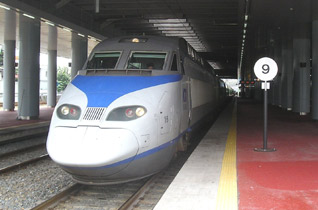
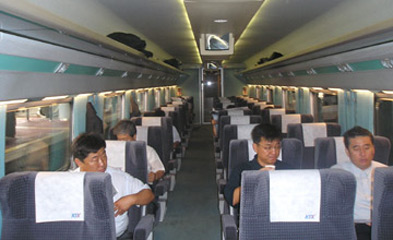
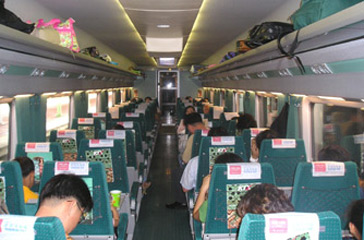
Seoul and Busan (the older spelling is Pusan) are linked by a new high-speed train service known as KTX. The KTX runs on a new high-speed line built using French TGV technology. Trains run frequently, taking just 2h35. The fare is 59,800 won ($48) one way 2nd class, 83,700 won ($67) 1st class. For times, fares and online booking of KTX trains, see www.korail.com.
Right: The high-speed KTX train from Seoul to Busan. Photos courtesy of Shigeyuki Kaneko.
For tickets see www.letskorail.com or 12go.asia.
-
Option 1, the official Korail site is www.korail.com (for English click Language top right) but to buy tickets or a Korail Pass, go to their sub-site www.letskorail.com (again, for English click Language top right).
Booking opens 1 month before departure.
The high-speed KTX trains between Seoul and Busan are highlighted in pink. But if you are not in a hurry, the much slower non-high-speed Saemaul or Mugunghwa trains are cheaper and use the old route winding around the hills rather than through them.
-
Option 2, it can be easier to buy tickets online from reliable train & bus booking agency 12go.asia.
Booking opens around 3 weeks in advance.
You get instant confirmation, they email you an e-ticket which you can print or show in an app and use to board the train.
-
You can buy tickets at the station, but trains are busy on Fridays and Sunday evenings, so buying in advance is a good idea.
Trains are also busy around the two main 3-day national holidays, the lunar new year and Chuseok (meaning harvest, the 15th day of the 8th lunar month) as people travel home at these times.
The South Korean Railpass
-
There a railpass for Korea giving unlimited travel over the whole Korail network, including both their high-speed KTX and regular trains (but excluding tourist trains & city metro trains). For details and to buy a pass online, see www.letskorail.com, select English top right then click for the Korail Pass.
Private operator Seoul-Busan: Super Rapid Train (SRT)
-
A new private high-speed operator called Super Rapid Train (SRT) started operating in December 2016 in competition with the existing State-owned Korail trains between Seoul & Busan and Seoul & Mokpo. In Seoul, trains are currently using an out-of-the-centre station at Suseo, an hour by metro from central Seoul.
-
See www.srail.co.kr for information, it now has an English version.
Hotels in Seoul & South Korea

 Backpacker
hostels
Backpacker
hostels
www.hostelworld.com: If you're on a tight budget, don't forget about backpacker hostels. Hostelworld offers online booking of cheap private rooms or dorm beds in backpacker hostels in most cities at rock-bottom prices.
Travel insurance & other tips
|
|
|
|
|


Always take out travel insurance
Never travel overseas without travel insurance from a reliable insurer, with at least £1m or preferably £5m medical cover. It should also cover cancellation and loss of cash and belongings, up to a sensible limit. An annual multi-trip policy is usually cheaper than several single-trip policies even for just 2 or 3 trips a year, I have an annual policy with Staysure.co.uk myself. Here are some suggested insurers. I get a small commission if you buy through these links.
 www.staysure.co.uk
offers enhanced Covid-19 protection & gets 4.7 out of 5 on
Trustpilot.
www.staysure.co.uk
offers enhanced Covid-19 protection & gets 4.7 out of 5 on
Trustpilot.
www.columbusdirect.com
is also a well-know brand.
 www.staysure.com/ie if you live in Ireland.
 If you live in the USA try
Travel Guard USA.
If you live in the USA try
Travel Guard USA.
|
|

Get an eSIM with mobile data package
Don't rely on WiFi, download an eSIM with a European mobile data package and stay connected. Most newer mobile phones can download a virtual SIM including iPhone 11 & later, see device compatibility list. There's no need to buy a physical SIM card! Maya.net is a reliable eSIM data retailer with a 4.5 out of 5 Trustpilot rating and a range of packages including unlimited data.
|
|

Get a VPN for safe browsing. Why you need a VPN
When you're travelling you often use free WiFi in public places which may not be secure. A VPN encrypts your connection so it's always secure, even on unsecured WiFi. It also means you can select the geographic location of the IP address you browse with, to get around geoblocking which a surprising number of websites apply. See VPNs & why you need one explained. ExpressVPN is a best buy with a 4.7 out of 5 Trustpilot ranking which I use myself - I've signed up as an ExpressVPN affiliate, and if you go with expressvpn.com using the links on this page, you should see a special deal, 3 months free with an annual subscription. I get a small commission to help support this site.
|
|


Get a Curve card for foreign travel
Most banks give you a poor exchange rate, then add a foreign transaction fee on top. A Curve MasterCard means no foreign transaction fees and gives you the mid-market exchange rate, at least up to a certain limit, £500 per month at time of writing. The money you spend on your Curve card goes straight onto one of your existing debit or credit cards.
How it works: 1. Download the Curve app for iPhone or Android. 2. Enter your details & they'll send you a Curve MasterCard - they send to the UK and most European addresses. 3. Link your existing credit & debit cards to the app, you can link up to two cards with the free version of Curve, I link my normal debit card and my normal credit card. 4. Now use the Curve MasterCard to buy things online or in person or take cash from ATMs, exactly like a normal MasterCard. Curve does the currency conversion and puts the balance in your own currency onto whichever debit or credit card is currently selected in the Curve app. You can even change your mind about which card it goes onto, within 14 days of the transaction.
I have a Curve Blue card myself, it means I can buy a coffee on a foreign station on a card without being stung by fees and lousy exchange rates, just by tapping the Curve card on their card reader. The money goes through Curve to my normal debit card and is taken directly from my account (in fact I have the Curve card set up as payment card on Apple Pay on my iPhone, so can double-click my phone, let it do Face ID then tap the reader with the phone - even easier than digging a card out). I get a little commission if you sign up to Curve, but I recommend it here because I think it's great. See details, download the app and get a Curve card, they'll give you £5 cashback through that link.
|
|

Carry an Anker powerbank
Tickets, reservations, vaccination records and Interrail or Eurail passes are often held digitally on your mobile phone, so it's vital to keep it charged. I always carry an Anker powerbank which can recharge my phone several times over if I can't get to a power outlet. Buy from Amazon.co.uk or from buy from Amazon.com.
Touring cities? Use hill walking shoes!
One of the best things I've done is swap my normal shoes for hill-walking shoes, in my case from Scarpa. They're intended for hiking across the Pennines not wandering around Bangkok, but the support and cushioning for hiking works equally well when you're on your feet all day exploring foreign cities. My feet used to give out first and limit my day, now the rest of me gives up before they do!