


|
Interactive mapClick a route for times, fares & info 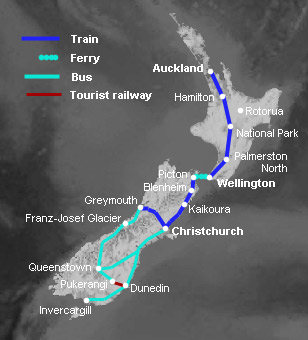
|
See New Zealand by train
Whether you're an overseas visitor or a born-and-bred New Zealander, trains are the best way to travel between New Zealand's three main cities, Auckland, Wellington and (with a little help from the Interislander ferry) Christchurch. Trains are also the way to reach the North Island's Tongariro National Park, the South Island's west coast at Greymouth, the whale-watching and dolphin-swimming centre at Kaikoura or the Marlborough vineyards at Blenheim. See the route map opposite.
Unlike domestic flights, the trains take you at ground level past superb scenery that can't be seen by road, in civilised comfort that cramped and uncivilised long-distance buses can't match. So ditch that short-haul flight and actually see New Zealand!
New Zealand's long-distance trains are operated by Kiwi Rail's passenger division, originally called Tranz Scenic but returned to public ownership in 2008 as KiwiRail Scenic and in 2017 rebranded yet again as Great Journeys of New Zealand. Who knows what it will be called next year? This page explains routes, train times, fares, the best way to buy tickets, and what there is to see on the journey.
Train times, fares, tickets
 Auckland
to Wellington by
Northern Explorer train
Auckland
to Wellington by
Northern Explorer train
Wellington to Picton by
Interislander Ferry
Wellington-Christchurch by ferry & Coastal Pacific train
Christchurch - Greymouth by
Tranz-Alpine train
Christchurch - Timaru - Dunedin - Invercargill
Christchurch - Queenstown - Milford Sound
Dunedin - Queenstown by Taieri Gorge Railway
Other useful information
Hotels & accommodation in
New Zealand
Travel insurance, mobile data, VPN &
other tips
Useful country information: currency,
time zone...
Interactive route map
Click a route for info.
Useful country information
 |
Auckland to Wellington by train
The train ride from Auckland to Wellington over the North Island Main Trunk Railway is an amazing experience and one of my favourite journeys. So ditch that domestic flight or nightmare bus journey and ride the Northern Explorer from downtown Auckland to central Wellington, in comfort at ground level. Stop off if you like at the Tongariro National Park. This is an epic 681 kilometre (423 mile) journey right across the interior of the North Island, taking you in a single day past every kind of scenery there is, from coastline to volcanoes to mountains, from lush green farmland to thick New Zealand rainforest. The historic North Island Main Trunk Railway was completed in 1908 and includes such feats of engineering at the Raurimu Spiral, Turangarere Horseshoe & Makatote Viaduct.
For times, fares, information & photos, see the Northern Explorer page.
Wellington to Picton by ferry
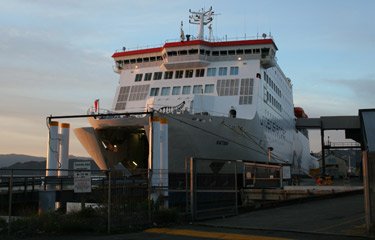
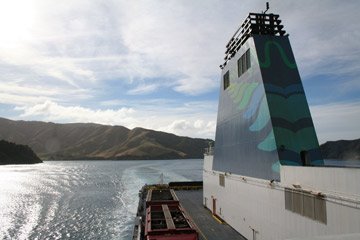
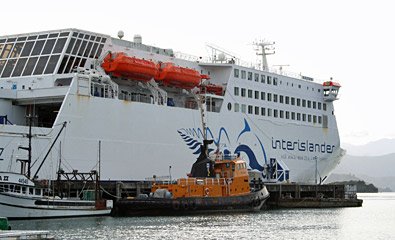
New Zealand's Interislander is one of the most scenic ferry crossings in the world, easily the best way between the North & South Islands - a genuine experience, not a mere flight. There are up to 5 daily sailings across the Cook Strait between Wellington and Picton, crossing time 3½ hours. The 08:45 sailing from Wellington and 14:15 sailing from Picton connect with the Coastal Pacific train to/from Christchurch, see the Wellington-Christchurch timetable below. The Cook Strait has a reputation for choppy seas, but in reality only a third of the crossing is actually in the Strait itself, most of it is in very sheltered waters, and in my experience it was rock steady on the big, modern and stabilised ferry Kaitaki.
Interislander sailings from Wellington: 06:15*, 08:45, 13:00, 15:45, 20:30**.
Interislander sailings from Picton: 07:30*, 11:00*, 14:15, 18:30, 20:35.
Crossing time 3½ hours. * Not Mondays. ** Not Saturdays.
Times vary by season, so check ferry fares & times at www.greatjourneysofnz.co.nz/interislander.
In Wellington, the Interislander terminal is a long walk north of the railway station, but a free shuttle bus clearly marked Interislander leaves from platform 9 at the railway station 50 minutes before each sailing. The journey time is 5 minutes. Foot passengers must check in at the terminal at least 30 minutes before sailing time. All heavy baggage is checked in so only hand luggage is carried on board. Passengers connecting with the train to Christchurch can check in bags in Wellington all the way through to Christchurch.
In Picton, the Interislander terminal is 200 metres from the station. All heavy baggage is checked in so only hand luggage needs to be carried on board.
The 08:25 sailing from Wellington & 13:15 sailing from Picton connect with the Coastal Pacific train to/from Christchurch. You can book combined Wellington-Christchurch ferry & train tickets online at www.greatjourneysofnz.co.nz, but see the advice bee below to get the cheaper tickets. Both these sailings are normally operated by the Kaitaki, the largest ferry in New Zealand waters.
The Kaitaki may look familiar to ferry travellers from Ireland or the UK. She started life in 1995 as the Isle of Innisfree on the Irish Ferries Holyhead-Dublin and Pembroke-Rosslare routes, and later the P&O's Pride of Cherbourg on the Portsmouth-Cherbourg route. The Interislander ferry company was started in 1962 by New Zealand Railways, hence its close connections with the train service to Christchurch. Another ferry company also operates several daily ferries between Wellington and Picton, www.bluebridge.co.nz, but these ferries don't connect with the train to Christchurch.
Kaitaki Plus first class lounge: For an extra NZ$80 paid on board, you can access the Kaitaki Plus lounge with quiet seating, power sockets, free WiFi, complimentary alcoholic and non-alcoholic drinks and a free light hot meal. Over-18s only. On the down side, the views from the lounge are slightly obstructed, and you may spend much of the crossing on deck, gazing at the scenery!
A voyage on the Interislander
-
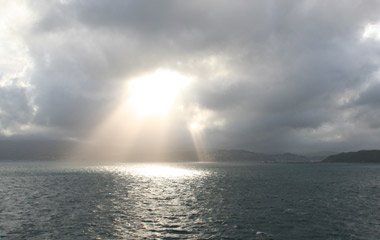
The ship sails out of the Interislander terminal at Wellington and heads out of the harbour in a wide arc with views of Wellington's seafront.
-
It passes the suburb of Seatoun on the right and exits the harbour into the Cook strait separating the North and South Islands. Also on the right are some wicked-looking rocks, including the Barrett Reef where the Lyttelton-Wellington overnight ferry m/v Wahine came to grief in a storm in 1968.
-
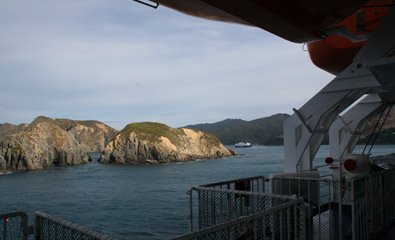
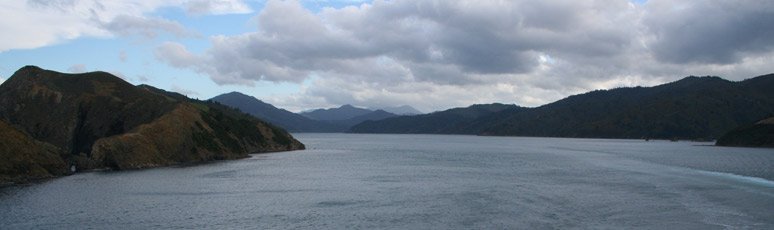
The crossing of the Cook Strait itself only lasts an hour, and at the other side the ferry passes between narrow headlands into the Tory Channel. Named after the "Tory", a migrant ship which passed through the channel in 1840, the Tory Channel is one of the Marlborough Sounds, a narrow channel between Arapawa Island on the right and a strip of mainland on the left.
-
The ship slowly follows this channel, through an 's' bend, entering the larger Queen Charlotte Sound and finally arriving at Picton, a small town and the railhead for the South island.
Picton to Christchurch by train
The most comfortable and scenic way to travel from Wellington to Christchurch is to take the famous Interislander ferry and the connecting Coastal Pacific train. Named TranzCoastal until 2011, the train has now regained its original name Coastal Pacific.
* Runs from late September until late April. Runs every day in summer, February-April. For exact dates see www.greatjourneysofnz.co.nz. The Coast Pacific used to run daily all year but was reduced to running in New Zealand's summer season only. It was planned to restore all-year-round running in 2019, but this didn't happen.
One class of seating, cafe-bar, open-air viewing platform.
There are other Wellington-Picton Interislander ferry sailings, see www.greatjourneysofnz.co.nz/interislander, only the rail-connected sailing is shown here. It leaves Wellington at 08:45 on some dates, and northbound times vary too, so always check for your date of travel.
Children aged 2-14 travel at reduced fare. Infants under 2 travel free.
How to buy tickets
-
Option 1, you can buy Wellington-Christchurch combined train+ferry tickets (or tickets between any other two stations on this route) at KiwiRail's official passenger train website www.greatjourneysofnz.co.nz with print-your-own tickets.
To book by phone with KiwiRail, call 0800 TRAINS when in NZ or call + 64 4 495 0775 from outside NZ.
-
Option 2, you can buy tickets for the train and for the ferry at 12go.com, a reliable agency. The process is easy, but you need to book the Wellington-Picton ferry and Picton-Christchurch train separately. Tickets are usually confirmed within 24h and sent by email.
-
Option 3, tour operator Railbookers offers various holidays & tours around New Zealand which include train travel, more information here.
What's the train like?
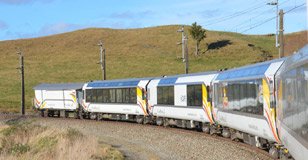
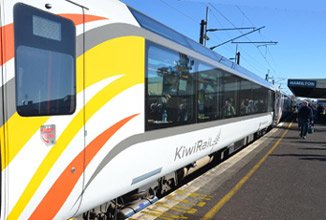
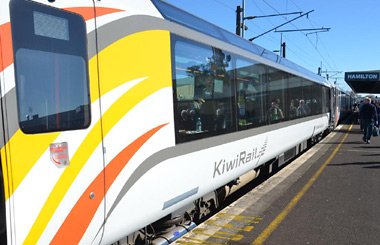
The Coastal Pacific uses new AK panoramic sightseeing coaches built in KiwiRail's Dunedin workshops in New Zealand in 2011-2012. These replace the old rebuilt 1930s & 1940s carriages used until 2012. Photos courtesy of James Chuang
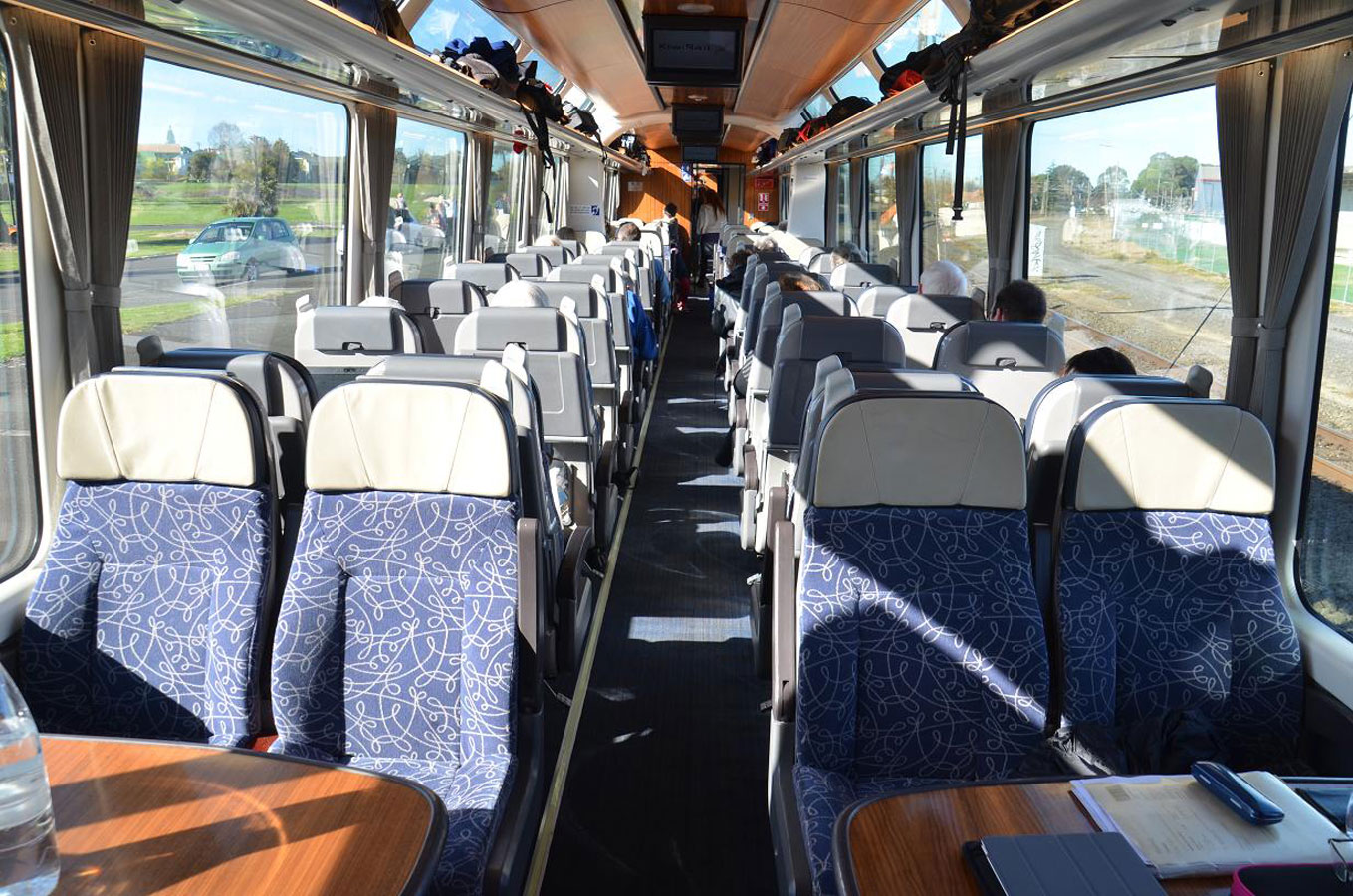
Comfortable seats, most facing direction of travel, some in bays of 4 around a table, all lining up with huge panoramic windows (note the roof skylights too!), with loads of legroom even if you're over six feet tall. Seats are not always allocated at booking, but by the train manager before departure. However, if you book by phone (or book online and then call KiwiRail's freephone number when you get to NZ and quote your booking reference) you can make a seating request. For example, four friends or family travelling together could request one of the few bays of 4 seats facing each other around a table, keen photographers could request a seat close to the viewing platform. Requests can't be guaranteed, of course, but it doesn't hurt to ask! All your heavy baggage is checked in to the baggage van, only hand luggage may be taken into the seating coaches. All seats in the new 'AK' cars have power sockets for mobiles, laptops or cameras (New Zealand voltage and plug, of course). Larger photo.
New Premium class: From October 2020, a new Premium class carriage was added to the Coastal Pacific, with extra-legroom extra-width reclining seats arranged 2+1 across the car width (the usual cars have seats 2+2 across the car) and included food & wine, served at your seat.
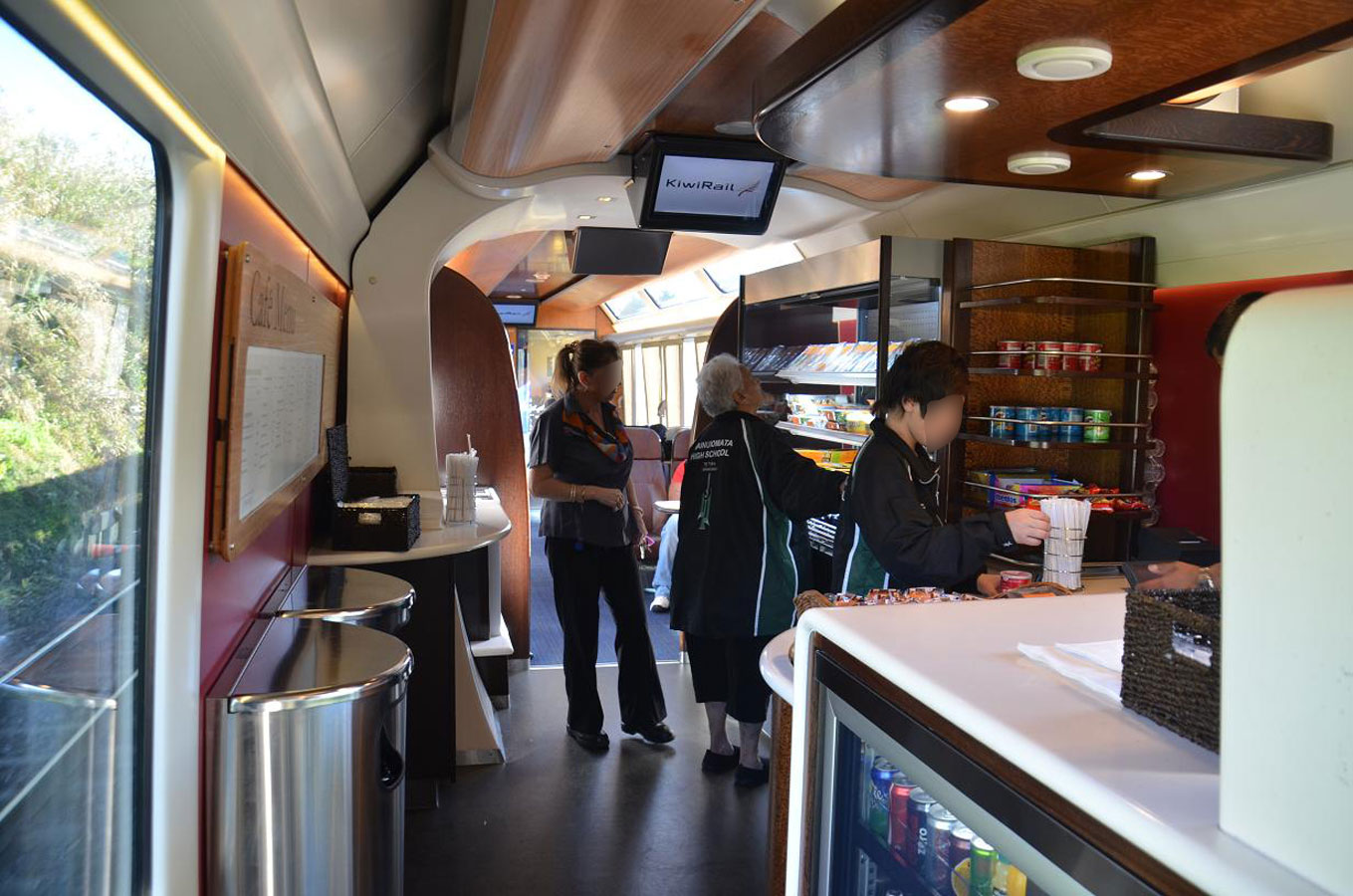
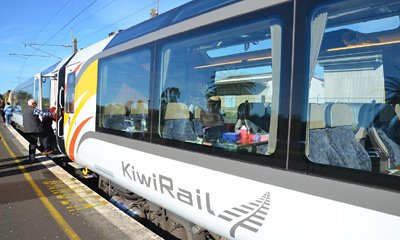
Cafe-bar: In the centre of the train is a counter selling tea, coffee, wine, beer, spirits, snacks & light microwaveable meals at reasonable prices. I can recommend a cream tea in the afternoon, and a glass of Sauvignon Blanc! You can buy at the counter and take your food & drink back to your seat, but staff also come through the train taking orders for delivery to your seat. Bring cash, as cards are sometimes not accepted if the credit card machine is out of cellphone range. Larger photo.
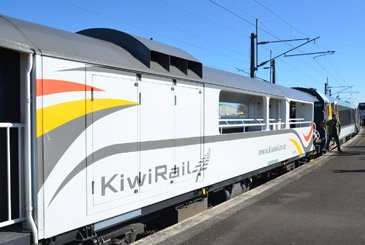
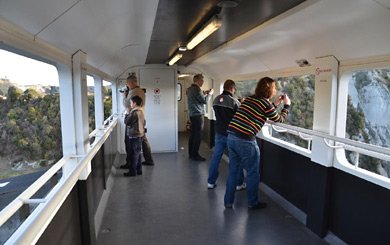
Open-air viewing platform: At the Wellington end of the train (rear going north, behind the locomotive going south) is a large open-air viewing platform, ideal for seeing and photographing the scenery, with no glass in between you and it. Children must be accompanied. The viewing cars now have additional rails to prevent you leaning out.
What's the journey like?
Travel tips
-
Shuttle bus for ferry departures and arrivals at Wellington: The Interislander terminal is a long walk north of Wellington city centre, but a free shuttle bus (clearly marked Interislander) operates from platform 10 at the railway station 50 minutes before each ferry leaves, journey time 5 minutes. Tickets can be bought with cash or credit card from the ticketing station. Similarly, a shuttle bus meets each ferry arrival and will take you to the railway station as soon as everyone has reclaimed their baggage (although there's no shuttle bus for ferry arrivals after 9pm).
-
Check-in & baggage: You must check in to the Wellington Interislander ferry terminal at least 45 minutes before departure. At the ferry terminal, all bags except hand baggage must be checked in. If you're connecting with the Coastal Pacific train, you can check your bags all the way through to Christchurch. Similarly, when checking in at Christchurch, you can check your bags all the way through to Wellington Interislander ferry terminal. Your bags will automatically be transferred between ferry and train at Picton, and you reclaim them at your final destination, either Wellington or Christchurch.
-
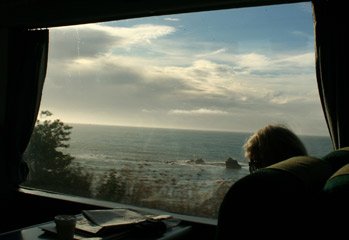
Make a seating request: If you book by phone (or book online and then call Kiwi Rail's freephone number when you get to NZ at least the day before travel, quoting your booking reference) you can make a seating request. The obvious request to make is for seats on the left-hand side of the train going south from Picton, or the right-hand side coming north from Christchurch, as this puts you on the coastal side of the train where most of the scenery is. Keen photographers could also request seats at the northern (Picton) end of the train close to the viewing platform. Requests can't be guaranteed, of course, but it doesn't hurt to ask!
About the journey
-
The 3½ hour, 92km crossing of the Cook Strait is one of the most scenic ferry rides in the world. You sail in a wide arc out of Wellington harbour and across the open sea of the Cook strait itself, before passing between headlands into the Tory Channel, named after the migrant ship 'Tory' which navigated the channel in 1840. The ship follows this narrow channel between the island of Arapawa and the mainland, all the way to Picton at the head of Queen Charlotte Sound.
-
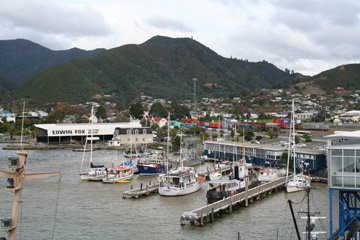
At Picton, the station is an easy 200 metre walk straight ahead of you. Look out for the Edwin Fox, a preserved 19th century sailing ship in a museum on the left. It's the ninth oldest wooden sailing ship in the world, and you can see it from the road even if you don't have time to go in to the museum. At the station, the small wooden station building now houses a 'Subway' fast food place, a travel agency, and a small check-in desk for the train. Seats on the train are allocated there.
-
The train leaves Picton station and curves around valley out of the town. Within half an hour you're in the middle of vineyards in the Marlborough wine region. You'll pass one of the main Montana wineries, with its huge stainless steel tanks. The train calls at Blenheim, the region's main town.
-
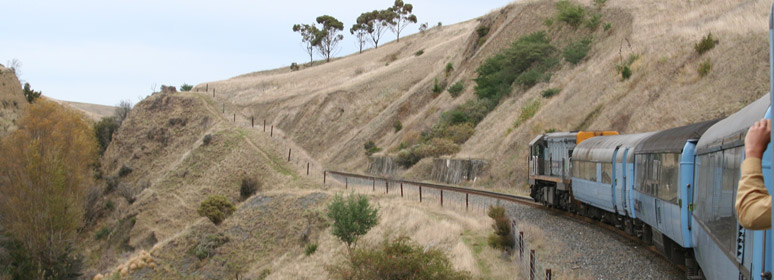
Soon after Blenheim, the train climbs hard up a long gentle pass through grassy hills.
-
Within an hour of leaving Picton, snow-capped mountains appear in the distance on your right, and you pass over what used to be a double-decker combined road and rail bridge over the Awatere river, with the railway on top and roadway underneath. The road deck has been removed now that a separate road bridge has been built.
-
Just over an hour from Picton you skirt Lake Grassmere. Salt is produced here, by letting sea water evaporate in large salt pans. You'll see piles of harvested salt on the right.
-
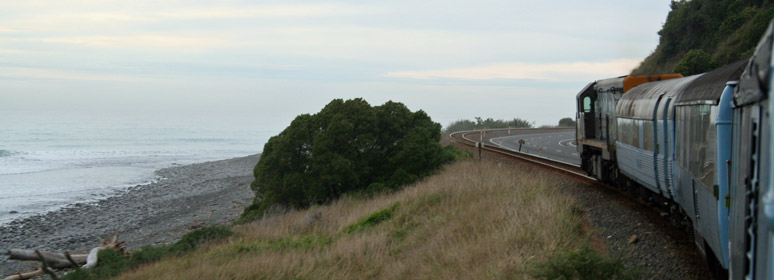
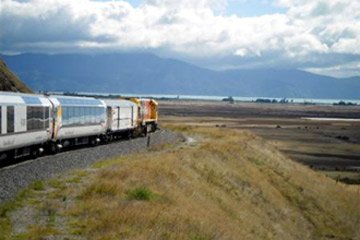
About an hour and a half after leaving Picton the train reaches the sea. It now runs right along the coastline for about 98 km. You'll see beaches, cliffs, rocky headlands, in places draped with low-lying sea mist.
-
Although parts of the line are much older, the Picton-Christchurch railway was only completed in 1945, although work on this coastal section started in the 1930s. Until then, overnight ferries had linked Lyttelton (the port of Christchurch) direct with Wellington.
-
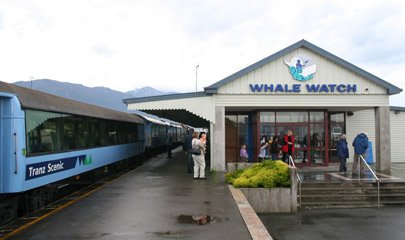
The train stops at Kaikoura, the South Island's main whale-watching and dolphin-swimming centre. The whale-watching centre is now housed in the old station building. the train stops for several minutes here and you can get out and stretch your legs.
-
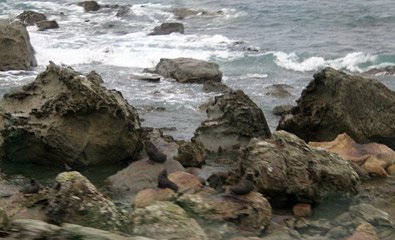
The train continues along the coast. Watch out for the seal colonies just feet from the train. the seals tend to be the same colour as the rocks, but with a bit of practice you can spot huge numbers of them!
-
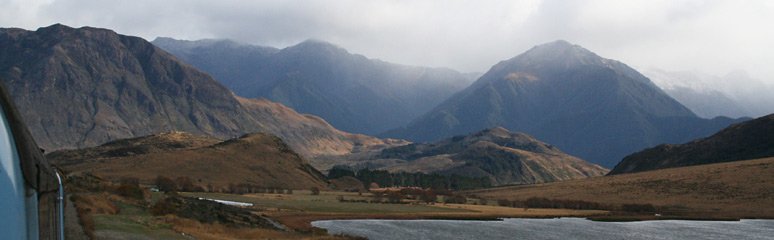
Just over 3 hours from Picton, the train swings inland again, through green hills and pretty valleys.
-
The train passes through the Christchurch suburbs and arrives at Christchurch station. This is now a small modern single-platform rail terminal, opened in 1993 in an unremarkable industrial estate built on what was once the massive Addington Railway Works. Much of New Zealand Railways' locomotives and rolling stock were once built there, although there's little left to show for it..! The new station is some 3km from the city centre, but taxis and shuttles (shared minibus taxis) are available. Until the recent earthquake, Christchurch's original station (well, the building opened in 1960 though built to a design first published in 1938) still stood on Moorhouse Avenue to the south of the city centre where it had become the 'Science Alive' entertainment centre.
Christchurch to Greymouth by train
The TranzAlpine is the most scenic train journey in New Zealand, and one of the most scenic train trips in the world. Not surprisingly, it's become the most successful of all the Kiwi Rail Great Journeys passenger train services, very popular with tour groups because of the spectacular crossing of the Southern Alps between Christchurch and the South Island's west coast at Greymouth. It's a fantastic trip, though in my opinion neither as epic or as historically-significant as the Auckland-Wellington Northern Explorer.
See the TranzAlpine page for times, fares & details.
Once important cities, Dunedin and Invercargill have declined in importance and apparently no longer justify a proper train service to the rest of New Zealand. The last Christchurch-Dunedin-Invercargill train service, the daily "Southerner" over the South island's Main South Line, was withdrawn in 2004. Nowadays, anyone wishing to reach these towns must endure a long bus journey from Christchurch. Here are the main bus services, although an additional bus may run on Fridays and Sundays. Please check times before travelling at the bus operator websites, www.intercity.co.nz.
Fares & how to buy tickets
Christchurch-Dunedin costs NZ$33-$46. Christchurch-Invercargill costs NZ$35-$67. You can check fares and book bus tickets online at www.intercity.co.nz.
Christchurch to Queenstown & Milford Sound
There were never any train services to Queenstown, although historically you might have taken a slow train from Invercargill to Kingston (the preserved Kingston Flyer train uses part of this route), then a steamer across Lake Wakatipu to Queenstown, a route on which Queenstown's famous 100-year old working steamship Earnslaw would have worked. Today, there are bus services operated by national operator Intercity. You need to change buses and overnight in Queenstown if you are travelling to/from Milford Sound.
Fares & how to buy tickets
You can check times, fares and book bus tickets online at www.intercity.co.nz.
Dunedin - Queenstown by train
The Taieri Gorge Railway
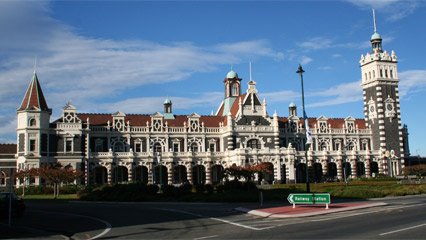
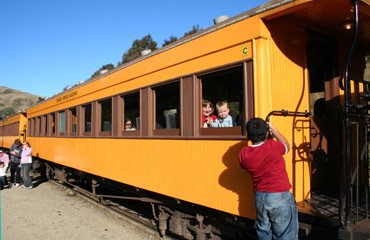
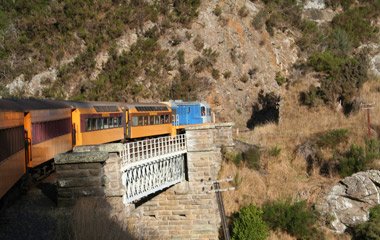
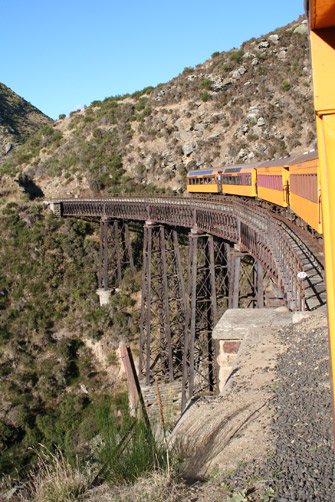
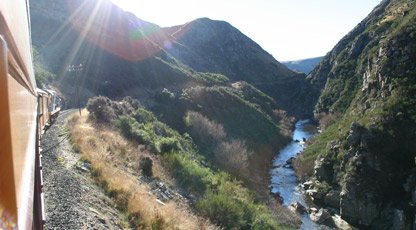
The most rewarding way to travel between Dunedin and Queenstown was via the Taieri Gorge Railway's Track & Trail train/bus link, but sadly they no longer offer this train-bus combo (perhaps you could arrange a private transfer between Pukerangi & Queenstown using a Queenstown taxi service?). However, you can still ride the Taieri Gorge Railway (www.dunedinrailways.co.nz), a preserved railway running daily year-round tourist trains through spectacular scenery over part of the old Dunedin-Cromwell branch railway. Leaving from the beautiful and much-photographed 1906 railway station in Dunedin's town centre, it travels a few kilometres south over the South Island Main Trunk Line (still well-used for freight but sadly with no passenger service) before branching off inland through the scenic gorge that gives the line its name. The train terminates at Pukerangi, 58 km from Dunedin, extended to Middlemarch on summer Fridays & Sundays, 76 km from Dunedin. Highly recommended! The Taieri Gorge Railway now also operates a tourist train called the Seasider along the main line between Dunedin and Palmerston.
Update: The Taieri Gorge Railway ceased operating to Pukerangi, although now runs some seasonal trains on shorter runs, see www.dunedinrailways.co.nz
* = The railway no longer offers an integrated bus connection.
Fares & how to buy tickets
To check times, fares & buy tickets, contact the Taieri Gorge Railway on www.dunedinrailways.co.nz or call (03) 477 4449.

 Tours
of New Zealand by train
Tours
of New Zealand by train
Railbookers specialise in train-based tours and offer several tours of New Zealand with rail travel, including Essential New Zealand (8 days), Best of New Zealand (16 days), Scenic New Zealand (14 days) and Ultimate Tour of New Zealand (19 days), all of which can all be customised to your own requirements.
 UK call 0207 864 4600,
www.railbookers.co.uk.
UK call 0207 864 4600,
www.railbookers.co.uk.
 US call free 1-888-829-4775,
www.railbookers.com.
US call free 1-888-829-4775,
www.railbookers.com.
 Canada call free 1-855-882-2910,
www.railbookers.com.
Canada call free 1-855-882-2910,
www.railbookers.com.
 Australia call toll-free 1300 971 526,
www.railbookers.com.au.
Australia call toll-free 1300 971 526,
www.railbookers.com.au.
 New Zealand call toll-free 0800 000 554 or
see
website.
New Zealand call toll-free 0800 000 554 or
see
website.

 Make
sure you take a good guidebook. The Lonely Planets
and Rough Guides are easily the best out there for the independent traveller.
Both guides provide an excellent level of practical information and historical
and cultural background. You won't regret buying one of these
guides..!
Make
sure you take a good guidebook. The Lonely Planets
and Rough Guides are easily the best out there for the independent traveller.
Both guides provide an excellent level of practical information and historical
and cultural background. You won't regret buying one of these
guides..!
Click to buy online at
Amazon.co.uk
Lonely Planet New Zealand Rough Guide to New Zealand
Hotels in New Zealand
-
In Auckland, the Airedale Hotel or Mercure Auckland Hotel are both sound central choices, the latter right near the Britomart station and Devonport ferry terminal, though not the cheapest options.
-
In Wellington, the Shepherds Arms Hotel is a cosy gastro pub just 15 minutes walk from Parliament and the city centre with friendly staff, great food and good beer. A top choice!


Backpacker hostels
www.hostelworld.com: If you're on a tight budget, don't forget about backpacker hostels. Hostelworld offers online booking of cheap private rooms or dorm beds in backpacker hostels in many places in New Zealand at rock-bottom prices.
Flights to New Zealand
Overland travel by train & bus around New Zealand is an essential part of the experience, so once there, don't cheat and fly, stay on the ground! But a long-haul flight might be unavoidable to reach New Zealand in the first place.
1) Check flight prices at Opodo, www.opodo.com
2) Use Skyscanner to compare flight prices & routes worldwide across 600 airlines...

3) Lounge passes
Make the airport experience a little more bearable with a VIP lounge pass, it's not as expensive as you think! See www.loungepass.com
Travel insurance & other tips
|
|
|
|
|


Always take out travel insurance
Never travel overseas without travel insurance from a reliable insurer, with at least £1m or preferably £5m medical cover. It should also cover cancellation and loss of cash and belongings, up to a sensible limit. An annual multi-trip policy is usually cheaper than several single-trip policies even for just 2 or 3 trips a year, I have an annual policy with Staysure.co.uk myself. Here are some suggested insurers. Seat61 gets a small commission if you buy through these links.
www.staysure.co.uk
offers enhanced Covid-19 protection & gets 4.7 out of 5 on
Trustpilot.
www.columbusdirect.com
is also a well-know brand.
If you live in the USA try
Travel Guard USA.
|
|

Get an eSIM with mobile data package
Don't rely on WiFi, download an eSIM with a mobile data package for the country you're visiting and stay connected. Most newer mobile phones can download a virtual SIM card so you don't need to buy a physical SIM, including iPhone 11 & later, see device compatibility list. Maya.net is a reliable eSIM data retailer with a 4.5 out of 5 Trustpilot rating and a range of packages including unlimited data.
|
|


Get a Curve card for foreign travel
Most banks give you a poor exchange rate, then add a foreign transaction fee on top. A Curve MasterCard means no foreign transaction fees and gives you the mid-market exchange rate, at least up to a certain limit, £500 per month at time of writing. The money you spend on your Curve card goes straight onto one of your existing debit or credit cards.
How it works: 1. Download the Curve app for iPhone or Android. 2. Enter your details & they'll send you a Curve MasterCard - they send to the UK and most European addresses. 3. Link your existing credit & debit cards to the app, you can link up to two cards with the free version of Curve, I link my normal debit card and my normal credit card. 4. Now use the Curve MasterCard to buy things online or in person or take cash from ATMs, exactly like a normal MasterCard. Curve does the currency conversion and puts the balance in your own currency onto whichever debit or credit card is currently selected in the Curve app. You can even change your mind about which card it goes onto, within 14 days of the transaction.
I have a Curve Blue card myself, it means I can buy a coffee on a foreign station on a card without being stung by fees and lousy exchange rates, just by tapping the Curve card on their card reader. The money goes through Curve to my normal debit card and is taken directly from my account (in fact I have the Curve card set up as payment card on Apple Pay on my iPhone, so can double-click my phone, let it do Face ID then tap the reader with the phone - even easier than digging a card out). I get a little commission if you sign up to Curve, but I recommend it here because I think it's great. See details, download the app and get a Curve card, they'll give you £5 cashback through that link.
|
|

Get a VPN for safe browsing. Why you need a VPN
When you're travelling you often use free WiFi in public places which may not be secure. A VPN encrypts your connection so it's always secure, even on unsecured WiFi. It also means you can select the geographic location of the IP address you browse with, to get around geoblocking which a surprising number of websites apply. See VPNs & why you need one explained. ExpressVPN is a best buy with a 4.7 out of 5 Trustpilot ranking which I use myself - I've signed up as an ExpressVPN affiliate, and if you go with expressvpn.com using the links on this page, you should see a special deal, 3 months free with an annual subscription. I get a small commission to help support this site.
|
|

Carry an Anker powerbank
Tickets, reservations, vaccination records and Interrail or Eurail passes are often held digitally on your mobile phone, so it's vital to keep it charged. I always carry an Anker powerbank which can recharge my phone several times over if I can't get to a power outlet. Buy from Amazon.co.uk or from Buy from Amazon.com.