

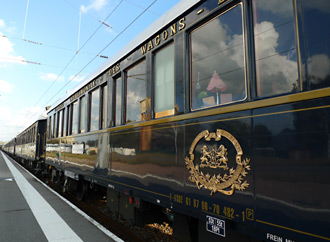
 An LX-series sleeping-car, built in 1929 for the Wagons-Lits Company, now restored for the Venice Simplon-Orient-Express. Is this the real Orient Express? |
On this page
 The end of the Orient
Express, 12 December 2009
The end of the Orient
Express, 12 December 2009
Orient
Express until 2009 - the real one!
Things you didn't know about the Orient Express...
What was the Orient Express really like?
A history
of the Orient Express 1883 to 2009
Books about the
Orient Express
On other pages
Venice Simplon-Orient-Express,
London to Venice
End of the Orient Express, 2009
On 12 December 2009, EuroNight sleeper train 469 Orient Express left Strasbourg on its final overnight run to Vienna, and on 13 December the name Orient Express disappeared from the official European timetables after 126 years. True, the Orient Express was the ultimate example of a knife that's had both blade and handle replaced many times, but this train was indeed the true descendant of the first 1883 Express d'Orient and it officially carried the name Orient Express. You can trace its evolution from timetable to timetable, year to year from 1883 to 2009. On its last run, the Orient Express had evolved into an Austrian Railways (ÖBB) EuroNight train, with one Austrian Railways air-conditioned sleeping-car (1 & 2 bed compartments, including two deluxe compartments with toilet and shower), two modern air-conditioned couchette cars with 4 & 6 berth compartments, and an Austrian seats car. The Orient Express was cut back to start in Strasbourg rather than Paris in June 2007 when the Paris-Strasbourg high-speed TGV line opened, as it could no longer be attached to a French domestic train between Paris & Strasbourg. Although a TGV connection from Paris was provided, the writing was on the wall when it no longer reached the French capital. It had lost its Paris-Budapest Hungarian couchette car and Paris-Bucharest Romanian sleeping-car in June 2001, and it hadn't carried any through cars for Istanbul since the 1960s.
But I thought it last ran in 1977?
Perhaps you thought that the Orient Express was a special luxury train, and that it stopped running in 1977, was then beautifully restored and put back into service and runs from London & Paris to Venice and costs a fortune to travel on and people like David Suchet & Terry Wogan do TV programmes about it... The train you're thinking of is the privately-run Venice Simplon-Orient-Express (VSOE), which uses vintage restored sleeping-cars & dining-cars and costs around £2,500 per person between London & Venice. Wonderful though the VSOE is - you'll find more about the VSOE here - it is certainly not the 'original' Orient Express as there's no such thing, nor is it the 'real' Orient Express referred to above, withdrawn on 12 December 2009. This page tries to clear up some myths, put the Orient Express in context, and explain what the Orient Express really was.
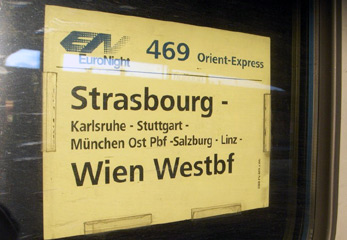
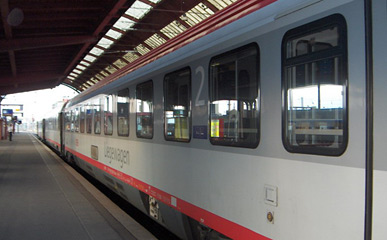
The (real) Orient Express ran until 2009
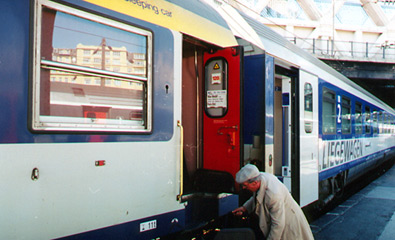
The Orient Express referred to here and shown in these photographs was the real Orient Express, the actual true descendant of that first Express d'Orient that left Paris in October 1883. It was a normal scheduled EuroNight express, run by the Austrian national railways (ÖBB), and you could travel on it with normal tickets including Interrail and Eurail passes. Until 8 June 2007 it left Paris every evening at 17:16 and arrived in Vienna at 08:30 next morning. From June 2007 onwards you needed to leave Paris around 17:54 by high-speed TGV train to connect with the Orient Express at Strasbourg. The Orient Express left Strasbourg at 20:37 and arrived in Vienna at 06:40 next morning. You can still travel from Paris to Vienna or Budapest by train today, see here. You can trace the history of the train pictured above from one year's railway timetable to the next all the way from 1883 to 2009, so the pedigree of this train is quite genuine - more so than either of the two expensive tourist trains of restored vintage rolling stock claiming to be the Orient Express (the Venice Simplon-Orient-Express and the Nostalgic Orient Express), beautiful though they are.
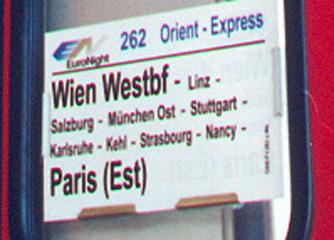
The photographs above show the real Orient Express about to leave Strasbourg for Vienna in summer 2009. The photos below date from around 2005 and show the Orient Express before being cut back to Strasbourg, about to leave Paris Gare de l'Est. The gentleman is boarding the Paris-Vienna sleeping-car, which was staffed by an attendant from Newrest, a modern subsidiary of the Compagnie Internationale des Wagons-Lits (CIWL), the company that operated the original Orient Express from its inception. However, since 1971 the Wagon-Lits Company has staffed sleeping-cars as a contractor instead of owning and operating the sleeping-cars in their own right - they provide the sleeper attendant, room service catering, bed linen, etc. for all ÖBB's sleeping-cars and continue to do so for ÖBB's current Nightjet trains. The coach to the right marked liegewagen is one of the two modern Austrian Railways couchette cars, also as it happen staffed by the CIWL, or strictly-speaking, Newrest. The right-hand photo is a close-up of the destination label, clearly announcing the train as the EuroNight train Orient Express.
I've used the Orient Express myself on many occasions over the years, the last occasion being a journey from Vienna to Paris on my return from Petra, Damascus, Aleppo, and (appropriately enough) Istanbul in September 2005.
Other things you didn't know about the Orient Express
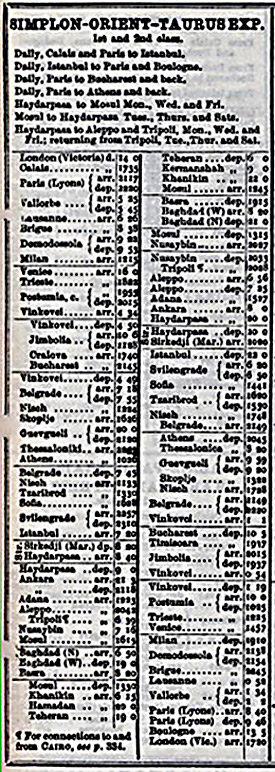
- Agatha Christie's Murder on the Orient Express isn't set on the Orient Express, it's set on the Simplon Orient Express. By the 1920s and 30s there were a whole inter-connecting network of Wagons-Lits Company trains with Orient Express as part of their name in addition to the Orient Express itself. The Orient Express has always run from Paris Gare de l'Est via Munich, Vienna & Budapest, whereas the Simplon Orient Express started running in April 1919, taking a Southerly route from Calais and Paris Gare de Lyon to Milan, Venice, Trieste, Zagreb, Belgrade, Sofia and Istanbul, with a portion for Athens. In the 1920s and 30s the Simplon Orient Express linked Calais, Paris and Istanbul every day, whereas the (plain) Orient Express only carried Paris-Istanbul cars three times a week, although both Orient and Simplon Orient would have been one combined train east of Belgrade. You can see the summer 1939 timetable for this train below.
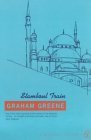
- Graham Greene's book Stamboul Train isn't set on the Orient Express either - It's set on the Oostende-Vienna Orient Express. This train ran from Oostende & Brussels via Frankfurt to Vienna, Budapest, Belgrade and beyond, combining with cars of the Orient Express east of Vienna and with those of the Simplon Orient Express between Belgrade & Istanbul. In the 1960s its 3-times-a-week through sleeping car from Oostende to Istanbul was withdrawn, and the Oostende-Vienna Orient Express became just plain Oostende-Vienna Express. In 1991 the train's name was changed to Austria Nachtexpress, and in 1993 it was renamed again as the DonauWalzer. With the coming of Eurostar in 1994 and the ceasing of all Dover-Oostende ferry service, the Donauwalzer was cut back to start in Brussels rather than Oostende. The DonauWalzer survived as the Brussels-Vienna overnight train until December 2003 when it was withdrawn along with the Brussels-Milan, Brussels-Switzerland & Brussels-Copenhagen overnight trains as Belgian Railways finally pulled out of the long-distance sleeper train business. Brussels-Vienna passengers then needed to change in Cologne onto an Austrian Nightjet sleeper train - which funnily enough has the sleeper attendant and on-board catering & service provided by a company called Newrest, a subsidiary of what's left of the Compagnie Internationale des Wagons-Lits, erstwhile operator of the Orient Express. Today, I'm pleased to say that the Nightjet has been extended and now runs Brussels to Vienna once more, at least 3 times a week.
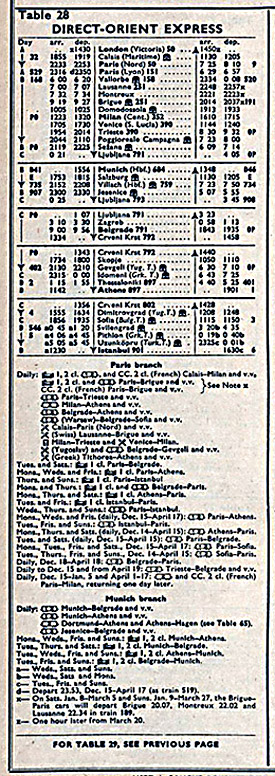
- In 1962 the daily Simplon Orient Express was replaced by a slower train, called the Direct Orient Express, which had a twice-weekly sleeping-car Paris to Istanbul. Most journalists reported the withdrawal of the Direct Orient Express in May 1977 as the withdrawal of the Orient Express. Wrong. The (plain) Orient Express continued to run until 2009, as the main overnight train between Paris and Vienna (Strasbourg & Vienna from June 2007). Until 2001, it also had through cars to Budapest and (in the form of a through sleeper on certain days of the week) Bucharest. You can see the summer 1965 timetable for the Direct Orient Express below.
- Don't confuse the real Orient Express (a scheduled railway service between Paris and Vienna which ran until 2009) with the Venice Simplon-Orient-Express (VSOE) run by VSOE Ltd, a special train of restored vintage ex-Wagon-Lits Company sleeping cars, or the Nostalgic Orient Express, a similar operation. The VSOE is the one most people have heard of, costing about £2,500 or more per person from London to Venice. See the VSOE page.
-
The Venice Simplon-Orient-Express website (www.belmond.com/venice-simplon-orient-express) actually lists an FAQ 'Is the VSOE train the original Orient Express?' and suggests that the answer is 'yes'.
Let's get one thing clear. There isn't, and cannot be, any such thing as the 'original' Orient Express, for a very good reason. Take air travel. Suppose there's a British Airways flight to New York called 'Flight BA123'. Is there an actual unique aircraft called 'Flight BA123'? Of course not. 'Flight BA123' is a abstract concept, a service, a departure, something which appears in the timetable, in the reservation system and on your ticket. BA own a whole fleet of whichever type of aircraft is required to operate flight BA123 to New York, and any of these might be used to run that flight on any given day. And if flight BA123 existed in the timetables 30 years ago, I bet it would have been operated with different design of aircraft than it is today.
So it is with the Orient Express. It was and is a service, and not a particular set of rolling stock. It would have used different rolling stock at different periods in its history, and at any given time it would have required several sets of rolling stock to operate. Think about it - in its heyday in the 1930s, it ran daily from Paris to Istanbul, a journey that took three nights. On any given night, there must have been one Simplon Orient Express leaving Paris, another on its second night out from Paris, a third approaching Istanbul on the last night of its journey, and another three Simplon Orient Expresses travelling in the other direction towards Paris. So there must have been at least six sets of rolling stock!
Furthermore, both the Venice Simplon Orient Express and Nostalgic Orient Express use LX-type sleeping-cars dating from 1929, the most spacious and luxurious cars built for the Wagon-Lits company. The real Orient Express and its sister trains didn't use LX sleepers for the through cars from Calais to Istanbul & Athens. Before the war, the Orient Express used S-type sleeping-cars on the Calais-Istanbul and Calais-Athens run (dating from 1922, a few years older than the LX's with slightly smaller compartments and without all the wood marquetry of the LX sleepers), and after the war the Z-type. LX sleepers were used for the Paris-Istanbul and Paris-Athens cars on the Simplon Orient Express, and on trains such as the Train Bleu between Calais/Paris and the South of France, the Rome Express from Calais/Paris to Rome and on the Paris-Berlin-Warsaw-Riga Nord Express. The Calais-Trieste sleeping car attached to the Simplon Orient Express would have been an LX-type in the 1930s.
Simplon Orient Express 1939Below: This is the summer 1939 timetable for the Simplon Orient Express. At this period, the train consists exclusively of Wagons-Lits sleeping cars. Note that the departure time for London is just the time of the train+ferry connection - the Simplon Orient Express starts in Calais. The Taurus Express is a separate connecting train - see the Syria page. Reproduced with kind permission from the 1939 edition of the Thomas Cook Continental Timetable, © Thomas Cook |
|
 |
|
The Orient Express in its heyday - What was it really like?
This might give you an idea of what travelling on the Orient Express was like in its heyday.
Departure from Istanbul
Imagine it is the mid-1930s, and you are in Istanbul. You dine at the Pera Palas Hotel, the hotel established by the Wagons-Lits Company in 1894 specifically to cater for Orient Express clientele, and still a great hotel today. About 9pm, you head down to Sirkeci station for the 22:00 departure of the Orient Express. You need to eat beforehand, because there is no restaurant car attached to the Orient Express when it leaves Istanbul - one isn't attached until the Turkish/Bulgarian border in the early morning, in time to serve breakfast.
At Sirkeci station, under the station lights, you catch you first glimpse of the blue and gold sleeping-cars of the Orient Express. It's a very short train - Just four sleeping-cars, with a baggage van (fourgon in French) at either end. The train isn't so much a train as a collection of through sleeping cars, made up as follows:
-
Two sleeping-cars make up the Simplon Orient Express from Istanbul to Paris Gare de Lyon via Sofia, Belgrade, Zagreb, Trieste, Venice, Milan, Lausanne, and Dijon. Just one of these two sleepers goes through to Calais Maritime for the London connection.
-
Depending on the day of the week, the third sleeping-car is either the 3-times-a-week Orient Express sleeping-car for Paris Gare de l'Est via Sofia, Belgrade, Budapest, Vienna, Munich and Strasbourg, or the 3-times-a-week Oostende-Vienna Orient Express sleeper for Brussels and Oostende (with a boat connection for Dover for the train to London) via Sofia, Belgrade, Budapest, Vienna, Frankfurt and Cologne.
-
Depending on the day of the week, the fourth sleeping-car is either Istanbul-Berlin (4 times a week) or Istanbul-Prague (3 times a week).
On board the Orient Express sleeping-cars
The sleeping-car from Istanbul to Calais would usually be a 1927-built S-type, as would the cars to Berlin, Prague, Oostende & Paris Est via Vienna. The Istanbul-Paris (via Venice) sleeping car would be a slightly grander 1929-built LX-type. Each car has 10 wood-panelled compartments with two beds (upper & lower berths) plus a washbasin - there are no baths or showers on board. The sleeper compartments convert for daytime use into a compact carpeted sitting room with sofa and small table. An attendant looks after each sleeping-car. There is no lounge, no bar, no pianos, nor any seats car of any kind, at least not this side of Trieste. Agatha Christie needed a salon-pullman car for dramatic purposes in Murder on the Orient Express, so uses some dramatic licence and writes one into her story. Very wealthy passengers travelling alone might pay for sole occupancy of a 2-bed compartment, but other passengers would share a compartment with another passenger of the same sex - as Hercule Poirot himself does...
Shunting around in Belgrade
At Belgrade the following day, the sleepers bound for Berlin or Prague and Oostende or Paris Gare de l'Est are detached and shunted on to a train for Budapest. Meanwhile, the Istanbul-Paris and Istanbul-Paris-Calais sleeping-cars of the 'Simplon Orient Express' (plus one of the baggage vans) are attached to an Athens-Paris and an Athens-Paris-Calais sleeping-car that have arrived in Belgrade from Greece a little earlier. Hercule Poirot's situation will now be clear to aficionados of 'Murder on the Orient Express' - he is travelling to London, so needs to reach Calais. However, he is unable to get a berth in the Istanbul-Calais sleeper of the Simplon Orient Express 'because the whole world travels tonight...'. Instead, he takes a spare berth in the SOE's Istanbul-Paris sleeper, but it is '...for one night only...' as he will transfer to a spare berth in the Athens-Calais sleeper when it is attached at Belgrade. Agatha Christie knew her trains..!
The Simplon Orient Express gains some more cars along the way - for example, two more sleeping-cars are added at Trieste bound for Paris, both luxurious LX-types, one of these going through to Calais. The Istanbul-Trieste restaurant car is swapped for another restaurant which will operate Trieste-Paris. Yet another sleeping-car will be attached in Switzerland, running Brig-Paris.
The Wagons-Lits company has no locomotives of its own, it contracts with the state railways in each country to haul its train. So the locomotive is changed at every border where one national railway hands over to another, and at other places in between. For example, both Belgrade and Milan Centrale are dead-end termini, so the train reverses there and gets a fresh locomotive on the other end.
Arrival in Paris
At Paris Gare de Lyon, three nights out of Istanbul, the Simplon Orient Express terminates. The three through sleeping-cars to Calais (Istanbul-Calais, Athens-Calais, Trieste-Calais) are taken around the Paris ceinture (literally belt line) from the Gare de Lyon to the Gare du Nord, where they are attached to a train from Paris Nord to Calais.
All change at Calais for the London connection
No, the sleeping cars aren't loaded onto the ferry at Calais! The only passenger coaches ever to be physically ferried across the Channel were the London-Paris (and for a while, London-Brussels) sleeping cars of the Night Ferry, which started in 1936, was suspended during World War II, then ran after the war until withdrawal in 1980. Orient Express passengers for London have to leave their sleeping-cars at Calais Maritime and board a ferry for Dover. At Dover, a British Southern Railway boat train is waiting to take them non-stop to London Victoria.
Orient Express, Arlberg Orient Express...
Incidentally, you can see that in the 1930s the Orient Express itself (as opposed to the Simplon Orient Express) ran three times a week from Paris Gare de l'Est - Munich - Vienna - Budapest - Belgrade - Istanbul. It also conveyed a Paris - Budapest - Bucharest sleeper, and a Calais - Budapest - Bucharest sleeper. On three days of the week when it wasn't running, its departure slot from the Gare de l'Est was taken up by the Arlberg Orient Express, which took a Southerly route through Switzerland (via Basel and Innsbruck) to reach Vienna. It also had Paris - Vienna - Budapest - Bucharest and Calais-Bucharest sleepers, maintaining an almost daily Wagons-Lits service between these cities. You can begin to see how the network fitted together...
Direct Orient Express, 1965Below: The 1965 timetable for the Direct Orient Express, which replaced the Simplon Orient Express in 1962. You can see from the long list of through cars that this train isn't a whole train running from A to B either, but an assortment of through carriages between different points. You can see that it now includes ordinary seats cars (the carriage symbol) and couchettes ('CC') as well as sleeping-cars (the bed symbol). Note that the departure time shown against London is the departure time of a train+ferry connection. The actual Direct Orient Express starts in Paris with a few through cars from Calais. Reproduced with kind permission from the 1965 edition of the Thomas Cook Continental Timetable, © Thomas Cook. |
|
 |
|
A chronology of the Orient Express
-
1876: A Belgian, Georges Nagelmackers, founds La Compagnie Internationale des Wagons-Lits, to operate luxury sleeping cars and dining cars all over Europe, much as George Mortimer Pullman was doing in the USA... The various national railway companies provide the track, the stations and the locomotives. The Wagons-Lits company provides and staffs the sleeping-cars and dining cars. Passengers pay for a 1st class ticket plus a Wagons-Lits supplement. The railway companies get the ticket revenue, the Wagons-Lits company get the revenue from the supplement.
-
1883: Nagelmackers' flagship, the 'Express d'Orient', starts running, twice a week, Paris (Gare de l'Est) - Strasbourg-Munich-Vienna-Budapest-Bucharest-Giurgiu. At Giurgiu, passengers cross the Danube by ferry to Ruse in Bulgaria, where a second train would be waiting for the 7-hour journey to Varna on the Black Sea. An Austrian Lloyd steamer then connects for the 14-hour sea voyage to Constantinople (Istanbul).
-
1885: Service increases to daily over the Paris-Munich-Vienna section. The Orient Express continues to operate on two days a week beyond Vienna to Giurgiu for the ferry to Ruse, the connecting train to Varna and ship to Istanbul, and on a third day each week it runs beyond Vienna to Belgrade and Nis. As the railway was incomplete in Bulgaria, horse-drawn carriages took passengers from Nis across the mountains to Plovdiv, where the rail journey resumed for Istanbul.
-
1889: The line is completed, and direct Paris-Constantinople operation starts in June 1889. The Orient Express leaves Paris (Gare de Strasbourg, now renamed Gare de l'Est) every night at 18:25. It has daily sleepers for Vienna, twice-weekly sleepers on Sundays & Wednesdays for Constantinople, and twice-weekly sleepers on Monday & Friday for Bucharest. Arrival in Constantinople was at 16:00, 3 nights (67.5 hours) from Paris.
-
1891: 'Express d'Orient' is officially renamed 'Orient Express'.
-
1909: The Orient Express trainsets are re-equipped with new sleepers and restaurant cars. The new sleepers feature softer suspension and an upper berth which folds more completely away for day use.
-
1914: The Orient Express is suspended from July 1914, due to the war. The Germans try to run a Berlin-Constantinople train, the 'Balkanzug', without much success.
-
1919: In February 1919 the Orient Express is reinstated, twice a week from Paris to Vienna, Budapest and Bucharest, but via Zurich and the Arlberg Pass into Austria to avoid Germany. It resumes operation through Germany in 1920, although suspended again 1923-24 with the occupation of the Ruhr.
-
1919: On 11 April 1919 the Simplon Orient Express starts running in addition to the Orient Express, using the Southerly route from Paris (Gare de Lyon) to Lausanne, Milan, Venice, Trieste, Belgrade, and (from 1920 onwards) Istanbul. This route has the advantage of avoiding Germany (which the Allies still didn't trust), and it rapidly becomes the main route from Calais and Paris to Istanbul. The Treaty of Versailles has a specific clause requiring Austria to accept this train - previously, Austria had insisted that international trains could not pass through their territory (which then included Trieste) unless they ran via Vienna.
-
1922: From 1922 onwards, the pre-war wooden R-class sleepers are progressively replaced by new steel S-type sleeping-cars. The new cars are painted blue with gold lining and lettering, replacing the varnished teak of earlier Wagons-Lits cars. Blue and gold all-steel dining cars replace the older restaurant cars from 1925 onwards.
-
1929: The westbound Orient Express becomes stuck in snow for 5 days at Tcherkesskeuy (spelt Çerkezköy in today's timetables), some 130km from Istanbul. The incident inspired Agatha Christie's plot in Murder on the Orient Express.
-
1930s: By the 1930s, a complete network of through sleeping cars was in operation between Western and Central/Eastern Europe, involving the Orient Express and several sister trains with 'Orient' as part of their name. The trains inter-connected and swapped sleeping-cars at various points such as Budapest and Belgrade:
Simplon Orient Express: Daily through sleeping cars from Calais & Paris (Gare de Lyon) to Istanbul, via Dijon - Lausanne - Milan - Venice - Trieste - Zagreb - Belgrade - Sofia. The Simplon Orient Express also provided daily though sleeping-cars from Calais and Paris to Athens. The Calais-Trieste, Paris-Athens & Paris-Istanbul sleepers were normally luxurious LX-type sleeping-cars, but the Calais-Istanbul & Calais-Athens sleeping-cars would normally be S-types.
Orient Express: 3 times a week service from Paris Gare de l'Est - Strasbourg - Munich - Vienna - Budapest, with through sleeping-cars from Calais & Paris to Bucharest, and from Paris to Istanbul (combined with the Simplon Orient Express between Belgrade and Istanbul).
Arlberg Orient Express: On 3 out of the 4 days of the week when the Orient Express wasn't running, its departure slot from Paris Est was taken up with the three-times-a-week Arlberg Orient Express from Paris to Basel, Zurich, Innsbruck, Vienna, Budapest, with through sleepers Calais & Paris - Bucharest and Paris-Athens. This train was created in 1932 out of the Suisse Arlberg Vienna Express.
The trains also conveyed an Istanbul-Berlin sleeping car 4 times a week, alternating with an Istanbul-Prague car 3 times a week.
-
1939-42: Most of the great trains are suspended for world war 2. The Wagons-Lits Company's arch rival, the German Mitropa company, tried running its own Orient Express into the Balkans reserved for military and diplomatic personnel, but this was not a success as partisans kept blowing it up...
-
1945-7: The Simplon Orient resumes running in November 1945, three times a week Calais - Paris - Milan -Venice - Belgrade - Sofia, finally extended to Istanbul again in 1947. However, ordinary railway company seating cars and couchette cars are now conveyed for various parts of the journey, in addition to the Wagon-Lits company sleepers and restaurant. Although service to Istanbul restarted, the through sleeping cars to Athens were unable to resume because the Greek / Yugoslav border was closed. At this period, a Z-class sleeper was normally used Paris-Belgrade, a luxurious LX-class sleeper Paris-Brig, and S-class sleepers Paris-Istanbul. Later, Z-class sleepers would also end up on the Paris-Istanbul & Athens run.
-
1947 onwards: With communists firmly in control in eastern Europe, the Wagons-Lits Company's sleeping-car and dining car operations in Eastern Bloc countries are gradually taken over by the eastern European railway companies' own sleeping-car and dining car subsidiaries. Although the Orient Express through sleeping-cars from western to eastern Europe remain operated by the Wagons-Lits Company, Wagons-Lits sleepers and diners operating on these trains wholly within Eastern Bloc borders are progressively replaced by non-Wagons-Lits cars.
-
1950: A LIFE Magazine photographer makes a journey from London to Istanbul on the Simplon Orient Express, see retours.eu/en/01-simplon-orient-express-1950-england. The only through cars from Calais at this stage are a baggage van and a Calais-Trieste Wagons-Lits sleeper (a Z type). Only a Wagons-Lits sleeping-car (also a Z type) and one 2nd class seats car run all the way from Paris Gare de Lyon to Istanbul.
-
1951: The Greek border reopens and the Athens portion of the Simplon Orient Express resumes running. Unfortunately, the Bulgarian / Turkish border then closed, temporarily halting the Istanbul portion until 1952.
-
1960: The through sleeping cars to / from Calais are withdrawn and all cars of the Simplon Orient Express now start / terminate at Paris Gare de Lyon. The Pullman cars of the Calais - Paris Golden Arrow / Fleche d'Or are extended to run around Paris from the Gare du Nord to the Gare de Lyon to maintain a connection (the Gare du Nord to Gare de Lyon trip was necessary anyway to convey the through sleeping-car from Calais to San Remo bound for the Train Bleu and the Calais to Rome through sleeping-car bound for the Rome Express).
-
1962: The Simplon Orient Express is withdrawn and replaced by a slower train called the Direct Orient Express. The Direct Orient Express conveys a daily sleeping car and seats cars Calais-Paris-Milan, a daily sleeping car and seats cars Paris (Gare de Lyon) - Milan - Venice - Trieste - Belgrade, a twice-weekly sleeping car and seats car Paris - Belgrade - Istanbul (initially a Z-type, later a YU-type sleeping-car), and a three-times-a-week (later twice weekly) sleeping car Paris - Belgrade - Athens (also a Z-type or YU-type car).
-
1962: In addition, the Arlberg Orient Express loses its Paris-Budapest and Paris-Bucharest sleepers, and becomes plain Arlberg Express running Paris-Zurich-Innsbruck-Vienna. It continues in the timetables as the Arlberg Express until the mid-1990s, when it loses it's Vienna and Innsbruck cars and becomes just an overnight train Paris-Zurich-Chur, still with a sleeper staffed by the Wagons-Lits company, but without any name. This Paris-Zurich-Chur sleeper train was finally withdrawn in June 2007, when the new TGV-Est high-speed line reduced Paris-Zurich journey time to 4 hours 45 minutes.
-
1967: The Compagnie Internationale des Wagons-Lits drops the suffix 'et des grands express Européens' from its title and adds 'et du tourisme' instead.
-
1971: The Wagons-Lits company decides that it can no longer maintain and renew the ageing sleeping car fleet based on receiving revenue from sleeper supplements alone (passengers travelling on the Orient express paid for a normal ticket plus a sleeper supplement - the supplement went to the Wagons-Lits Company, the ticket revenue went to the relevant national railway operators). The Wagons-Lits Company therefore either sells or leases its sleeping cars to the national railway operators all over Europe. Although now owned or leased by the various state railway companies themselves, most sleeping-cars in Western Europe are still staffed by the Wagons-Lits company who provide the sleeper attendant, the bed linen and the on-board catering. Until 1995, sleeping cars were marketed jointly by most western European railways as "Trans Euro Night / Nuit / Nacht / Notte / Nat" and painted in a mid-blue livery with a white line under the windows and a big white 'TEN' on the side.
-
1977: The Direct-Orient Express is withdrawn completely, ending all direct service from Paris to Istanbul or Athens. The last run left Paris Gare de Lyon at 23:56 on 19 May 1977 (actually, a few minutes late, on 20th May!), it's solitary Paris-Istanbul sleeping-car a Y-type car built in 1939, now in the modern blue and white livery. A rump of this train remains until the early 1990s, running from Paris (and in summer, from Calais) to Milan and Venice with sleepers, seats and couchettes. The (plain) Orient Express from Paris to Vienna, Budapest and Bucharest continues to run as before.
-
1977 onwards: The Orient Express itself continues to run, as the main overnight train between Paris and Vienna, also providing direct through cars between Paris, Budapest & Bucharest. It conveys ÖBB (Austrian Federal Railways) or SNCF (French Railways) couchettes and seats between Paris & Vienna, a MAV (Hungarian Railways) air-conditioned couchette car & seats car between Paris & Budapest, a Hungarian dining-car and more air-conditioned seats cars over the Salzburg-Vienna-Budapest section. It also conveys a sleeping car, owned by ÖBB but staffed by the Compagnie Internationale des Wagons-Lits, running daily between Paris & Vienna and (until 1991) extended to Bucharest 3 times a week full of Caucesceau's diplomats. This sleeping-car was a standard MU type in mid-blue 'Trans Euro Night' colours, built 1964-1974, with 12 compartments each usable as 1, 2 or 3 bed.
-
1980s: In the 80s, a faster and better-timed train ran between Paris & Vienna during the summer months ('the Paris-Vienna rapide'), in addition to the Orient Express. The Orient Express's Paris-Vienna seat cars, couchette cars & sleeping-car were transferred to this train when it ran. The Paris-Vienna rapide left Paris earlier than the Orient Express, around 17:15 whereas the Orient Express left the Gare de l'Est at 23:15, and it arrived in Vienna the next morning, as opposed to mid-afternoon. On the days of the week when the Paris-Vienna sleeping-car was extended to Bucharest, it would have a long layover at Vienna waiting to be attached to the Orient Express for its onward journey to Romania.
-
1982: James Sherwood, rail enthusiast and head of Sea Containers Inc., starts up a regular service from London and Paris to Venice called the 'Venice Simplon-Orient-Express' (VSOE for short). The service uses vintage 1920s and 1930s Pullmans from London to the Channel port, and 1929-vintage Wagons-Lits sleepers from Boulogne to Venice. This train should not be confused with the (real, plain) Orient Express. The Venice Simplon-Orient-Express continues to run today, once a week from March until November every year - see the section below and the VSOE's official website, www.belmond.com/venice-simplon-orient-express.
-
1991: The thrice-weekly extension of the Orient Express's sleeping-car to Bucharest is withdrawn. The train now only runs between Paris, Vienna & Budapest, with sleeping-car, couchettes & seats Paris-Vienna, couchettes & seats cars Paris-Budapest, seats car & restaurant car Vienna-Budapest. It no longer extends to Romania.
-
1998: Surprisingly perhaps, the Orient Express regains a Paris-Bucharest sleeping car, running twice a week, this time a separate one provided by CFR (Romanian Railways). This was a modern German-built sleeper in a smart red and cream colour scheme, with ten compartments each useable as 1, 2 or 3 berth.
-
2001: On 10 June 2001, the Orient Express's through couchettes and seats cars from Paris to Budapest are withdrawn, as is the twice-weekly Romanian sleeping-car from Paris to Bucharest. The Orient Express now only runs between Paris & Vienna, a normal scheduled EuroNight train with seats, couchettes and a sleeping-car. The Paris-Vienna couchette cars & sleeping-car are attached to a French domestic train between Paris and Strasbourg. On departure from Paris, the majority of the train consist of domestic French air-conditioned 'Corail' cars only going as far as Strasbourg, with the sleeping-car, two couchette cars and two seats cars for Vienna attached a long way down the platform right at the front of the train.
-
June 2007: The new TGV-Est high speed line from Paris to Strasbourg opened on 10 June 2007, and the domestic French Paris-Strasbourg train to which the Orient Express was attached over this section has been replaced by a 320 km/h TGV. As a result, the Orient Express is cut back to run only between Strasbourg and Vienna, with TGV connection to/from Paris. However, it still retains its famous name, 'Orient Express'. It's now a purely Austrian Railways (ÖBB) EuroNight sleeper train.
-
12 December 2009, the Orient Express makes its last run: The much-truncated Strasbourg-Vienna Orient Express made its last run on 12 December 2009. From the Europe-wide timetable change on 13 December, the name Orient Express finally disappears. In a way it's hardly surprising since being cut back to Strasbourg. Strasbourg itself is unable to support a sleeper train to Vienna and little effort seems to have been made to integrate fares, ticketing & marketing between the sleeper and it's Strasbourg-Paris TGV connection to offer an integrated Paris-Vienna service. You can still travel from Paris to Vienna by train of course, as shown on the Austria page.
-
Present day: How would you travel by train between London, Paris and Istanbul today? See the London to Istanbul page!
Simplon Orient Express 1939Below: This is the summer 1939 timetable for the Simplon Orient Express. At this period, the train consists exclusively of Wagons-Lits sleeping cars. Note that the departure time for London is just the time of the train+ferry connection - the Simplon Orient Express starts in Calais. The Taurus Express is a separate connecting train - see the Syria page. Reproduced with kind permission from the 1939 edition of the Thomas Cook Continental Timetable, © Thomas Cook |
|
|
Direct Orient Express, 1965...Below: The 1965 timetable for the Direct Orient Express, which replaced the Simplon Orient Express in 1962. You can see from the long list of through cars that this train isn't a whole train running from A to B either, but an assortment of through carriages between different points. You can see that it now includes ordinary seats cars (the carriage symbol) and couchettes ('CC') as well as sleeping-cars (the bed symbol). Note that the departure time shown against London is the departure time of a train+ferry connection. The actual Direct Orient Express starts in Paris with a few through cars from Calais. Reproduced with kind permission from the 1965 edition of the Thomas Cook Continental Timetable, © Thomas Cook. |
|
|
Venice Simplon-Orient-Express (VSOE)
These days, the train which most people mean when they talk about the Orient Express is the Venice Simplon Orient Express (VSOE). The Venice Simplon Orient Express is a privately-run train (in fact, two trains, one on each side of the Channel) of restored 1920s, 30s, & 50s coaches, providing a once-a-week service London-Paris-Venice between March and November. The complete London-Venice journey costs around £1,920 per person one way, including meals. Its official website is www.belmond.com/venice-simplon-orient-express.
For more information, see the Venice Simplon Orient Express page.
Books about the Orient Express
 Click the pictures to buy these
books online at Amazon. The book on the far left has
more about the history of the Orient Express, the book on the
right concentrates on the restored Venice Simplon Orient
Express. The red book is a
reprint of the 1913 Bradshaw's
timetable - showing the Orient Express!
Click the pictures to buy these
books online at Amazon. The book on the far left has
more about the history of the Orient Express, the book on the
right concentrates on the restored Venice Simplon Orient
Express. The red book is a
reprint of the 1913 Bradshaw's
timetable - showing the Orient Express!
Also recommended is 'The Orient Express - The life and times of the world's most famous train' by E H Cookridge. Although out of print, you can buy it second hand through Amazon - click here for details.
The Orient Express also features heavily in fiction: Murder on the Orient Express (book), Murder on the Orient Express (DVD), Stamboul Train by Graham Greene (book).