


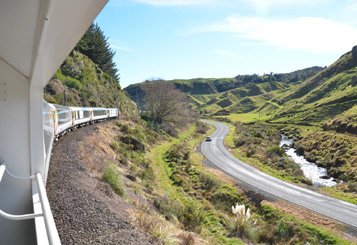
 |
|
|
Auckland to Wellington by train. |
Auckland to Wellington by train
The wonderful Northern Explorer train is easily the best way to get from downtown Auckland to city centre Wellington, stress-free and in comfort at ground level, stopping off at the Tongariro National Park for a couple of days if you like.
It's an epic 681 kilometre (423 mile) journey across the interior of the North Island, through every kind of scenery there is, from coastline to volcanoes to mountains, lush green farmland to thick New Zealand bush. It takes you the length of the historic North Island Main Trunk Railway, started in 1885 and completed in 1908, over feats of engineering such the Raurimu Spiral, Turangarere Horseshoe and Makatote Viaduct. It's one of the world's great railway journeys and one of my favourites, far more historically and economically significant than the branch line used by the TranzAlpine train on the South Island.
And all this costs from NZ$ 158 (£90 or US$115). Don't waste the opportunity, ditch that domestic flight and take the train!

Auckland-Wellington Northern Explorer timetable & fares
* = Since December 2015 the train leaves from the Kiwirail Scenic terminal, a basic platform at the old Strand Station.
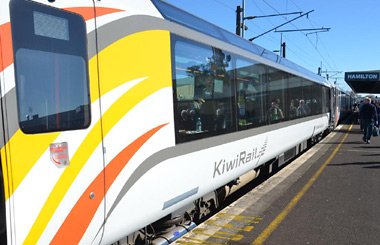
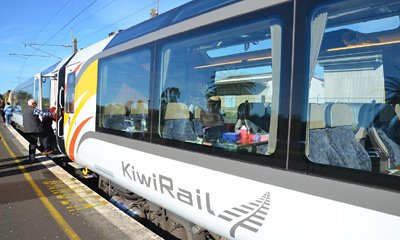
The Northern Explorer has new panoramic carriages, reclining seats, cafe car, open air viewing car, power sockets at all seats.
Children aged 2-14 travel at reduced fare. Infants under 2 travel free.
How to buy tickets
-
Option 1, quickly & easily buy tickets from reliable agency 12go.com.
Tickets are usually confirmed within 24h and emailed to you.
-
Option 2, easily buy tickets at www.klook.com, in various currencies, you are emailed a voucher.
-
Option 3, buy tickets at KiwiRail's own site www.greatjourneysofnz.co.nz. You print your own ticket.
To book by phone with KiwiRail, call 0800 TRAINS when in NZ or call + 64 4 495 0775 from outside NZ.
-
Option 4, tour operator Railbookers offers various holidays & tours around New Zealand which include train travel, more information here.
What's the train like?
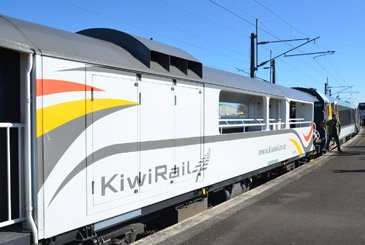
The Northern Explorer uses new AK panoramic sightseeing coaches built in KiwiRail's Dunedin workshops in New Zealand in 2011-2012. These replace the old rebuilt 1930s & 1940s carriages used until June 2012 by its predecessor, the Overlander. Photos courtesy of James Chuang
Scenic class
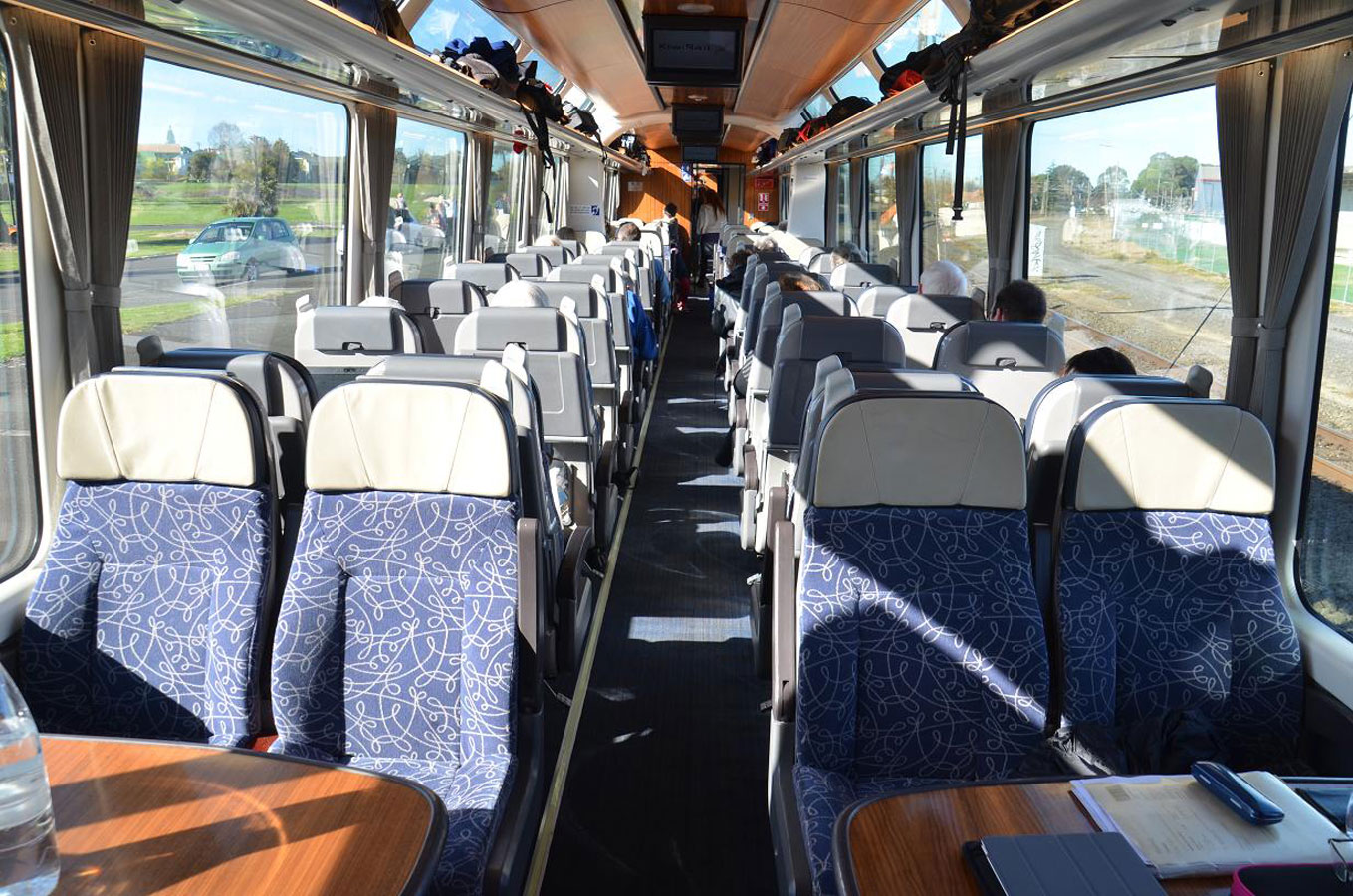
Most seats face the direction of travel, all line up with huge panoramic windows - note the roof skylights too!. There's loads of legroom even if you're over six feet tall. Seats are not allocated at booking, but by the train manager before departure. However, if you book by phone (or book online then call Kiwi Rail's freephone number when you get to NZ quoting your booking reference) you can make a seating request. Four friends or family travelling together could request one of the few bays of 4 seats facing each other around a table, keen photographers might want to request a seat close to the open-air viewing car. Requests can't be guaranteed, but it doesn't hurt to ask! All your heavy baggage is checked in to the baggage van, only hand luggage may be taken into the seating coaches. All seats in the new 'AK' cars have power sockets for mobiles, laptops or cameras (New Zealand voltage and plug, of course). Larger photo.
Cafe-bar
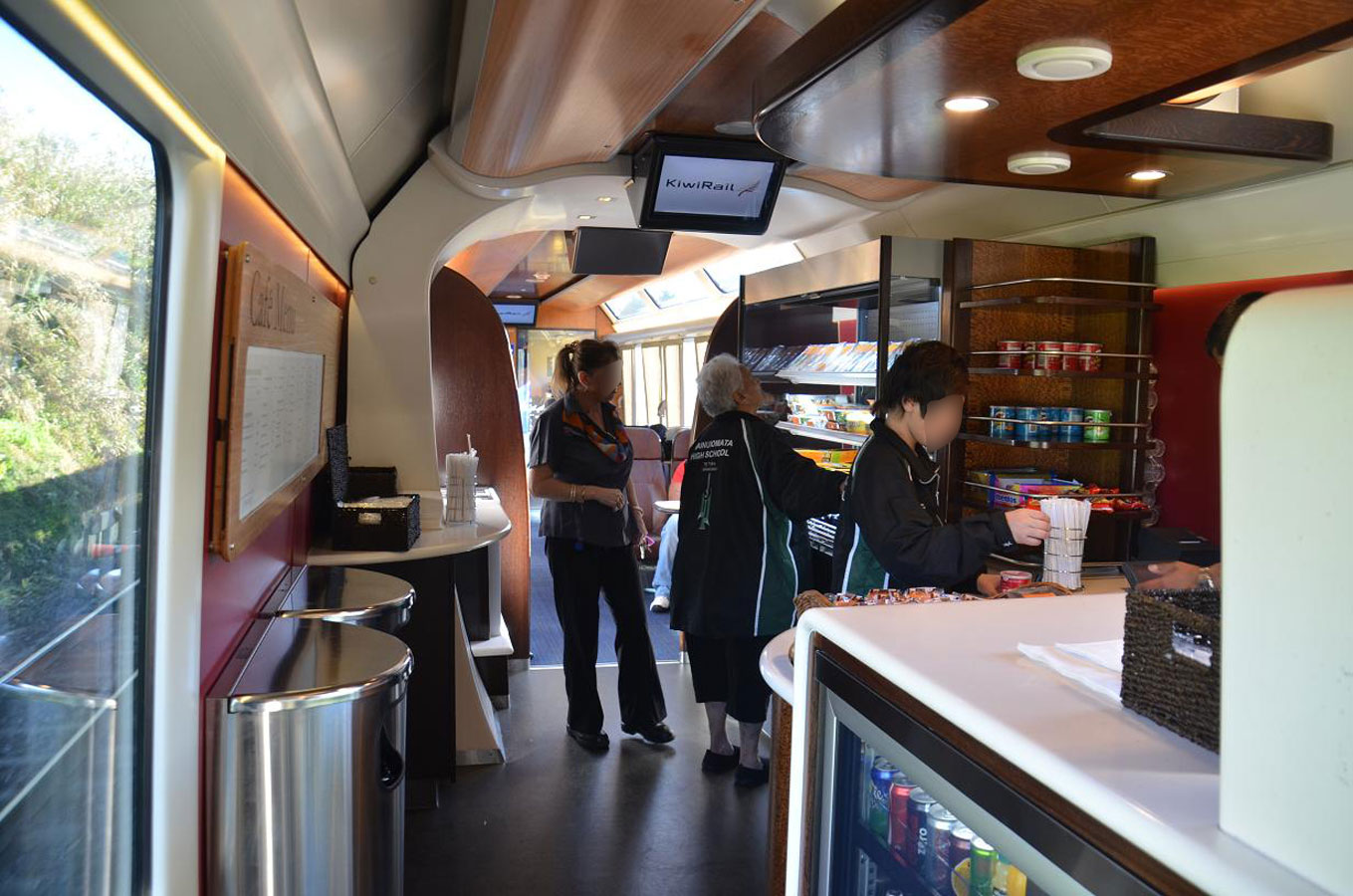
In the centre of the train is a counter selling tea, coffee, wine, beer, spirits, snacks & light microwaveable meals at reasonable prices. I can recommend a cream tea in the afternoon, and a glass of Montana Sauvignon Blanc! You take your food & drink back to your seat. Bring cash if possible as cards are sometimes not accepted if the credit card machine is out of cellphone range. Larger photo.
Open-air viewing platform
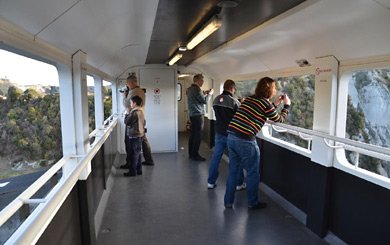
At the Wellington end of the train (rear going north, behind the locomotive going south) is a large open-air viewing platform, ideal for seeing and photographing the scenery, with no glass in between you and it. Children must be accompanied. The viewing cars now have additional rails to prevent you leaning out.
Scenic Plus class
Scenic Plus class was added to the TranzAlpine in April 2023, in a dedicated carriage with a special livery and extra-legroom reclining seats. A freshly-cooked meal & wine is included, prepared by a chef in the adjacent kitchen car and served at your seat.


What to see on the Auckland to Wellington train ride
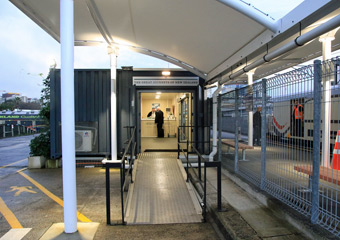 The Northern Explorer leaves from Auckland Strand Terminal: A 423-mile adventure lies ahead. Since December 2015 it has left from it's new home at Strand Station, 1km from the Britomart Centre. There are only basic facilities at Strand, so buy any supplies before going there. Courtesy James Chuang. |
|
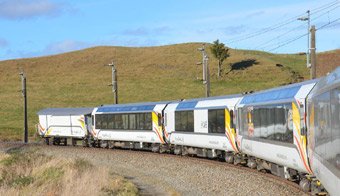 On its way. The new Northern Explorer. |
|
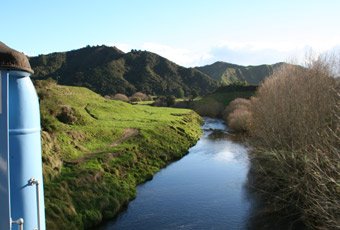 Middle Earth! No wonder filmmaker Peter Jackson realised that NZ looked so much like Tolkien's Middle Earth! (Photo taken from the old 'Overlander') |
|
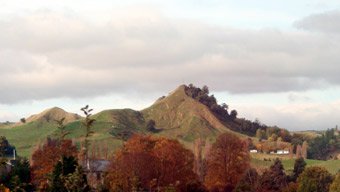 King Country. A green & pleasant land. |
|
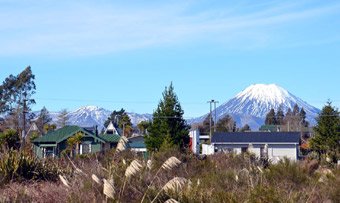 Approaching National Park. Are those old volcanoes..? |
|
|
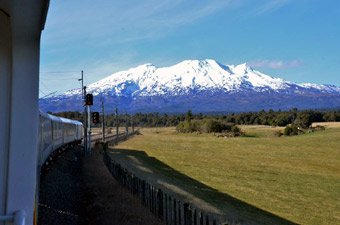
Mount Ruapehu, seen from the Northern Explorer train. Photo courtesy of James Chuang. |
|
|
Crossing the Makatote Viaduct. This photo was taken from the old Overlander's open-air viewing platform. |
|
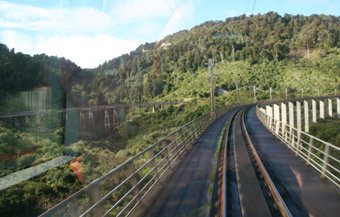 Crossing the Hapuawhenua Viaduct. This photo was taken through the rear-facing observation lounge window of a northbound Overlander. Note the original steel viaduct, now a walking trail, on the left. |
|
|
Crossing the Kawhatau Viaduct over the Rangitikei gorge, on the Northern Explorer's viewing platform. Photo courtesy of James Chuang. |
|
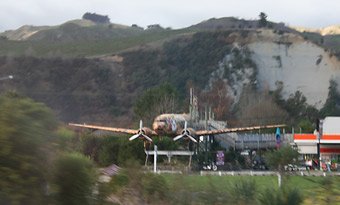
The "Cookie Time" DC3. It has since been repainted. |
|
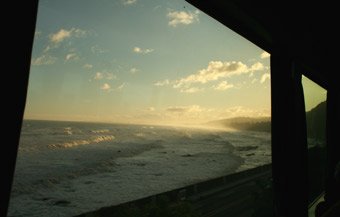 Coastline north of Wellington, seen in the early morning light from a northbound Overlander. |
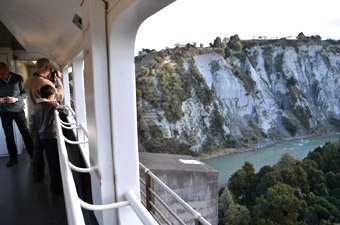
A recorded commentary is played over your complimentary headphones, pointing out things of interest. It's linked with the route map displayed on the in-car display screens. Here's a summary of what to look out for on the journey from Auckland to Wellington:
-
The Northern Explorer leaves from a new and somewhat basic KiwiRail Great Journeys platform 1km from the city centre in part of the old historic and mostly now derelict Strand Station of 1930, the station used by all New Zealand Railways trains from 1930 until 2003.
You can walk or take a taxi from your hotel to Strand Station, see walking map. Don't expect any shops or facilities at the new platform, which is an open platform and a shipping container!
Before 20 December 2015 the train left from Auckland's modern Britomart Transport Centre opened in 2003, right at the northern end of Queen Street (Auckland's main street), just across the road from the Devonport and islands ferry terminal, and a few minutes' walk from all the city centre hotels and the Sky Tower. This is the station now used by Auckland's suburban trains.
-
You should check-in at least 20 minutes before departure at the KiwiRail Great Journeys kiosk. You can then take your large luggage onto the platform and check it into the train's baggage car. The baggage car is at the Auckland end of the train, so at the rear leaving Auckland, at the front northbound from Wellington.
-
A bit about Auckland's railway stations: The Britomart Transport Centre was opened in 2003, and the building that forms its main hall was originally Auckland's General Post Office, built in 1912 and used as a post office until the 1990s. Auckland's suburban trains (and until 21 December 2015, KiwiRail's Northern Explorer) now use five underground railway platforms, reached by two short escalators at the back of the main hall.
Funnily enough, the Britomart Transport Centre occupies the site of Auckland's second railway station (albeit on the surface), right behind the post office, opened in 1885 on land reclaimed from the sea and used until 1930. Auckland's very first station (1873-1885) was located only a few hundred yards away from here too.
The 1885 station was closed in 1930 when an imposing new railway terminal was opened on Beach Road, an inconvenient 15 minutes' walk from the town centre. Only in 2003 was this 1930 station closed and the trains once more extended into the city centre to the new Britomart station. The impressive 1930 station still stands, the platforms empty and decaying, although the station building itself is now a university accommodation centre. It's virtually a clone of the railway station at Wellington, which you'll see later. And now in December 2015 KiwiRail are moving back to part of this 1930 station, using it as their new Strand Station KiwiRail terminal.
-
As the train leaves you'll see Auckland harbour and container terminal to the left, and a glimpse of the derelict platforms of Auckland's 1930 station to the right (in fact, from 21 December 2015 onwards, you'll be using one of these old platforms!). The train swings right onto a causeway across the Orakei Basin (a submerged crater of an extinct volcano), passing regular electric local trains as it snakes its way through the Auckland suburbs.
-
From Auckland to the first major stop, the train passes towns, villages, light industry and farmland. There are some very scenic sections, with extinct volcanoes dotted in places over the landscape. The train runs along the Waikato river and passes right by Taupiri Mountain (287metres), the sacred mountain of the Waikato people. Many ancestors and chiefs are buried on Taupiri, including all the Maori kings.
-
Hamilton is the train's first major stop, where there may be a few minutes to get off and stretch your legs. The central part of the Auckland-Wellington North Island Main Trunk Railway between Hamilton and Palmerston North was electrified in 1988, allowing heavier loads to be hauled over the difficult terrain, although the Northern Explorer is diesel-hauled throughout. Several new bits of track ("deviations") were also constructed in the 1980s, easing the most severe curves and gradients.
-
Beyond Hamilton, the scenery starts to hot up. The flat farmland immediately south of Hamilton is amongst the richest in the world, grazed by sheep, cattle and red deer. You'll cross the boundary between the Waikato and the King Country, and see the volcano Mt Pirongia (959 metres high) in the distance. The King Country is the area once ruled by the Maori Kings. In the 1870s, the New Zealand government admitted that it had no real control over this area. However, after 1882 an agreement was reached with the king which allowed a railway to be constructed. Surveying started in 1883 and construction in 1885, though it would be another 23 years before Auckland and Wellington were finally linked by rail.
-
The train passes through Te Kuiti and on the left just after the station you'll see a king-size statue of a man shearing a sheep, as Te Kuiti bills itself as the sheep shearing capital of the world. A few minutes later the Northern Explorer crosses the Waiteti viaduct, built in 1887 and the oldest viaduct on the North Island Main Trunk Railway.
-
For the next hour or two, you'll start to appreciate just how lush and green New Zealand is. The train winds its way through valleys, hills, rivers, and you can almost see those hobbit holes in the hillocks! Indeed, Sir Peter Jackson (filmmaker and producer of the "Lord of the Rings" films) has said that it was on board an Auckland-Wellington train aged eighteen and reading Tolkien for the first time, that he realised how like Tolkien's Middle Earth the New Zealand landscape is. The train follows the picturesque Ongarue river all the way to Taumarunui.
-
About 30 minutes after passing through Taumarunui, an announcement will be made that the Northern Explorer is about to enter the world-famous Raurimu Spiral. Actually a couple of major hairpin bends then a couple of loops and two tunnels, all built through thick rainforest, the Raurimu Spiral is how the railway engineers building the North Island Main Trunk got the line to climb 221 metres (700 feet) in less than 6 kilometres (3½ miles). The train twists, turns, and doubles back on itself as it climbs. As a result of the spiral, Raurimu to National Park is 11 km by rail, though only 5.6 km as the crow flies! Designed in 1898, the spiral was adopted in preference to an earlier proposal for a longer way round that would have been 19km long and involved several difficult viaducts.
-
Just after clearing the top of the Raurimu Spiral, the train arrives at National Park station, 7 km by road from Whakapapa village in the centre of Tongariro National Park. On a clear day, you can see the huge volcanoes in the distance.
-
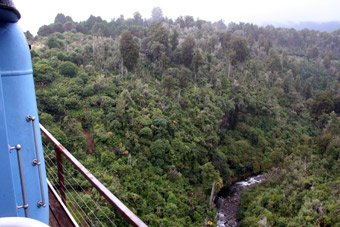
After the train leaves National Park, you pass over a succession of imposing viaducts, in thick bush over huge river gorges. The first is the famous Makatote Viaduct, 11km south of National Park, the highest of the lot and a huge steel structure 860 feet long and 258 feet above the river.
-
A minute or two later, the Northern Explorer passes the site at Manganuioteao where engineers building the North Island Main Trunk from Wellington northwards and from Auckland southwards finally met and New Zealand's Prime Minister Sir Joseph Ward drove in the final spike in 1908. When completed, the new railway reduced the Auckland to Wellington journey from 3 days of train, stagecoach or steamer then train, to just 14 hours by direct train. A small grey obelisk and sign marks the spot on the right, though you may not notice it as the Northern Explorer swishes by.
-
A few viaducts further on, the huge Hapuawhenua viaduct was replaced in 1985 and is now a concrete structure, taking a shorter route across the valley. You can see the original 1908 steel viaduct curving round the valley on your left, now used as part of the Ohakune Coach Road cycle trail.
-
At Ohakune you'll see another New Zealand peculiarity, small wooden houses originally built by New Zealand Railways for employees. There are thousands of these houses, all built to the same handful of designs, all over New Zealand. In the northbound direction, the train stops here for 35 minutes and you can stretch your legs.
-
Ten minutes after Ohakune the train passes over the Tangiwai Bridge, across the Whangaehu River. After the huge viaducts in the Tongariro national park, this seems a very small and unimpressive bridge, but it was the scene of New Zealand's worst ever rail disaster in 1953. A small memorial stands next to the track on the right. It was Christmas Eve 1953, and a lake had formed in the crater of Mt Ruapehu. The wall of this crater burst, sending a "lahar" or 6-metre high torrent of water, mud and volcanic rock down the mountainside and along the river. The lahar washed away a bridge pier, just before the 3pm Wellington to Auckland express reached the bridge at around 10:21pm, with 285 people on board. 151 people died as the locomotive and five 2nd class coaches plunged into the river and were washed downstream. A sixth, 1st class car teetered on the brink allowing time for al but one passenger to be rescued, then plunged into the river. Today, bridge piers have been strengthened and an early warning devices have been placed upstream.
-
Ten minutes later, the train passes the army camp at Waiouru, running through barren country some 800 metres above sea level. There is little vegetation here except grass, because of the altitude. After another 15-20 minutes the train doubles back on itself around the Turangarere Horseshoe, a huge hairpin bend around a small green valley.
-
Soon, the train starts following the massive and dramatic Rangitikei river gorge, and passes over a series of huge viaducts and occasional tunnel. Once in Mangaweka, look out on the left for the cafe with a DC3 Dakota aircraft beside it, painted in "Cookie Time" colours!
-
The Northern Explorer descends off the volcanic plateau to Marton, named after the birthplace of Captain Cook near Middlesbrough. Marton is on the Wellington-New Plymouth railway, and it is the point where they started building the North Island Main Trunk into the interior.
-
The train descends further down the side of a hill, curves around a golf course and crosses the Rangitikei River. Shortly afterwards it passes through Feilding, which has won many "best kept town" competitions and is proclaimed on the station signs as "Friendly Feilding, New Zealand's most beautiful town".
-
Twenty minutes after Feilding, the train arrives at Palmerston North station. Until 1963, the railway ran right through the middle of Palmerston North's main square. This was not very convenient for either New Zealand Railways or the townspeople, so a new station on a deviation around the outskirts of the town was constructed. Here you may have a few minutes to stretch your legs on the platform.
-
An hour or two of rich green farmland follows, before the train reaches the coast. The Northern Explorer runs along a very scenic stretch of coastline for a mile or two, with great views of the sand and the breaking waves. It may be dark by now, but on the northbound journey the coastal views in the early morning sun are wonderful.
-
The coastline gives way to the picturesque Porirua Harbour and Porirua station, passed through non-stop.
-
The Northern Explorer heads on to finish its run at Wellington's imposing railway station, opened in 1937 and a stone's throw from the New Zealand Parliament buildings and city centre. You've done it, you've travelled overland between New Zealand's two biggest cities, all 423 miles of it. I hope you'll agree, it was an epic trip.
A brief history
-
Surveys for the route of the North Island Main Trunk Railway started in 1883, led by one John Rochfort. Building work started in 1885, and the line was finally completed in 1908.
-
From the 1920s to the 1950s, the most prestigious train on the route was the Night Limited, an overnight sleeping-car train that would have been used by businessmen, politicians, in fact anyone who was anyone travelling between Auckland and Wellington. With fewer stops and a lighter load it could manage the journey in about 12 hours.
-
There was usually also a slower overnight train with more stops, leaving Auckland and Wellington around 3pm and getting in next day in the early morning. This had seats but no sleepers, and it was the train involved in the accident at Tangiwai.
-
The third of the three main daily Auckland-Wellington trains was the Daylight Limited, also a fast limited stop train that as its name suggests ran during the day, from morning till night. When it switched from steam to diesel haulage in 1963, it was renamed the "Scenic Daylight".
-
In 1968, the Scenic Daylight was replaced by fast railcars with refurbished interiors & Fiat engines. This was successful, and New Zealand Railways bought several brand-new stainless-steel railcars from Japan, which it named Silver Fern. With comfortable seats and hostess service, these fast railcars ran the daytime service between Auckland and Wellington from 1972 until 1991, when they were replaced by the Overlander. You can still see Silver Fern railcars around as all three Silver Ferns have been preserved by KiwiRail to run occasional special and charter trains.
-
In 1971, the Night Limited was replaced by the Silver Star, a prestige sleeping-car train which used brand-new stainless-steel sleepers and dining-car also bought from Japan. Unfortunately, airline competition forced this service to close before the decade was out, and in 1979 it was replaced by the Northerner. You can still travel in the stainless steel Silver Star coaches between Singapore and Bangkok, as they were bought and rebuilt for the luxurious Eastern & Oriental Express tourist train.
-
The Northerner had both seats and sleepers until 1987, when the last sleeping-cars between Auckland and Wellington were withdrawn. The Northerner continued with seats only until it was withdrawn in 2004. There is now no convenient overnight train between Auckland and Wellington.
-
The Overlander was introduced in 1991, increasing capacity compared to the Silver Fern railcars it replaced.
-
The Overlander was almost withdrawn itself in 2006, but was saved, albeit reduced to 3 times a week (as opposed to daily) in the off-peak season.
-
On 26 June 2012, the Overlander and its rebuilt 1950s carriages were replaced by the new Northern Explorer running 3 times a week all year, using brand new AK carriages built in 2011-2012. It is intended to take train travel upmarket as an 'internationally recognised tourism product'.
Auckland to Wellington in pictures |
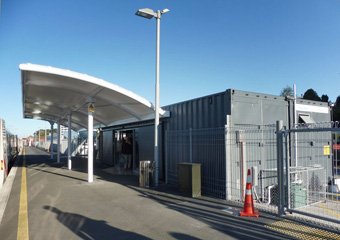
The Northern Explorer leaves from Auckland Strand Terminal: A 423-mile adventure lies ahead. Since December 2015 it has left from it's new home at Strand Station, 1km from the Britomart Centre. There are only basic facilities at Strand, so buy any supplies before going there. Courtesy Jim Walshe. |
|
On its way. The new Northern Explorer. |
|
Middle Earth! No wonder filmmaker Peter Jackson realised that NZ looked so much like Tolkien's Middle Earth! (Photo taken from the old 'Overlander') |
|
King Country, a green & pleasant land. |
|
Approaching National Park. Are those old volcanoes? |
|
Mount Ruapehu, seen from the Northern Explorer train. Photo courtesy of James Chuang. |
|
Crossing the Makatote Viaduct. This photo was taken from the old Overlander's open-air viewing platform. |
|
Crossing the Hapuawhenua Viaduct. This photo was taken through the rear-facing observation lounge window of a northbound Overlander. Note the original steel viaduct, now a walking trail, on the left. |
|
Crossing the Kawhatau Viaduct over the Rangitikei gorge, on the Northern Explorer's viewing platform. Photo courtesy of James Chuang. |
|
The "Cookie Time" DC3. It has since been repainted. |
|
Coastline north of Wellington, seen in the early morning light from a northbound Overlander. |
Watch the video: The Auckland to Wellington train on the Raurimu Spiral
The video was taken from the old Overlander's tail-end observation lounge, and some shots from the open-air viewing platform, as it climbs the famous Raurimu Spiral. The 'Goodbye' in the title is no longer necessary, as the Overlander was saved, and now replaced by the Northern Explorer. Take it the next time you need to go from Auckland to Wellington! Video by iafilm
 Tours
of New Zealand by train
Tours
of New Zealand by train
Railbookers specialise in train-based tours and offer several tours of New Zealand with rail travel, including Essential New Zealand (8 days), Best of New Zealand (16 days), Scenic New Zealand (14 days) and Ultimate Tour of New Zealand (19 days), all of which can all be customised to your own requirements.
 UK call 0207 864 4600,
www.railbookers.co.uk.
UK call 0207 864 4600,
www.railbookers.co.uk.
 US call free 1-888-829-4775,
www.railbookers.com.
US call free 1-888-829-4775,
www.railbookers.com.
 Canada call free 1-855-882-2910,
www.railbookers.com.
Canada call free 1-855-882-2910,
www.railbookers.com.
 Australia call toll-free 1300 971 526,
www.railbookers.com.au.
Australia call toll-free 1300 971 526,
www.railbookers.com.au.
 New Zealand call toll-free 0800 000 554 or
see
website.
New Zealand call toll-free 0800 000 554 or
see
website.
Guidebooks
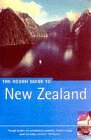 Make
sure you take a good guidebook. The Lonely Planets
and Rough Guides are easily the best out there for the independent traveller.
Both guides provide an excellent level of practical information and historical
and cultural background. You won't regret buying one of these
guides..!
Make
sure you take a good guidebook. The Lonely Planets
and Rough Guides are easily the best out there for the independent traveller.
Both guides provide an excellent level of practical information and historical
and cultural background. You won't regret buying one of these
guides..!
Click to buy
online at Amazon.co.uk

Lonely Planet New Zealand Rough Guide to New Zealand
Suggested hotels
In Auckland in descending order of price, try the Britomart Hotel (5-star with superb reviews), Mercure Auckland Hotel (4-star), DeBrett Hotel, Legacy Airedale Hotel or Adina CityLife Auckland, all sound central choices.
In Wellington, the Shepherds Arms Hotel is a cosy gastro pub just an 18-minute 1.2 km walk from Parliament and the city centre with friendly staff, great food and good beer, a lovely place to stay that I've used myself. Alternatively, for something affordable and central an easy walk from Wellington railway station, try the Wellesley Boutique Hotel or James Cook Hotel Grand Chancellor.
In Christchurch, to be at the heart of the city in or near Cathedral Square, try the Novotel Christchurch Cathedral Square, Adina Heritage Hotel (in a lovely restored Italian Renaissance-style building), or the inexpensive Christchurch City Hotel. But if you really want something special, splurge on the iconic Observatory Hotel, a 10-minute 750m walk from Cathedral Square, occupying a beautifully restored 19th-century gothic revival building.

Personal recommendation in Wellington
In Auckland, the Airedale Hotel or Mercure Auckland Hotel are both sound central choices, the latter right near the Britomart station and Devonport ferry terminal, though not the cheapest options. In Wellington, the Shepherds Arms Hotel is a cosy gastro pub just 15 minutes walk from Parliament and the city centre with friendly staff, great food and good beer. A top choice!
Travel insurance & VPN
|
|
|
|
|


Always take out travel insurance
Never travel overseas without travel insurance from a reliable insurer, with at least £1m or preferably £5m medical cover. It should also cover cancellation and loss of cash and belongings, up to a sensible limit. An annual multi-trip policy is usually cheaper than several single-trip policies even for just 2 or 3 trips a year, I have an annual policy with Staysure.co.uk myself. Here are some suggested insurers. I get a small commission if you buy through these links.
www.staysure.co.uk
offers enhanced Covid-19 protection & gets 4.7 out of 5 on
Trustpilot.
www.columbusdirect.com
is also a well-know brand.
 www.staysure.com/ie if you live in Ireland.
If you live in the USA try
Travel Guard USA.
|
|

Get an eSIM with mobile data package
Don't rely on WiFi, download an eSIM with a European mobile data package and stay connected. Most newer mobile phones can download a virtual SIM including iPhone 11 & later, see device compatibility list. There's no need to buy a physical SIM card! Maya.net is a reliable eSIM data retailer with a 4.5 out of 5 Trustpilot rating and a range of packages including unlimited data.
|
|

Get a VPN for safe browsing. Why you need a VPN
When you're travelling you often use free WiFi in public places which may not be secure. A VPN encrypts your connection so it's always secure, even on unsecured WiFi. It also means you can select the geographic location of the IP address you browse with, to get around geoblocking which a surprising number of websites apply. See VPNs & why you need one explained. ExpressVPN is a best buy with a 4.7 out of 5 Trustpilot ranking which I use myself - I've signed up as an ExpressVPN affiliate, and if you go with expressvpn.com using the links on this page, you should see a special deal, 3 months free with an annual subscription. I get a small commission to help support this site.
|
|


Get a Curve card for foreign travel
Most banks give you a poor exchange rate, then add a foreign transaction fee on top. A Curve MasterCard means no foreign transaction fees and gives you the mid-market exchange rate, at least up to a certain limit, £500 per month at time of writing. The money you spend on your Curve card goes straight onto one of your existing debit or credit cards.
How it works: 1. Download the Curve app for iPhone or Android. 2. Enter your details & they'll send you a Curve MasterCard - they send to the UK and most European addresses. 3. Link your existing credit & debit cards to the app, you can link up to two cards with the free version of Curve, I link my normal debit card and my normal credit card. 4. Now use the Curve MasterCard to buy things online or in person or take cash from ATMs, exactly like a normal MasterCard. Curve does the currency conversion and puts the balance in your own currency onto whichever debit or credit card is currently selected in the Curve app. You can even change your mind about which card it goes onto, within 14 days of the transaction.
I have a Curve Blue card myself, it means I can buy a coffee on a foreign station on a card without being stung by fees and lousy exchange rates, just by tapping the Curve card on their card reader. The money goes through Curve to my normal debit card and is taken directly from my account (in fact I have the Curve card set up as payment card on Apple Pay on my iPhone, so can double-click my phone, let it do Face ID then tap the reader with the phone - even easier than digging a card out). I get a little commission if you sign up to Curve, but I recommend it here because I think it's great. See details, download the app and get a Curve card, they'll give you £5 cashback through that link.
|
|

Carry an Anker powerbank
Tickets, reservations, vaccination records and Interrail or Eurail passes are often held digitally on your mobile phone, so it's vital to keep it charged. I always carry an Anker powerbank which can recharge my phone several times over if I can't get to a power outlet. Buy from Amazon.co.uk or from buy from Amazon.com.
Touring cities? Use hill walking shoes!
One of the best things I've done is swap my normal shoes for hill-walking shoes, in my case from Scarpa. They're intended for hiking across the Pennines not wandering around Bangkok, but the support and cushioning for hiking works equally well when you're on your feet all day exploring foreign cities. My feet used to give out first and limit my day, now the rest of me gives up before they do!