


Cut your CO2 emissions by up to 90%
It's not an exact science and I'm no expert, but there's a growing realisation that climate change is real. Air travel is the fastest-growing contributor to climate change, avoiding a flight when there are easy (and more enjoyable) alternatives is the single biggest thing an individual can do to reduce their impact on the environment.
Some years ago, Eurostar commissioned independent research to assess the CO2 per passenger for a London to Paris Eurostar trip versus a London to Paris flight. The research looked at actual Eurostar loadings, power consumption and electricity sources, actual aircraft loadings and fuel consumption and so on. The conclusion was remarkable: Taking the train instead of flying cuts your CO2 emissions by a staggering 90%.
With airport check-ins up to 2 hours even for a 1-hour flight, plus the time & cost involved in getting to & from remote airports at each end, taking the train city centre to city centre is a nicer experience, too.
The environmental benefit of train instead of plane could in fact be significantly greater. Jet planes emit other substances into the upper atmosphere which cause further damage not included in the Eurostar comparison. Here are some estimated comparisons, looking at CO2 emissions alone:
Journey times are one-way centre-to-centre. Kg CO2 is per passenger for a return journey. The source is The Observer, 29/01/06, except for London-Paris which is taken from independent research commissioned by www.eurostar.com, and London-Dublin & London-Amsterdam. London-Amsterdam & London-Dublin are calculated using the DECC/DEFRA figure of 22.54g of CO2 per passenger km for ferry foot passengers x distance (201 km Harwich-Hook & 105 km Holyhead-Dublin) plus train sectors calculated using www.ecopassenger.org. The equivalent flights are assumed to be from Luton-Schiphol & Luton-Dublin.
Where can I get accurate CO2 figures?
A good source for European train/plane/car emissions comparisons is www.ecopassenger.org. It will compare emissions for journeys such as Birmingham to Paris or Paris to Rome. For CO2 emissions per km for each mode of transport, see the graphic below.
High-speed TGVs across France are technically similar to Eurostar and use electricity from similar sources, so are likely to make a similar environmental saving as Eurostar compared to flying. Sleeper trains have fewer passengers per car than a high-speed train, but they travel at lower speeds using much less energy than a powerful 300 km/h high-speed train. So sleeper trains also make a significant saving on CO2 emissions when compared to flying.
Ferries used to be a problem for emission calculations because CO2 has to be allocated between freight, motorists & foot passengers. However, the Department of Energy & Climate Change (DECC) and the Department for Environment, Food and Rural Affairs (DEFRA) have allocated CO2 emissions from ferries on the basis of weight, giving a figure of 22.54 grams of CO2 per passenger kilometre for ferry foot passengers. So as a foot passenger, ferry is a low-carbon choice, see the graphic below.
But can't you offset the CO2 from a flight?
Having talked with several experts, the consensus is that 'offsetting' is not a long term solution to climate change. Partly because your money doesn't always get to where it should do (there have been some scandals, and in any case much of your money disappears into 'admin costs'), and partly because there's a limit to how many wind farms can be built or new forests planted. Most importantly, 'offsetting' is an excuse for the travel industry to simply carry on polluting without changing their business practices. The real answer is not to offset, but to stop producing as much CO2 in the first place.
How to find an alternative to a flight
The alternatives to flying are easier than you think. For step-by-step instructions on how to plan & book train travel, select your journey here.
Doing yourself a favour, as well as the planet
I'm not an eco-warrior, I didn't start seat61.com to avoid flying for environmental reasons. I started it because overland travel by train is so much more enjoyable and fulfilling than the commercialised air travel experience. In an increasingly globalised world, where every flight is the same stressful non-experience, trains and ships show you more of the country you're visiting and its culture. On business, train travel can be productive, with room to work, power outlets for laptops and free WiFi. On leisure journeys, time together on the train can actually be quality time with your loved ones. You might just find a train journey a more interesting and rewarding experience that in reality doesn't take that much longer than flying...
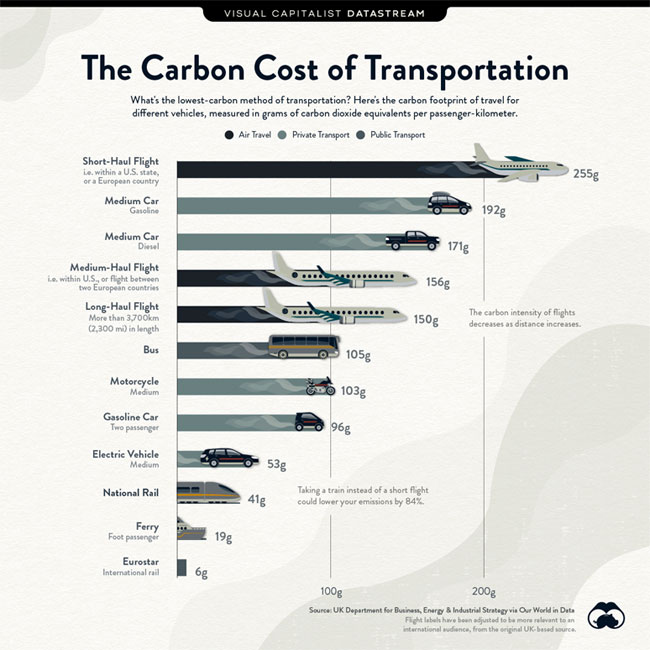
Reproduced from www.visualcapitalist.com/comparing-the-carbon-footprint-of-transportation-options