


Breakfast in London, dinner in Barcelona
There's no need to fly. It's surprisingly easy, quick and comfortable to travel by train from London to almost anywhere: Spain, Italy, Switzerland, Greece, Finland, wherever. The difficult bit is finding out how to do it and where to buy tickets. That's where Seat 61 comes in.
On this site I explain the best trains and routes (a) between the UK and each other European country, and (b) between Europe's major cities and tourist destinations.
I then explain the best way to buy tickets for those trains, whether you live in the UK, mainland Europe, the USA, Australia, India, Singapore or wherever.
|
|
Train times & tickets
If your journey starts in the UK, select your destination country in the upper drop-down box to see recommended routes, train times, fares & how to buy tickets.
If your journey starts in another European country, select the city where your journey starts in the lower drop-down box - if it isn't listed, select one nearest to it in the same country.
Return to this page for general information & advice about European train travel.
|
|
Planning your trip
How to buy tickets
Luggage, bikes, dogs & cars
About specific trains & routes
Station guides
How to check train times
|
|
-
For European train schedules use int.bahn.de
If you only remember one European train travel resource (apart from Seat61, of course!), make it Int.bahn.de. Provided by Deutsche Bahn (DB, German Railways), this has an online timetable for the whole of Europe.
Ask it for Stockholm to Palermo or Lisbon to Bucharest and you'll see what I mean. If you want to know if a European journey is possible by train, how long it takes, how frequently it runs, and if there's a direct train, start with Int.bahn.de.
-
Place names
It recognises English-language place names & prompts with station or city names.
-
If you don't know which station to select
The safest option is to select the plain city name, usually in capitals, for example PARIS or BERLIN, the system will then work out the relevant station.
If it only offers specific stations, select the main station, shown as main station, Centrale (Italian), Centraal (Dutch), Hauptbahnhof, Hbf or HB (German, Austrian, Swiss), Hlavni or hl.n. (Czech) or Glowny (Gl.) (Polish).
In Brussels, Brussels South Station is the main station, also known as Brussels Midi or Brussel Zuid. In Barcelona, select Barcelona Sants. In Verona, select Verona Porta Nuova. In Turin, the main terminus station is Torino Porta Nuova, but the TGV trains to/from Paris use Torino Porta Susa, which many trains leaving from Porta Nuova heading for Venice or Rome also call at. In Venice, Venice Santa Lucia is on the Grand Canal in central Venice, Venice Mestre is on the mainland. In Lisbon, select Lisbon Santa Apolonia.
-
It holds data for all the main national European train operators
int.bahn.de shows all trains which have been loaded into the European timetable database called MERITS. All the main national operators load their timetables into MERITS, so do many smaller operators including Iryo, Westbahn, Flixtrain, Regiojet & European Sleeper.
-
It doesn't hold data for a few smaller railways & operators
A few open-access and some small local operators don't use MERITS and their trains don't show up. These include:
- Private open-access operator Italo in Italy.
- The Circumvesuviana Railway, Naples-Herculaneum-Pompeii-Sorrento.
- The former FEVE narrow-gauge routes in northern Spain.
- Spanish suburban routes including Barcelona to Latour de Carol.
- Data is not always 100% complete for the Balkans or Greek domestic trains.
- For British trains it's better to use www.nationalrail.co.uk as this shows engineering work alterations.
-
How far ahead can you look?
All European railways change their timetables at midnight on the 2nd Saturday in December. The Belgians, Dutch, Germans, Austrians, Swiss, Danish, Czechs, Hungarians, Polish (for example) load data for the whole timetable year from mid-December to mid-December, so you can check train times for any date from now until the 2nd Saturday in December. You can even look up times for dates in the past.
However, French, Italian, Spanish & Swedish railways only load data a few months in advance, so in January (for example) you may only be able to see French trains as far ahead as June or July, no trains appear after that. It does not mean all French trains are cancelled after July! In Spain, Renfe sometimes loads trains only weeks ahead, but months ahead on routes where they've competition - strange that, isn't it?
Some operators - the biggest culprits being Trenitalia (Italy) & Renfe (Spain) - load trains bit-by-bit. So if you look 2 months ahead all trains are shown, if you look 8 months ahead no trains are shown, but if you look 4 months ahead several random trains are shown when there should be an all-day service. The worried emails I get about this drive me nuts. No, they haven't cancelled all the other trains, just WAIT!
Timetable data for the following year (from mid-December onwards including Christmas) usually appears in mid-October for France, Germany & Austria, but won't be 100% complete for Spain, Hungary, Poland or Bulgaria until November or even early December. More about this.
If you don't see what you expect to see, check the operator's own website, see a list on the links page.
-
You can adjust transfer time
By default the system allows the minimum time to change trains, whether you're changing into a local train that runs every 30 minutes or into a sleeper train which you can't afford to miss. It won't suggest impossible connections, it always allows enough time to walk from one train to the other if the first train is on time. But it doesn't allow for delays and doesn't make risk assessments like a savvy traveller should.
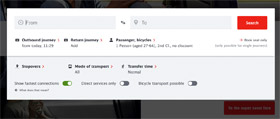
It's often a good idea to allow more time for transfers, so click in the From box to open the details panel, then change Transfer time from Normal to (say) at least 40 minutes.
On a through ticket you're legally entitled to later onward travel if a delay means a missed connection (more on that here), but with separate train-specific tickets the risk is yours so I'd allow more than the minimum, see more about how long to allow for connections.
-
You can specify a route or add stopovers
Click Stopovers to set one or two via stations if you want to find journeys via a particular route. Leave Length of stay as 00:00 to specify a via. Enter a length of stay in hours and minutes to specify a stopover.
-
Fares & tickets
int.bahn.de shows train times for almost any journey in Europe, but it only sells tickets for journeys to, from or within Germany, and across Germany between Belgium, Netherlands, Luxembourg, Switzerland, Austria, Denmark, Sweden, Poland, Slovakia, Czechia.
If it says Determine price it means it cannot sell tickets directly using the German Railways ticketing system but will try to source tickets through its connection to other operators. In such cases you're usually better off booking directly with that other operator, see the How to buy European train tickets page.
-
An alternative: ÖBB's Scotty
There's one other Europe-wide timetable website worth mentioning, Austrian Railway's Scotty, fahrplan.oebb.at/webapp.
It also uses data from MERITS so has similar capabilities to int.bahn.de, it's a little more fiddly to use, but it also shows train names and can sometimes be more accurate when looking up times for Austria, Hungary, Romania, Slovenia, Croatia. If there's a minute or two difference in times shown by Bahn and Scotty for a Budapest-Bucharest train, I'd go with Scotty!

Phone apps
 |
|
|
|

-
DB Navigator is a free online train timetable app for all of Europe, the app version of the German Railways all-Europe online timetable at bahn.de. It provided a journey planner, train details, and calling points, though it needs a WiFi or mobile data connection. To download, go to int.bahn.de/en/booking-information/db-navigator (please let me know if that link stops working).
-
Railplanner is a free offline train timetable app that you can download onto your phone to check train times & train calling points on the move without the need to be on WiFi or to use mobile data. It's blisteringly quick and covers almost all the train covered by the DB Navigator app. The whole European timetable sits on your phone, with updates automatically downloaded every month. It's created with Eurail and Interrail passholders in mind, so also warns you if a train isn't covered by Interrail/Eurail, but it's useful for anyone. Download for iPhone or Android at www.eurail.com/en/plan-your-trip/rail-planner-app (please let me know if the link stops working).
Station arrivals & departures
-
You can check scheduled train departures & arrivals at almost any station in Europe at int.bahn.de/en/buchung/abfahrten-ankuenfte.
This is an online equivalent of the printed departure posters displayed at stations. It shows platform numbers and real-time information for stations in Germany and in some other countries. Enter the station name and (if necessary) use Mode of transport to select Long-distance travel only to eliminate all the many local trains. For more about real time information see the real-time section.
|
|
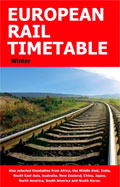
The European Rail Timetable
-
The world-famous European Rail Timetable is the train traveller's bible, with route maps and up-to-date timetables for trains, buses and ferries for all European countries, plus trains in Asian Turkey and Russia including the Trans-Siberian railway, ferries to North Africa & the Mediterranean islands.
-
Published since 1873, it had just celebrated 140 years of publication when Thomas Cook pulled the plug on their entire publishing department, and the August 2013 edition was the last to be published by Thomas Cook. The good news is that the dedicated ex-Thomas Cook team set up a private venture and a reborn European Rail Timetable continues to be published. Remarkably, the timetable has now survived its parent company, as Thomas Cook collapsed in 2019. What does it contain?
-
Buy online at www.europeanrailtimetable.eu with shipping worldwide.
If you live in the UK you can also buy from www.amazon.co.uk, it's eligible for Amazon Prime next-day delivery.
How to check fares & buy tickets
-
This section has turned into a bit of an essay...
If you just want to know how to buy tickets for a specific journey, skip this bit, go to the How to buy tickets page, select a journey and I'll tell you how to book it. But if you want to learn how European train booking works (and how it doesn't), read on.
-
Reality check: No one website sells tickets for all trains in all countries
You can look up train times almost anywhere in Europe using int.bahn.de or fahrplan.oebb.at/webapp, but there isn't a single website that can sell tickets for every European train in every country.
So you can't go to europeanrailways.com (there's no such site) and buy a Stockholm to Alicante ticket (there's no such ticket). It's perfectly possible to travel from Stockholm to Alicante by train, but we're talking 6 trains run by 5 different operators ticketed with at least 4 separate tickets.
Ah, I see from the look on your face that realisation is beginning to dawn...
-
Each country has its own national operator with its own website
Each national train operator has its own ticketing system and its own website. Then there are various private operators, either genuinely independent such as Italo, Regiojet or Leo Express, or quasi-independent such as Eurostar or TGV-Lyria created by the relevant national rail operator(s) to run specific international routes. These also have their own websites.
In fact, Europe has over 100 different rail operator websites selling train tickets for their own trains, even before considering third-party ticket resellers. You need to use the right website for the right journey. So which is the relevant operator for your journey?
If you go to the How to buy tickets page, select your starting city, and on the next page select your destination, you'll find my advice on how to book that specific route. But here I'll give some general advice.
-
The quasi-independent operators can also be booked at the owning national operator site
Eurostar is majority-owned by French Railways (SNCF) and Eurostar tickets can also be bought at SNCF's website www.sncf-connect.com. TGV-Lyria is owned by SNCF & SBB (Swiss Railways) and can also be booked at www.sncf-connect.com or www.sbb.ch. The national operator sites can of course book other trains in their respective countries too, in connection with Eurostar or TGV-Lyria. So London to Avignon by Eurostar & onwards French train can be booked as one transaction at French Railways www.sncf-connect.com, for example. It can be useful to know that!
-
International trains can usually be booked with the national operator at either end
For international journeys, a good starting assumption is that you should book on the national rail operator website for the country where the journey starts. But if a train can be e-ticketed (as most now can be), you can also book using the destination country's train operator website.
For example, Berlin-Prague trains are run jointly by German & Czech national railways, and can be booked at either German Railways int.bahn.de or Czech Railways www.cd.cz with e-tickets.
Now it gets interesting, as this is one of the routes where each partner operator manages advance-purchase prices independently. So the price at bahn.de might be €39.99 (with €19.99 & €29.99 tickets sold out), whilst €19 tickets remain available for the same train at cd.cz. So check both!
In fact, even the fixed-price full-flex fare can differ between partner operators. As I write this, Austrian Railways (ÖBB) charge €88 for a full-flex ticket from Vienna to Prague, but even if you were in the ÖBB ticket office at Vienna Hbf, it'd be cheaper to whip out your phone and buy exactly the same ticket for the same trains from Czech Railways for €58.
But a word of warning: Check the ticket delivery method if buying from the operator at the destination end. For example, Austrian Railways oebb.at issues e-tickets for Vienna-Venice trains so can be used for either direction. Trenitalia.com can also book these Vienna-Venice trains, but you must collect a hard-copy ticket from a Trenitalia ticket machine in Italy - no good if you're starting in Vienna!
There are now exceptions, where competition has replaced co-operation: Trenitalia's Paris-Milan Frecciarossas enter France on an open-access basis with no SNCF involvement and can only be booked at Trenitalia.com. Meanwhile, SNCF's Paris-Milan TGVs enter Italy on an open-access basis and can only be booked at SNCF-connect.com. It's a similar story between France and Spain with Renfe's AVEs and SNCF's TGVs.
-
Some trains aren't bookable online at all
Another reality check: Slovenian, Croatian, Serbian & Bulgarian railways don't sell international tickets online. Trains between Slovenia or Croatia & Germany can be booked in either direction at German Railways int.bahn.de. Trains between Slovenia or Croatia & Austria can be booked in either direction at Austrian Railways www.oebb.at. Trains between Budapest & Belgrade can be booked at www.mavcsoport.hu. But the only way to buy tickets between Ljubljana & Zagreb or from Belgrade to Montenegro is at the station.
-
Longer journeys may need to be broken down into stages
Many international journeys involve a change of train, often this means a change of operator. Operator websites may not be able to sell tickets for such journeys. Nice to Milan can't be booked at the French Railways website www.sncf-connect.com, because SNCF can't access prices or tickets for the Trenitalia train between Ventimiglia & Milan (Ventimiglia is the border station where you change trains). And the Trenitalia website can't book Nice to Milan either, because it can't access prices or tickets for the SNCF train between Nice & Ventimiglia. You need to book Nice-Ventimiglia at www.sncf-connect.com and Ventimiglia-Milan at Trenitalia.com. Two tickets, two bookings, on two different websites, such is the reality of Europe's rail network in the 21st century. But there are two specialist retailer sites that resolve this.
-
Introducing Raileurope.com & Thetrainline.com
Two ticket retailer websites deserve a special mention, www.raileurope.com & www.thetrainline.com. These connect to multiple operators, allowing tickets for trains across much of western Europe to be booked in one place.
They have their own journey planning logic, so (for example) they can work out a journey from Nice to Milan, they then source the Nice-Ventimiglia ticket from SNCF and the Ventimiglia-Milan ticket from Trenitalia, selling it as one seamless Nice to Milan transaction.
I often recommend www.raileurope.com or www.thetrainline.com as they allow you to book tickets together in one place for journeys that would otherwise require multiple bookings on different websites. They are designed for international users, so happily accept overseas payment cards (some national train operator sites struggle) and are written in plain English (some national rail operator sites slip back into local language or use iffy English translations). They charge a small booking fee, but it can be worth it.
Raileurope.com or Thetrainline.com currently connect to the following national railways: Great Britain (National Rail), France (SNCF), Spain (Renfe), Italy (Trenitalia), Switzerland (SBB), Germany (Deutsche Bahn), Austria (ÖBB). They also both connect to private operator Italo. www.thetrainline.com also connects to the Benelux ticketing system (SNCB, NS & CFL) and private operators Regiojet & Westbahn.
Raileurope.com or Thetrainline.com are as close as you'll get to a pan-European train booking system, but even they don't yet connect to the Portuguese, Czech, Slovakian, Slovenian, Croatian, Hungarian, Danish, Swedish, Norwegian, Finnish, Bulgarian, Turkish, Greek, Romanian, or Polish Railways ticketing systems. So for a €17 Lisbon-Porto ticket you still need to go to Portuguese Railways www.cp.pt and the only place you'll find a €21 Prague-Budapest ticket is Czech Railways www.cd.cz. You get the picture?
-
You might also come across Omio.com
Omio has similar connectivity to Raileurope and Thetrainline, but at the time I write this it doesn't have its own journey planning logic. So although it can sell you a Nice-Ventimiglia ticket if you ask it for Nice to Ventimiglia, and it can sell you a Ventimiglia-Milan ticket if you ask it for Ventimiglia to Milan, if you ask it for Nice to Milan it will say there are no trains (and will suggest a flight) because it lacks the capability to plan the journey and combine tickets from multiple sources.
It also says there are no trains for journeys where it lacks the necessary connectivity. For example, Omio says there are no trains from Budapest to Zagreb and suggests a bus, but you can easily buy a train ticket from €19 from Hungarian Railways at www.mavcsoport.hu. So it's important to understand it's limitations.
However, Omio has some useful connectivity which Raileurope & Thetrainline don't, for example it connects to Swedish Railways sj.se, useful if sj.se rejects your credit card, and to Portuguese Railways cp.pt which no other site currently does.
-
So which website should you use to buy tickets?
Don't worry! On seat61.com I'll tell you the right website to use for any given European journey (well, almost). Go to the How to buy European tickets page and select your starting city. On the next page, select your destination. I'll then explain the different ways you can make that specific journey and which website(s) to use to buy tickets.
-
When do train bookings open?
This is the biggest problem people have when booking European trains, either looking too far ahead before booking opens or (worse!) when data is incomplete and some trains are missing from the data. Train booking horizons vary from as long as 11 months to as little as 7 days, depending on the operator and on trackwork planning. This is a subject in its own right, see the When do train bookings open page.
-
More tips for buying tickets
For more tips on buying European train tickets, including child, youth & senior fares, seat selection, stopping off, and for an explanation of how train ticketing works, see the tips on the train tickets page.
To buy tickets within one country
-
You can check fares & (usually) buy tickets for domestic journeys at each country's national rail website, see the links page for a complete list.
To buy tickets for international journeys
-
Rule-of-thumb 1, try www.raileurope.com & www.thetrainline.com.
These connect to the British, French, Spanish, Italian, Swiss, German, Austrian, Benelux systems and can easily book journeys including multi-operator journeys to, from and within those countries.
But be aware of their limitations: You still need to use other websites for journeys not covered, for example they don't connect to the Portuguese, Norwegian, Finnish, Croatian, Bulgarian, Czech or Hungarian ticketing systems. They charge a small booking fee, you can avoid this by buying direct from train operator websites.
-
Rule-of-thumb 2, try the operator's website:
If you know the operator that runs the train you want, go to the operator's website:
www.eurostar.com for Eurostar trains between London & Paris, London & Brussels or anywhere in Belgium.
www.regiojet.com for Regiojet trains between Vienna & Prague or Prague & Bratislava.
www.italotreno.it for Italo trains in Italy.
www.europeansleeper.eu for the European Sleeper from Brussels & Amsterdam to Berlin & Prague.
-
Rule-of-thumb 3, try the national train website for where the journey starts:
if you don't know which operator you need, start with the national train website for the country where the journey starts. Although there are many exceptions as you can see below:
Journeys starting in London
Use www.eurostar.com for Eurostar to Lille, Paris, Brussels or anywhere in Belgium.
Use www.nsinternational.com or www.b-europe.com for journeys to Rotterdam, Amsterdam or anywhere in Belgium or the Netherlands.
Use www.raileurope.com or www.thetrainline.com for journeys to anywhere in France, Germany, Spain, Switzerland, Milan, Turin, Germany.
Journeys starting in Paris & France
French Railways www.sncf-connect.com sells many journeys from Paris & French cities to neighbouring countries.
For journeys from Paris to Germany, it's usually better to use German Railways int.bahn.de.
For journeys from Paris & France to Italy, Spain, Portugal, Austria it's better to use www.raileurope.com or www.thetrainline.com.
Journeys starting in Brussels, Bruges or Belgium
The Belgian Railways international site www.b-europe.com sells journeys to neighbouring countries.
For journeys to Germany, Austria, Switzerland, Denmark, Sweden, Czechia, Hungary it's better to use German Railways int.bahn.de.
For Nightjet sleepers from Brussels to Munich, Salzburg or Vienna it's better to use Austrian Railways www.oebb.at or www.thetrainline.com.
For the European Sleeper from Brussels to Berlin & Prague use www.europeansleeper.eu.
Journeys starting in Amsterdam & the Netherlands
The Dutch Railways international site www.nsinternational.com will handle journeys to Belgium, Luxembourg & other neighbouring countries.
For journeys to Germany, Austria, Switzerland, Denmark, Czech Rep., Sweden it's better to use German Railways int.bahn.de.
For Nightjet sleepers from Amsterdam to Basel, Zurich, Munich, Innsbruck, Vienna use Austrian Railways www.oebb.at or www.thetrainline.com.
For the European Sleeper from Rotterdam & Amsterdam to Berlin & Prague use www.europeansleeper.eu.
Journeys starting in Switzerland
The Swiss Railways site www.sbb.ch can book journeys to neighbouring countries, for example Paris.
For journeys to Paris you can also use French Railways www.sncf-connect.com, it's worth checking prices there too.
For journeys to Italy, it's better to use Italian Railways www.trenitalia.com as SBB can't sell Trenitalia's cheap fares beyond Milan.
For journeys to Germany, Benelux & Denmark it's better to use German Railways int.bahn.de.
For journeys to Austria you'll often find cheaper prices at the Austrian Railways site www.oebb.at.
For the sleeper train from Zurich to Prague, try Czech Railways www.cd.cz and Austrian Railways www.oebb.at.
For the sleeper trains from Zurich to Vienna, Budapest, Hamburg & Berlin use Austrian Railways www.oebb.at or www.thetrainline.com.
Journeys starting in Italy
Italian Railways www.trenitalia.com can book the Frecciarossas to Paris, but not the French-run TGV.
French Railways www.sncf-connect.com can book the Paris-Turin-Milan TGVs, but not Trenitalia's Frecciarossa.
Italian Railways www.trenitalia.com can book many other international trains from Italy.
Use Austrian Railways www.oebb.at for Venice-Vienna trains, Trieste-Vienna trains and Italy-Vienna/Munich sleeper trains.
Journeys starting in Germany
German Railways int.bahn.de sells through tickets to most neighbouring countries.
For travel to Austria, it's sometimes cheaper to use Austrian Railways www.oebb.at, so check this too.
For travel to Prague, it's sometimes cheaper to use Czech Railways www.cd.cz, so check this too.
For Nightjet sleeper trains within Germany & to/from neighbouring countries, use Austrian Railways www.oebb.at.
For the European Sleeper from Berlin to Amsterdam & Brussels, use www.europeansleeper.eu.
Journeys starting in Austria
Austrian Railways www.oebb.at can book journeys to most neighbouring countries.
For travel to Germany, also check German Railways int.bahn.de as they are sometimes cheaper for the same train.
For travel to Prague, check prices at Czech Railways www.cd.cz too as they are sometimes cheaper than ÖBB for the same train.
Journeys starting in Prague
Czech Railways www.cd.cz can book journeys to most neighbouring countries.
For journeys between Prague & Brussels, Amsterdam, Copenhagen, Stockholm also try German Railways int.bahn.de.
For the European Sleeper from Prague to Amsterdam & Brussels, use www.europeansleeper.eu.
Journeys starting in Budapest
Hungarian Railways www.mavcsoport.hu can book journeys to most neighbouring countries.
For journeys to Germany, you can also check prices at German Railways int.bahn.de, but the Hungarians are usually cheaper.
For journeys to Austria, you can also check prices at Austrian Railways www.oebb.at, but the Hungarians are usually cheaper.
For journeys to Romania, you can also book with Romanian Railways bileteinternationale.cfrcalatori.ro/en/booking/search.
The sleeper trains from Budapest to Zurich, Munich & Stuttgart can also be booked at www.oebb.at.
Journeys starting in Slovenia or Croatia
Zagreb or Ljubljana to Germany can be booked at German Railways int.bahn.de.
Zagreb or Ljubljana to Austria can be booked at Austrian Railways www.oebb.at.
Zagreb or Ljubljana to Hungary can be booked at Hungarian Railways www.mavcsoport.hu.
The sleeper train from Zagreb or Ljubljana to Stuttgart or Zurich can be booked at Austrian Railways www.oebb.at.
Other international journeys including Ljubljana-Zagreb cannot be booked online, just go to the station.
Journeys starting in Poland
The Polish Railways website can now book some international trains, so try www.intercity.pl.
It's easiest to book journeys from Warsaw, Krakow or other Polish city to Germany at German Railways int.bahn.de.
Daytime & sleeper trains from Warsaw & Krakow to Prague can be booked with Czech Railways at www.cd.cz.
Daytime & sleeper trains from Warsaw & Krakow to Budapest can be booked with Hungarian Railways at www.mavcsoport.hu.
The sleeper train from Warsaw & Krakow to Vienna, Salzburg & Munich can be booked at Austrian Railways www.oebb.at.
All international tickets starting in Poland can be arranged through reliable ticketing agency www.polrail.com.
Journeys starting in Copenhagen
Unfortunately, the Danish Railways website www.dsb.dk doesn't sell international tickets.
German Railways int.bahn.de sells tickets from Copenhagen to Germany, Brussels, Amsterdam, Luxemburg, Prague, Switzerland.
Omio.com & Swedish Railways www.sj.se sell tickets from Copenhagen to Stockholm.
The Öresund website www.oresundstag.se sells tickets for the frequent Öresund trains to Malmö & Gothenburg.
Journeys starting in Stockholm & Sweden
Omio.com & www.sj.se sell tickets to Oslo or Copenhagen or within Sweden.
The Öresund website www.oresundstag.se sells tickets for the frequent Öresund trains from Gothenburg & Malmö to Copenhagen.
German Railways int.bahn.de can sell tickets from Stockholm, Gothenburg & Malmö to anywhere in Germany.
German Railways int.bahn.de can also sell tickets from Stockholm, Gothenburg & Malmö to Amsterdam, Brussels, Switzerland & Prague.
-
Rule-of-thumb 4, break the journey down!
Don't expect any website to sell tickets for London to Istanbul or Stockholm to Alicante or Rome to Warsaw, all in one go. Even a relatively short two-operator journey such as Vienna to Paris or Milan to Munich or Nice to Rome can cause issues if you try to book it as one journey. I have lost count of the times I've advised travellers to break the journey down, buying tickets for each part of the journey or if necessary, for each individual train, at the relevant operator's website.
For example, int.bahn.de comes up with silly-money €250+ prices for Paris to Vienna with a change in Frankfurt, but it will happily sell you a Paris-Frankfurt ticket from €39.99 and a Frankfurt to Vienna ticket from €29.99 on exactly the same trains if you break the journey down.
Similarly, Prague to Venice can't be booked online, but the Czech Railways site www.cd.cz/eshop will happily sell you a Prague to Vienna ticket from €14 and Austrian Railways www.oebb.at will book the Vienna-Venice sleeper from €59.90 with couchette.
There are endless examples all over Europe, some creative thinking may be required!
-
Rule-of-thumb 5, some trains cannot be booked online
Some trains simply cannot be booked online at all and need to be booked by phone or at the station. For example Belgrade to Montenegro, Ljubljana to Zagreb.
-
I'll say it again, for advice on how to book specific European train journeys, see the How to buy European train tickets page.
By phone
-
It matters whom you call! Some agencies are better for some journeys than others because of the ticketing systems they use.
-
You'll find a list of agencies with advice on who to call on the How to buy train tickets by phone page.
Maps of the European rail network
Free online rail maps
-
This free online rail map of Europe is a good basic overview of the extent of the European railway network.
It's intended for people using a Eurail or Interrail pass so leaves out many routes in non-Interrail/Eurail countries such as Russia & Ukraine, and leaves out many smaller lines even in countries covered by these passes.
-
For more detail, try the zoomable online map of European (and indeed, world) railways at www.openrailwaymap.org.
-
You can also try the Swiss Railways all-Europe online map at maps.trafimage.ch. Zoom in for more detail.
-
For the best (and official) map of the British rail network, click here.
-
For an online map of the French rail network click here.
-
For an online interactive map of the German rail network click here.
-
For the best (and official) map of the Swiss rail network, click here.
-
But for a decent map of all European train routes, you really need to buy one of the printed rail maps listed below.
 |
 |
||
|
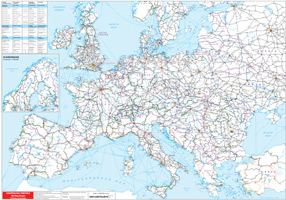
Buy at www.europeanrailtimetable.eu (shipping worldwide) or www.amazon.co.uk (UK). See map extract. On the back there's a more detailed map of the central Europe covering Benelux, Germany, Switzerland, Austria, northern Italy, Eastern France. |
|||
Rail Map Europe: Buy here
-
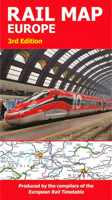
Highly recommended: The excellent and highly-regarded Thomas Cook Rail Map of Europe has been updated and reissued under new management. It covers the whole of Europe from Portugal to Moscow & Istanbul and from Sicily to Finland, with high-speed and scenic routes highlighted. See an extract from the map. Buy online at www.europeanrailtimetable.eu or (if you live in the UK) at www.amazon.co.uk.
Rail Atlas of Europe by Ian Allan: Buy here
-
Ian Allan Publishing do an excellent hardback rail atlas of Europe for around £21, available through Amazon.co.uk. You can also buy it in the USA at Amazon.com.
Rail Atlas of Europe by M Ball: Buy here
-
There's another highly-detailed European Railway atlas covering the whole of Europe, europeanrailwayatlas.com, price £24.95 in 122-page paperback book form covering 23,000 locations with free PDF version for your computer, tablet or phone.
Is your train running on time?
-
How to check for delays or disruptions
As with buying a ticket, there isn't a single website covering the whole of Europe for train delay & disruption information.
To check if a train is on time, or to check if there are any last-minute timetable alterations due to trackwork, strikes or other disruption, start by going to the relevant train operator's website, run an enquiry and find your train. You can see a list of train operator websites here.
If there is any form of delay or disruption, the timetable shown in that operator's journey planner will usually be updated. Some operators also have a separate page listing any significant alterations or disruption.
In fact, it's good practice to always run an enquiry on the train operator's website on the day of travel, just to check that there aren't any late schedule changes. Operators should email you if there are changes to a train you've booked, but you can't always rely on that.
You'll find real-time station arrivals & departures information for many European stations, either on the national train operator's website, or the website of the station/infrastructure operator.
-
Eurostar service updates
See www.eurostar.com/uk-en/travel-info/travel-updates for details of any disruption affecting London-Paris/Brussels/Amsterdam Eurostars.
-
London St Pancras arrivals & departures
See ojp.nationalrail.co.uk/service/ldbboard/dep/STP. This shows domestic as well as Eurostar arrivals & departures.
-
Trains to, from, within France
For general rail traffic updates, Google Traffic information SNCF and look for two sites in the search results, www.sncf-connect.com and www.sncf-voyageurs.com/en.
For station arrivals & departures, Google (for example) Paris Gare de Lyon arrivals and look for www.garesetconnexions.sncf in the search results.
Unfortunately, SNCF changes its website structure so often that I'm no longer prepared to give direct links, they keep going 404.
-
Brussels arrivals & departures
For real-time train arrivals & departures at Brussels Midi or any Belgian station, see www.b-europe.com/EN/Real-time.
-
Amsterdam arrivals & departures
For real-time train arrivals & departures at Amsterdam Centraal or any Dutch station, go to www.ns.nl, leave it in Dutch, click Menu top left then Actuele Vertrektijden (current departures). That link disappears if you switch it to English! For service updates, go to www.nsinternational.com, click for English, click Menu then Travel information then Travel updates. It may also be worth checking the German site (see below) if your train then crosses Germany.
-
Paris-Switzerland TGV-Lyria trackwork & disruptions
See www.tgv-lyria.com/fr/en/train-travel/practical-information/traffic-info.
-
Italian arrivals & departures
Trenitalia has a separate website for real-time train running & service updates, www.viaggiatreno.it. This will show you how Trenitalia's trains are running by train number, station or route.
On the station departures pages, Binario previsto is the planned platform number (posted even before the actual platform number appears on departure screens), binario reale is the actual one. Checking the Binario previsto allows you to position yourself ready and waiting ahead of the crowds!
Alternatively, you can see actual departure platforms for all trains including Italo by selecting the station at www.rfi.it/en/stations/station-page/quality-services/Public-information/Live-departures-Arrivals-Monitor.html.
-
Spanish service updates
Go to www.renfe.com, click Welcome for English then Notices top right. Use Google translate (or the Google Chrome browser automatic translation) as necessary, as the updates are in Spanish. You can also go to the Spanish infrastructure operator's site www.adif.es - click English at the top, then enter a station name under Railway traffic to see arrivals and departures in real time.
-
German arrivals & departures
Go to int.bahn.de/en/buchung/abfahrten-ankuenfte and enter the name of the station you're interested in. It will show current departures/arrivals with delay and platform information, or you can check planned platforms in the future. Use the Mode of transport feature to only show certain types of train, for example suburban or high-speed ones.
Alternatively, go to www.bahnhof.de/en and search for the station your want, then click Live departure/arrival for current real-time arrival & departure information.
Alternatively, if you bring up a train that's currently running using the int.bahn.de journey planner, click for details, then click on the train number, the complete end to end timetable for that train will appear in a new window, with minutes late (or early!) shown against each stop within Germany.
-
For all other countries
The place to start is the national rail operator website for that country, see here for a list.
London to Paris or Brussels by Eurostar
-
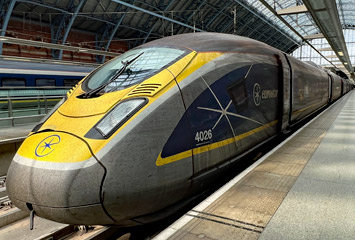
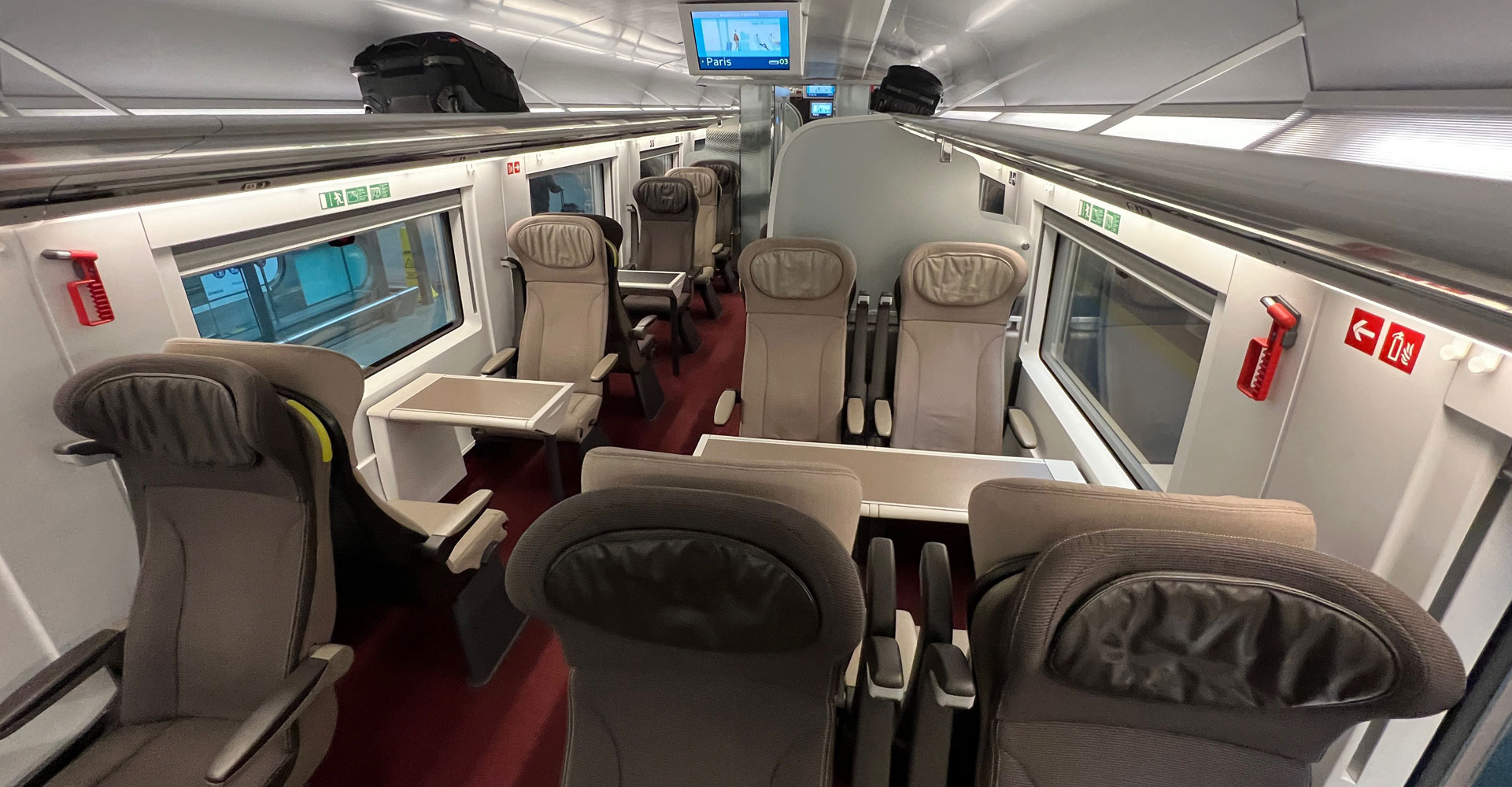
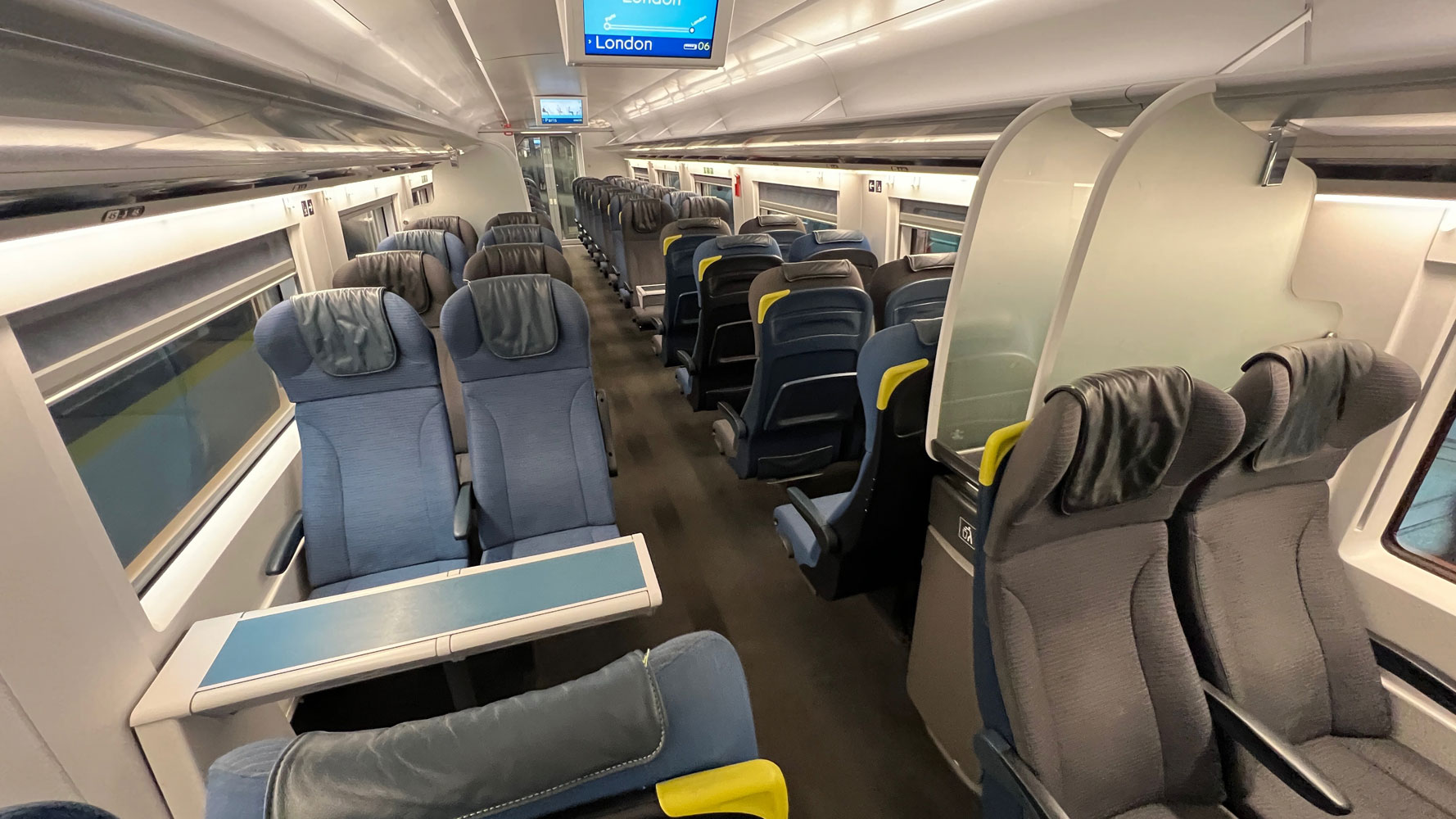
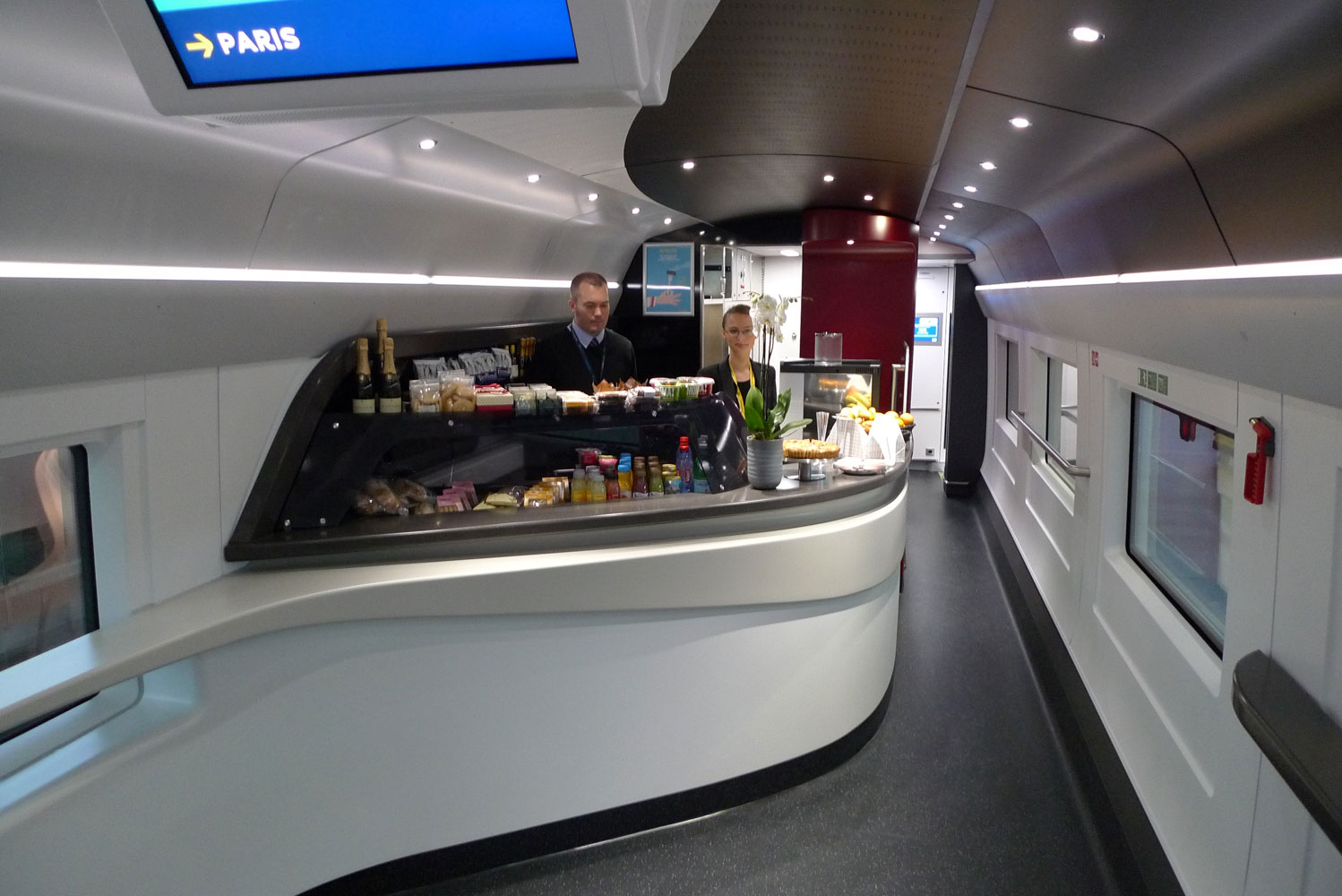
Eurostar is the high-speed passenger train from London's St Pancras to Paris & Brussels through the Channel Tunnel. Most journeys from the UK to Europe start with Eurostar. All 1st class fares include complimentary drinks and a meal, and all passengers have access to a bar car serving drinks and snacks. Remember that you need to check-in for Eurostar trains at least 30 minutes before departure (15 minutes for passengers with certain types of premium 1st class ticket) to allow for an airline-style security check. Eurostar does not run on Christmas Day.
-
Eurostar information page: Times, fares, tickets, luggage & info about the Eurostar journey
-
Eurostar website: www.eurostar.com
Changing trains in Paris
-
Train journeys from the UK into Europe often involve a change of train and station in Paris. Eurostar arrives at the Gare du Nord, which is an easy 7-minute 500m walk from the Gare de l'Est but a metro, bus or taxi ride from the other Paris stations including the Gare de Lyon.
The Paris metro website is www.ratp.fr.
See the Changing stations in Paris page for advice on metro/RER, bus and taxi travel, and a route guide.
-
If you want to spend some time in Paris, by all means take an earlier Eurostar on the outward journey or a later one on your return. There are left luggage lockers at several Paris rail stations if you need to leave your luggage somewhere.
-
You can avoid the hassle of crossing Paris when travelling to many French destinations, by changing at Lille, see the London to France page.
Changing trains in Brussels
-
Bruxelles Midi in French, Brussel Zuid in Flemish, Brussels South Stn in English, it's all the same place. It's Brussels' main hub station, and it includes the Eurostar terminal. All long-distance trains use Brussels Midi station, including trains to Amsterdam, Cologne, Paris and all other destinations in Belgium, so changing trains is easy and only takes a few minutes.
-
See the Brussels Midi station guide for more about changing in Brussels.
The ferry alternatives
-
Most people start their journey by Eurostar, but there are ferry alternatives worth considering, especially to Amsterdam or Spain. If you prefer ferry travel, simply substitute the rail-sea-rail times shown on the London to Paris by train+ferry page or London to Amsterdam by train+ferry page for the Eurostar times shown on this site. In fact, I usually include a ferry alternative option on most pages covering travel from the UK to other European countries.
London to Paris by train & ferry
-
You can still travel from London to Paris by train + ferry if you like. It takes far longer that Eurostar, is much less convenient and usually costs more, but you avoid the Channel Tunnel if that's an issue for you and it can sometimes be cheaper if you have to travel at short notice and all the cheap Eurostar tickets have sold out. For more information, see the London to Paris by train + ferry page.
-
London to Paris 'sleeper' option via Portsmouth-Caen: There's an overnight train-ferry-train option where you can leave London Waterloo around 18:00, sleep in a comfortable cabin with shower & toilet 22:45-06:45 on Brittany Ferries' overnight sailing from Portsmouth to Caen, then take a train from Caen to Paris St Lazare arriving around 11:05. This is a good option if you need an alternative to Eurostar or live on the South Coast. See schedules, fares & info for London & Portsmouth to Paris by overnight train & ferry.
London to Amsterdam by train & ferry
-
There is an excellent, convenient inexpensive train+ferry service from London to Amsterdam & the Netherlands, see the London to Amsterdam Stena Line Rail & Sail page. Travelling from central London to central Amsterdam overnight with a bed in a comfortable private cabin on board the ship with shower, toilet, free WiFi & satellite TV can be more time-effective than Eurostar or even a flight.
Hull or Newcastle to Holland by overnight ferry
-
If you live in the north of England or Scotland, there's a comfortable overnight ferry from Newcastle or Hull to Holland which can be easier than taking a train to London then Eurostar:
DFDS (www.dfds.com) sail overnight from Newcastle to IJmuiden near Amsterdam, see the Newcastle-Amsterdam page.
P&O Ferries sail overnight from Hull to Rotterdam Europoort, see the Hull-Rotterdam page.
Portsmouth or Plymouth to Spain by ferry
-
Brittany Ferries operate excellent cruise ferries all year round from Portsmouth & Plymouth to Spain, a stress-free and highly-recommended way to get there. See the UK to Spain by ferry page.
Other useful ferry routes
-
West Country or South Coast to mainland Europe by ferry: If you live in the West Country or along the South Coast, you may prefer taking a ferry direct to France, then a train to Paris. More information.
-
UK to Scandinavia by ferry: Unfortunately, the last passenger ferry from the UK to Norway was withdrawn in September 2008, the last ferry from the UK to Sweden in 2006 and the last ferry to Denmark in September 2014. There are now no ferries to anywhere in Scandinavia, you need to go by train via Brussels and Copenhagen, or by ferry to Hoek van Holland then train via Copenhagen.
Should you travel 1st or 2nd class?
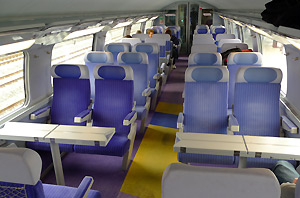 2nd class seats, arranged 2+2 across the car width. This is a TGV Duplex. |
|
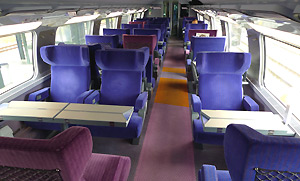 1st class seats on the same TGV Duplex, arranged 2+1 across the car width. Fewer seats per car, more leg & elbow room. Tables for 2 as well as tables for 4. That's it. |
-
2nd class is absolutely fine for most travellers. There's no need to pay for 1st class to travel in comfort these days. So if you're on a budget, don't bother with 1st class unless the cost of the upgrade is so cheap it'd be silly not to (which it sometimes can be!).
-
For most of us, 2nd class is the norm unless the Company is paying. If you're visiting Europe from overseas, rest assured that there are very few peasants and chickens in 2nd class these days.
What more do you get in 1st class?
-
First class gets you wider seats, plusher seats, more leg and elbow room, and fewer passengers per coach
-
Luggage room is the same, perhaps with fewer passengers per coach using it, but this is not a sensible reason for paying a 1st class fare as there's always room for luggage in any class.
-
On a few premier trains including Eurostar, Spanish AVE trains & Lyria, some 1st class fares include an at-seat service of food & drink, but these are the exceptions. Unless you're told otherwise, you should assume that a 1st class ticket simply gets you a nicer seat with more leg and elbow room, surrounded by more business travellers with laptops and fewer families with kids.
On German ICEs and Austrian railjets, food & drink is not included but in 1st class a steward will take orders and serve you at your seat, in 2nd class you have to go to the restaurant car.
-
Tables for two & solo seats: First class cars usually have seats arranged 2+1 across the width of the car (two seats abreast, aisle, then a solo seat), with wider seats and more elbow room than the 2+2 seating in 2nd class. So in a typical first class car you'll find face-to-face tables for two and solo seats as well as tables for four - if you're a couple, a key advantage of 1st class is being able to face each other across an intimate table, both of you getting a seat that's both window and aisle. As is booking a solo seat when travelling alone, a seat that's both aisle and window, so you aren't sitting next to anyone else.
-
Train seat maps: Click here for train seat maps
1st class can be an affordable treat
-
Don't decide until you see the price! Most train operators have airline-style dynamic pricing, you might find 2nd class costs €49.99 and 1st class only €59.99 because of the way the price buckets work in each class. In which case you'd be crazy not to pay €10 to upgrade!
On sleeper trains, class is irrelevant
-
On sleeper trains, whether you have a 1st or 2nd class ticket is almost irrelevant, as your comfort depends on the type of sleeping accommodation you pay for: Seat, couchette, or sleeper. A 2nd class couchette is more comfortable (and more secure) than a 1st class seat. A 2nd class sleeper is more comfortable than a 1st class couchette (where such things exist). In fact, on most routes only a 2nd class ticket is now needed for a 2-bed sleeper. On nightjet sleeper trains, for example, all accommodation is now technically 2nd class, even deluxe sleepers with shower. The options for travelling on overnight trains are explained here.
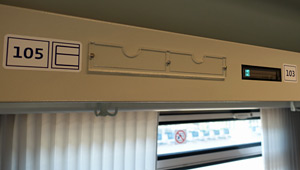 Which seats are reserved and which free? On trains with optional reservation, there will either be a small electronic display or a slot for paper reservation labels above each seat. The photo above is unusual, this Berlin-Prague train has both! |
Should you make a seat reservation?
-
Local, suburban & regional trains in most countries don't have seat reservations. You just get on and sit where you like. Think London Underground or New York Subway!
-
Long-distance trains in France, Italy, Spain, Portugal, Sweden & Poland are usually all-reserved and every ticket comes with a seat reservation included, free of charge.
The same goes for international trains to, from or between these countries including Eurostar, TGV-Lyria, Paris-Barcelona TGVs, Paris-Milan TGVs, Paris-Milan Frecciarossas and Paris-Germany TGV/ICE trains.
Such trains often don't have any displays showing which seats are reserved and which free because it's assumed that all passengers have a reserved seat.
-
Long-distance trains in Germany, Austria, Switzerland, Denmark & much of central Europe are usually reservation optional. You can travel without a reservation (but you may have to stand at busy times) or you can pay a small fee to reserve a seat. If you don't have a reservation you sit in any empty unreserved seat - an electronic display above each seat (or on older trains, a printed slip in a slot) show which seats are reserved.
As a solo traveller on a short trip mid-week in February, I might not bother making a reservation, especially if I'm boarding where the train starts so will have my pick of empty seats. But for a long journey or on a busy Friday or Sunday afternoon or travelling with your family or in a small group, I strongly recommend making a reservation to be sure of a seat. You're usually offered the option of adding a seat reservation when buying a ticket, if you fail to add one you can usually make a separate seat reservation only booking later, the German, Austrian & Czech railway websites can do that, but not all.
-
Sitting together: Seat selection from a seat map is still relatively rare for trains, but rail ticketing systems always book people together by default. Unlike some airlines, they will not spread your family randomly all over the train!
Forward-facing seats
-
I know from experience that American visitors in particular (if you'll forgive me for saying so) all think they'll get motion sick if they can't face forwards. Europeans less so, as we're used to trains with half the seats facing one way, half the other, and we know that it's no big deal as trains run smoothly on rails - think cruise liner restaurant, where half the diners are going backwards at 18 knots without noticing!
-
On many European trains you can't specify which way your seat faces. The reservation system knows the carriage seat layout, but it can't predict which way round that carriage will enter service that day. On some routes the train changes direction, for example between Rome and Venice, seats which are backward-facing from Rome to Florence will be forward-facing from Florence to Venice as the train changes direction at Florence SMN which is a dead-end terminus. Similarly, trains between Zurich and Innsbruck, Salzburg & Vienna change direction at Buchs.
-
There are some cases where a forward-facing seat can be requested. Some operators including Eurostar keep their trains a particular way round, for example on Eurostar car 1 is always at the London end, car 16 at the Paris end. You can sometimes select your seat from a seat map when you book such trains direct with the relevant operator and the direction of travel may be shown on the seat map.
In the UK, we have traditionally had a simple low-tech system: Two seats facing each other have the same number, say 15, the one facing is 15F and the one going backwards is 15B.
-
Remember that on trains where reservation is optional (domestic trains in Benelux countries, Germany, Austria, Switzerland, Denmark, and much of Eastern Europe) you can sit where you like, and if you find your reserved seats not to your liking just sit elsewhere. However, in France, Italy, Spain, Portugal, Sweden, all long-distance trains are all-reserved so you have to stick with your reserved seats.
-
My favourite arrangement in first class on most European trains is a face-to-face table for two. You both get a window seat that's also an aisle seat and one seat is always facing forwards. My wife usually gets that! It also means you get the full length of a window to look out of, not half a window.
Which side of the train?
-
On some routes the best scenery is on a particular side of the train, for example the left hand side going south along the Rhine Valley from Cologne to Mainz, or the right hand side from Switzerland into Austria through the Arlberg Pass, or the right-hand side going along the French coast from Marseille to Nice. I try and mention which side to sit on the relevant pages of this site, where it matters.
-
However, many reservation systems won't let you choose which side of the train to sit as the train or carriage could enter service either way round. Only in some cases is direction of travel shown. On trains where reservation is optional (domestic trains in Benelux countries, Germany, Austria, Switzerland, Denmark, much of central Europe) you can sit where you like so can move if your reserved seat is on the 'wrong' side.
First class lounges at stations
 |
|
|
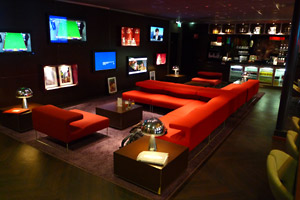
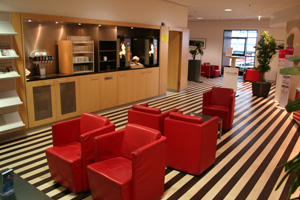
A typical first class lounge. Above, the NS International 1st class lounge at Amsterdam Centraal, open to anyone with a valid 1st class international ticket or pass, with complimentary tea, coffee, soft drinks, wine & beer. |
|
 |
|
|
The DB Lounge at Munich Hbf, for anyone with a 1st class Flexpreis ticket, but not railpasses or Sparpreis fares. There are similar lounges at other major stations in Germany. |
There are first class lounges at some major stations, typically with complimentary tea, coffee, soft drinks, plus WiFi & charging points. Sometimes the lounge is for anyone with a first class ticket (which may or may not include first class Eurail or Interrail passes), in other cases the lounge is only for holders of the most expensive business-orientated tickets or holders of that train operator's frequent traveller card. Here's a quick guide:
-
Eurostar business lounges at London St Pancras, Paris Nord & Brussels Midi
Eurostar has a business lounge opening off the departures hall after check-in & security at London St Pancras, Paris Nord & Brussels Midi with complimentary tea, coffee, soft drinks, wine & spirits, beer and snacks. The lounge has toilets, free WiFi and charging points. The London and Paris lounges even have a free cocktail bar, open afternoon until evening.
You can use the business lounge if you're travelling in Premier class or have Eurostar's top-tier Carte Blanche loyalty card. You can't use it with a Plus class ticket or a 1st class railpass.
-
Paris & France
Anyone travelling 1st class (Première or Première Signature) on TGV-Lyria trains from Paris to Switzerland can use the SNCF Salon Grand Voyageur at Paris Gare de Lyon with free WiFi, hot drinks and water.
Apart from this, the Salon Grand Voyageur is only open to travellers with SNCF loyalty cards or the most expensive full-price 1st class Business Première tickets. You can use it with any 1st class ticket if you have a Eurostar Carte Blanche loyalty card.
All the other major Paris termini and many big city stations across France have an SNCF Grand Voyageur lounge with free WiFi, hot drinks and water, but these are only for passengers with SNCF loyalty cards or the most expensive full-price 1st class Business Premier tickets. You can use them with any 1st class ticket if you have a Eurostar Carte Blanche loyalty card.
-
Brussels & Belgium
Eurostar (formerly Thalys) has its own lounge at Brussels Midi, only for Eurostar (formerly Thalys) passengers with Premier class tickets. Not open to holders of Plus class tickets or railpass holders.
Apart from this there is no first class lounge at Brussels Midi, but I consider the bar at the Pullman Hotel to be the best VIP waiting room for the price of a beer.
-
Amsterdam & the Netherlands
There is an NS International Lounge at Amsterdam Centraal at the western end of platform 2 and there's a similar lounge at Rotterdam Centraal. You can use these lounges with any type of 1st class international ticket including 1st class Eurail & Interrail passes and Eurostar Plus & Premier fares.
Follow the signs for NS International Lounge, check www.nsinternational.com for opening times. Tea, coffee, soft drinks and snacks available.
-
Switzerland
Unfortunately, SBB closed their first class lounges at Zurich & Geneva in 2016, citing lack of use.
-
Italy
Trenitalia has Freccialounges at major city stations. These are only for holders of the most expensive Executive class tickets, tickets for a seat in a Salottino, or who have Trenitalia's own frequent-traveller loyalty card. However, you can often pay to add Freccialounge access with other ticket types if you book direct with Trenitalia.com.
Competitor Italo also has lounges at major city stations, branded Club Italo. These are only for holders of the most expensive Club class tickets or who have Italo's own frequent-traveller loyalty card. However, you may be offered lounge access for a fee when buying other ticket types direct from Italo at www.italotreno.it.
-
Spain
There is a Renfe Sala Club lounge at Madrid Atocha, Madrid Chamartin, Barcelona Sants, Malaga Maria Zambrano, Seville Santa Justa, Valencia Joaquin Sorolla, Alicante, Girona, Zaragoza Delicias, Valladolid and several other stations.
The Sala Club is open to anyone who has paid the Premium fare (or made a Premium reservation with a 1st class railpass). Typically open from 06:00 to 22:00 every day. You can use them from 2 hours before your train leaves until departure.
Tea, coffee, soft drinks, beer and snacks available. For details search www.renfe.com.
-
Germany
There are DB Lounges at major stations, but only for holders of the most expensive 1st class DB Flexpreis tickets. You cannot use the lounges if you have a 1st class Sparpreis or Super Sparpreis ticket or Eurail or Interrail pass.
They don't admit holders of tickets for regional trains or trains operated without DB involvement such as Eurostar (formerly Thalys), Nightjet, European Sleeper, Westbahn or the Munich-Prague trains.
However, if you have a Eurostar Carte Blanche loyalty card you can use a DB Lounge with any ticket (once staff have looked this up!).
There are lounges at Berlin Hbf, Bremen, Dresden, Düsseldorf, Frankfurt am Main Hbf, Frankfurt Flughafen, Hamburg Hbf, Hanover, Cologne Hbf, Leipzig, Mannheim, Munich Hbf, Nuremberg, Stuttgart.
Typically open 07:00-21:00 daily, follow signs for DB Lounge, search int.bahn.de for opening times.
-
Austria
There are ÖBB Lounges at Vienna Hauptbahnhof, Vienna Meidling, Linz, Salzburg, Innsbruck, Graz & Klagenfurt.
These Austrian lounges are really useful because you can use them for up to 90 minutes before or after your journey with almost any type of 1st class ticket or with a ticket for any type of sleeper for Nightjet or EuroNight trains and with a 1st class Eurail or Interrail pass.
There's one exception: You can use the lounge with a 1st class DB Sparpreis or Flexpreis fare, but not with a Super Sparpreis fare.
Typically open 06:00-21:00, for details see www.oebb.at & search for ÖBB Lounge. Tea, coffee, soft drinks, snacks & free WiFi.
-
Budapest & Hungary
Budapest Keleti has an excellent premium lounge on platform 9, open 06:00-21:30 daily. This lounge is really useful as it can be used by anyone with a 1st class international ticket to, from or via Budapest, or a single or double sleeper ticket, or a 1st class Eurail or Interrail pass with a reservation for a train that day. Unfortunately, there's no lounge at Budapest Deli or Budapest Nyugati.
-
Prague & the Czech Republic
CD (Czech Railways) has a lounge at Prague Hlavni with newspapers and free WiFi, the main section is also open to 2nd class passengers with tickets for the higher categories of train such as EuroCity and SuperCity and there's a separate 1st class section. Although the excellent Fantova Kavárna or Foyer Cafe upstairs in the historic station hall may make a better VIP waiting lounge for the price of a cup of coffee!
-
Poland
PKP Intercity used to have poorly-advertised lounges at Warsaw Centralna & Krakow Glowny, but closed them in 2014 due to lack of users.
-
Copenhagen & Denmark
DSB Danish Railways have DSB1 lounges for first class passengers at Copenhagen, Aarhus and Odense. Open Monday-Friday only. Passengers with 1st class tickets for SJ trains to Stockholm or Intercity trains to Germany can also use it. For details search www.dsb.dk and use Google Translate.
-
Stockholm & Sweden
SJ have a first class lounge at both Stockholm Central & Gothenburg Central open to all first class ticket holders and 1st class Interrail/Eurail passholders. For opening hours and further details see www.sj.se.
Overnight trains
|
|
|
||
|
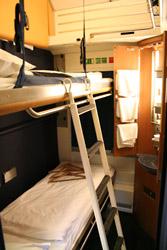
2-berth sleeper: A typical 2-berth sleeper, berths made up. |
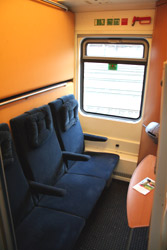
The same sleeper, converted to a sitting room for evening/morning use. |
||
|
|
|
||
|
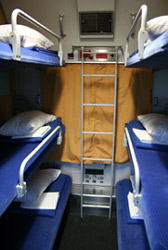
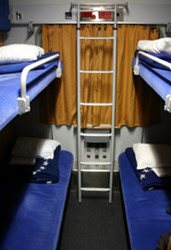
Couchettes, 6-berth, with the bunks folded out. |
Couchettes, 4-berth: Much more room! |
-
Sleeper trains are a time-effective way to travel. Huge distances can be covered while you sleep, using less daytime time than flying and saving a hotel bill, too.
-
Forget about first and second class on sleeper trains, such terms are misleading. The real classes are seat, couchette and sleeper. In fact, all accommodation on nightjet sleeper trains is technically 2nd class, even a deluxe single-bed sleeper with shower. Although some operators still require a 1st class ticket for a single-bed sleeper.
-
Incidentally, trains don't have sterns or bows or port or starboard as they are not a ship. They also don't have cabins, the correct term has always been compartment.
-
How are sleepers & couchettes numbered? This answers the typical worry We have berths 21 & 25, are we in the same 2-berth compartment? Yes, you are!
In a sleeping-car
-
A sleeping-car is the equivalent of a hotel: A cosy bedroom, with comfortable beds, washbasin, and room service. Sleepers come in 1, 2 & 3 berth varieties, depending on the route, whether you have a 1st or 2nd class ticket, and the price you want to pay. For evening/morning use, the beds fold away to reveal a sofa.
-
If you are travelling alone and don't want to pay for a 1st class single room, you can normally book just one berth in a 2 or 3-berth room and share with other passengers of the same gender. However, this is not possible in Italian, Norwegian or Finnish domestic sleepers, for example.
-
In addition to the normal lock, sleeper compartments have a security lock which cannot be opened from outside even with a staff key, so you'll be both safe and snug. The most modern sleepers now have CCTV in the corridor, too.
-
On most sleeper train routes there are inclusive fares covering travel, sleeper & breakfast. If you have an Interrail or Eurail pass, you can look up the additional cost of a sleeper on the Interrail & Eurail reservations page.
-
For more detailed information about what to expect when travelling by sleeper, see the Travelling by Sleeping-car or Couchette page or the pages on specific sleeper trains including:
- French domestic sleeper trains
- Italian domestic sleeper trains
- Nightjet sleeper trains linking Germany, Austria, Italy, Switzerland, Belgium, Netherlands.
- Berlin/Hamburg to Stockholm sleeper train
- Brussels/Amsterdam to Berlin/Prague by European Sleeper
In couchettes
-
A couchette is rail's answer to a youth hostel: Economical but comfortable, an ordinary seating compartment for 4 or 6 people by day, with fold-out padded bunks for 4 or 6 people by night, each with sheet, rug & pillow which you arrange yourself. Male and female passengers normally share the same compartment (although there are 'ladies only' compartments on most routes), and apart from removing shoes & jackets, passengers don't normally fully undress.
-
A berth in a 6-berth couchette compartment might cost around €30-€40 per berth per night, in addition to a 2nd class ticket or railpass. A berth in a less-crowded 4-berth couchette compartment costs around €40-€50 per berth per night, in addition to a 2nd class ticket or railpass.
-
In addition to a normal lock, couchette compartments have a security lock, bolt or chain which cannot be opened from outside, even with a staff key, so you'll be quite safe.
-
1st class couchettes (4 berths per compartment) are rare, they only really exist in on French domestic overnight trains.
-
For more detailed information about what to expect when travelling in a couchette, see the Travelling by Sleeping-car or Couchette page or the pages on specific overnight trains including:
- French domestic sleeper trains
- Italian domestic sleeper trains
- Nightjet sleeper trains linking Germany, Austria, Italy, Switzerland, Belgium, Netherlands.
- Berlin/Hamburg to Stockholm sleeper train
- Brussels/Amsterdam to Berlin/Prague by European Sleeper
In a seat
-
It's the cheapest option, but travelling overnight in an ordinary seat is a false economy. It's not recommended however tight your budget, either for comfort or security, unless there's no alternative. There's no lock on the compartment door, and no staff on duty. Think of it as the equivalent (almost!) of sleeping in a shop doorway. Always budget for at least the couchette supplement for a comfortable night.
|
|
|
|
|
2-berth sleeper: A typical 2-berth sleeper, berths made up. |
The same sleeper, converted to a sitting room for evening/morning use. |
|
|
|
|
|
|
Couchettes, 6-berth, with the bunks folded out. |
Couchettes, 4-berth: Much more room per passenger! |
How early to be at the station?
 |
|
|
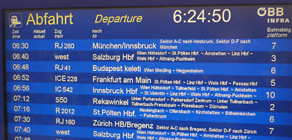
It's easy to find your train. Just look at the departure boards or TV screens showing time, train number, destination & platform. If you can find your flight at an airport, you can find your train at a station. |
|
 |
|
|
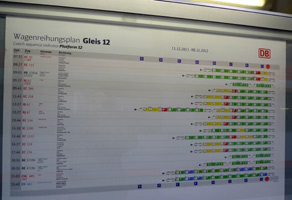
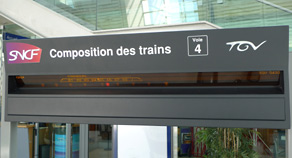
Train formation display, showing where along the platform each car of a train will stop. This saves you running up and down looking for your car. You can be waiting in the right place when your train comes in! Above is a printed German version. Below is an electronic French railways version.
|
-
Do you need to check in for a train?
Generally speaking, no. You simply walk off the street into the station, glance at the departure boards, walk to the relevant platform, press the door-open button and step onto the train.
To spell it out, if a train is due to leave at 12:00, the doors might close at 11:59, and off it goes at 12:00. If you are on board at 11:59, you go with it. If you're not, you get left behind. It's as simple as that.
-
At most European railway stations there's no physical barrier between the street outside, the station concourse, the platforms and the train. Tickets are checked on board the train during the journey, not at the station. So even if you weren't catching a train and didn't have a ticket, you could wander into the station, walk up to the train and peer in through the windows!
-
There are exceptions, of course. Major Italian stations have a simple manual ticket check or automatic ticket gates between concourse and platform circulating area. In France major stations now have automatic ticket gates when boarding long-distance trains, scan the QR code on your ticket and they open, they're work until 2 minutes before departure. But it's still nothing like air travel.
In Spain, there's a brief luggage X-ray check and a manual ticket check before boarding AVE, Euromed, Alvia and other high-speed trains at stations on the high-speed network. This may all take only a few minutes, but don't arrive 30 seconds before your train leaves!
-
Obviously, this doesn't mean you should cut it fine. It's best allow plenty of time to get to the station and find your train. It may leave from a remote platform a minute or two's walk from the main concourse, for example.
-
Don't expect a train to be ready for boarding hours before it leaves. Even at the station where a train starts, the platform number might be posted only 20 minutes before departure - or for a local train, perhaps just 10 minutes before. So don't panic if the platform isn't shown hours before it leaves, just wait until it comes up on the departure boards. This is perfectly normal.
Train composition displays
-
On each platform at major stations you'll often find an electronic display or printed poster labelled Composition des trains (French), Wagenreihungsplan or Wagenstandsanzeiger (German). It shows the formation of each train using that platform and where along the platform each car number will stop. Or the platform departure screens may show the train formation under the list of calling points.
-
This might show (for example) that cars 1 & 2 will stop in sector A, cars 3 & 4 in sector B. The sectors are marked by signs along the platform length. If you are reserved in a specific car, go and wait in the correct sector, this will save you running up and down the platform like a headless chicken when the train comes in!
Is there passport control before boarding?
-
Passport control on international trains usually takes place at the border on board the train. If there is any passport control, of course, as most western European countries are now in the Schengen zone with no border controls at all - unless they choose to do spot checks. But if it's done at all, it's done at the border during the journey, not before you board or on arrival.
-
The major exception is Eurostar linking London with Paris, Lille, Brussels & Amsterdam. Eurostar has a minimum 30 minute check-in so that passports and X-ray security checks can take place before boarding. When you arrive at your destination, you walk off the platform into the station with no further checks. For more about Eurostar check-in, see the Eurostar page.
How long to allow for connections?
-
I spend half my time reassuring people that a 10 minute connection into a frequent local train is fine, the other half telling people to allow an hour or two between a 700-mile sleeper train and an onward 500-mile daytime train on their epic trip across Europe, especially where you have separate tickets for each train so missing the onward train potentially means buying a new ticket (more about that here).
So here I've attempted the impossible, combining seemingly-contradictory advice into one coherent section for newbie travellers covering all eventualities. Just remember I said attempted! Here it is, Train Connections 101.
It takes just minutes to change trains
-
It physically takes just 1 minute to step off a train, cross the platform and step onto another train. Or perhaps 2 minutes 30 seconds to step off one train, go down the steps/escalator into the station underpass, walk a few metres across to another platform, go up onto that platform and step onto your next train. You can walk from platform 1 to platform 20 at virtually any of Europe's major city stations in just 3 minutes. There's no check-in and no physical barriers. Switching trains is usually quick and easy, it's not like changing planes.
-
The real issue is not whether it takes you 2 minutes 36 seconds or 3 minutes 17 seconds to walk between trains. The real issue is risk management. How likely is the first train to be late? What are the consequences if you miss that connection?
-
The chances of a European high-speed train being significantly late are relatively small. 90% of all Eurostars arrive on time or within 15 minutes, and typically 75%-90% of European high-speed trains run on time or within 15 minutes, better than competing airlines. On the other hand, sleeper trains can easily run an hour late, as can any train in the Balkans, so here you need to allow more time.
If your onward train is a local one
-
If you miss an onward local train, or a domestic train in Switzerland, Belgium or the Netherlands, you simply hop on the next one. No reservation is necessary and tickets are normally valid on any departure. So allowing a few minutes for a connection is fine. If you make it, great, if you don't, you take the next one.
Example: You're reserved on a high-speed Eurostar (formerly Thalys) train from Paris to Brussels and have 10 minutes to change onto a domestic InterCity train to Bruges. Is this enough? Yes, because if you miss the train to Bruges, there's another one 30 minutes later, no reservation needed and your Brussels-Bruges ticket is good for any train.
The same advice applies to catching a TGV-Lyria from Paris to Basel and changing onto a Swiss domestic train to Interlaken or Lucerne. Or catching an all-reserved high-speed train from Rome to Florence and changing onto a regional train to Siena or Pisa.
If your onward train is all-reserved
-
If you're connecting into an all-reserved train with an advance-purchase ticket that's only good for that specified train, you don't really want to miss it. In this case I'd allow more time, perhaps half an hour.
Example: You're travelling from Bruges to Paris via Brussels and you've a reserved seat on a Eurostar (formerly Thalys) train from Brussels to Paris, your ticket is only valid on this specific departure. An InterCity train from Bruges arrives in Brussels 10 minutes before the Eurostar leaves, and this ticket is good for any departure that day. Is 10 minutes enough? Yes if the InterCity is on time, but not if it's 10 minutes late. I'd catch the previous train leaving Bruges 30 minutes earlier, giving you 40 minutes in Brussels to have a coffee and a stress-free connection.
The same advice applies to catching a Swiss domestic train from Lucerne or Interlaken to Basel to connect with an all-reserved TGV-Lyria to Paris. Or taking a local train from Pisa or Siena to Florence to connect with an all-reserved high-speed train to Rome.
If your onward train is a sleeper
-
If you're connecting with a sleeper train that you cannot afford to miss, I'd allow an hour or two between trains. Have a coffee, beer or meal!
For example, suppose you're taking Eurostar to Brussels to connect with the sleeper to Vienna or Prague. Online journey planners suggest interchange times as short as 15 minutes. Is this enough? No way! You don't want to miss the sleeper because of a 15 minute delay to the Eurostar, I'd allow far more time, say 60-90 minutes at least, and have an early dinner in Brussels.
-
In fact, in this particular example there's another issue: Those sleepers from Brussels are occasionally retimed due to trackwork to leave an hour earlier, at 18:xx instead of 19:xx, you might get an email telling you this only a few weeks before departure. That is why I recommend booking the 13:01 Eurostar from London not the 15:04, and allowing 3 hours not 1 hour in Brussels!
If connecting out of a sleeper
-
To be on the safe side, I'd allow for a long-distance overnight sleeper train to arrive at least an hour late. In the Balkans I'd expect the Istanbul to Bucharest train to be at least an hour late, possibly 2. Allow for this when planning onward connections.
Example You're catching the Amsterdam-Munich sleeper train, due to arrive in Munich at 07:10. There are onward connections to Salzburg at 07:25 and 09:30, both with cheap fares available which are only valid on whichever specific train you choose. Online systems and the European Rail Timetable suggest the 07:25. But is this a safe connection? No, it isn't. Even this excellent sleeper train can arrive 20, 40 or 60 minutes late, so I'd recommend booking the 09:30 and having breakfast in Munich.
However, there are exceptions to this advice. You can buy a through ticket from Amsterdam to Salzburg covering this sleeper to Munich and the tight connection with the 07:25 to Salzburg all on one ticket. In this case I might go with it, because with a through ticket you're definitely covered by CIV international conditions of carriage and will be able to take a later train if there's a delay and you miss the 07:25. Which you will, on a significant proportion of occasions. But in this case it would be no big deal.
When making major journeys across Europe
-
When making a major long-distance journey right across Europe, I'd suggest allowing 1-2 hours between trains at major interchange hubs such as Paris, Zurich, Munich or Berlin. Think of such a well-padded connection as a 'firebreak'. Have a coffee, beer or meal!
For example, suppose you used bahn.de to plan a journey from London to Istanbul. It might come up with a 20-minute connection in Paris, an 8-minute connection in Munich, 15 minutes in Budapest and 20 minutes in Bucharest. Is this realistic?
No it isn't! The computer is allowing the same minimum time between trains it would allow for any trivial short journey, it is not factoring in any allowance for delay as a savvy traveller should. In this case, I'd allow 2 or even 3-hour 'firebreaks' between trains at each major city, so that any delay on one sector can be recovered and does not impact the rest of the trip.
Through ticket or separate tickets?
-
The consequences of a missed connection are smaller if you have a through ticket for the whole journey than if you have two separate tickets.
If you have a through ticket you're covered by the CIV international conditions of carriage. If you miss a connection due to a train delay, you're legally entitled to be rebooked on a later onward train at no extra charge. So even a tight connection might be fine in this case.
If you have two separate tickets, you're not covered by CIV where you change trains and in theory a missed connection could mean having to buy a new onward ticket at an expensive on-the-day price. However, there are two agreements that may still mean you'll be rebooked on a later onward train at no extra charge, the Agreement on Journey Continuation (AJC) and Railteam HOTNAT.
You'll find an explanation of CIV, AJC and Railteam HOTNAT in the When things go wrong section.
Example: You're booking an inter-city journey across Germany on the German Railways website bahn.de from Amsterdam to Heidelberg. You're seeing an excellent €49.99 fare, but this includes an 8-minute change of trains at a station en route. Is it safe to book this? Yes, it wouldn't sell a ticket if the connection wasn't reasonable, and you're buying a through ticket so if there's a delay and you miss this connection, you're entitled to take a later onward train as explained below. True, that 8-minute connection is quite likely to be broken if there's a 10-minute delay, but if that happens you're covered! You could of course change Transfer time to 30 minutes and re-run the enquiry to get a more relaxed journey!
-
Incidentally, don't assume you have a through ticket just because you booked the journey as one transaction at websites such as www.raileurope.com or www.thetrainline.com. For example, if you book from Nice to Milan, those websites will give you a Nice to Ventimiglia ticket sourced from SNCF's system and a Ventimiglia to Milan ticket sourced from the Trenitalia system. One seamless transaction, but two separate tickets with no CIV protection if the connection in Ventimiglia is missed. In this case, through tickets don't exist for this journey.
Recommended connection times when changing stations in Paris
-
The recommended times to allow for connections involving a change of trains and stations in Paris, for example between Eurostar from London and an onward train from Paris, are shown on the How to cross Paris by metro or taxi page.
Travel tips
-
When booking or planning a journey at the German Railways website int.bahn.de, you can change the default transfer time from normal to longer, up to 45 minutes.
What happens if you miss a connection?
-
All is not lost! You may well be entitled to be re-booked on a later train, even with a non-changeable ticket. All is explained in the When things go wrong section below.
If things go wrong...
 Oops... |
-
High-speed trains in western Europe often achieve 80%-85% on time or within 15 minutes, when short-haul airlines struggle to reach 70%-75%. Over the years I've travelled back from Croatia to London by train whilst volcanic ash grounded all flights for a week, I've taken the ferry to the Netherlands for Christmas spot on time with our in-cabin TV showing endless news about Heathrow's closure due to snow, I have travelled to Seville in Spain by train and got there ahead of airline passengers who found Heathrow closed for several days due to fog. But of course, things do occasionally go wrong...
Here's what you should know
-
Plan realistic connections to start with.
Changing trains only takes a minute or two to, but you need to (1) allow for delays to the first train, and (2) consider the consequences of missing the onward train. I explain how long to allow for connections above.
-
Be aware of your rights if connections are missed.
With a through ticket the international conditions of carriage (CIV) give you a cast-iron legal entitlement to travel on by later trains if a delay means a missed connection, so tight connections aren't necessarily a problem.
However, through tickets no longer exist for many journeys and you'll often have separate tickets for each train. Unfortunately, CIV protection only applies to connections within each ticket, not between tickets.
The good news is that rail staff will usually help you out if there's a delay, as connections between separate tickets and different operators are often covered by the Agreement for Journey Continuation (AJC) or RailTeam/HOTNAT, which I explain below.
So if you miss a connection, don't rush to buy new onward tickets, ask staff first, they will usually help you out and rebook you on a later onward train under the AJC or in some cases HOTNAT. If you fork out money on your own initiative it's difficult to get it back afterwards.
-
Take out travel insurance, but don't expect it pay for missed connections.
Many rail tickets are non-refundable. If you or a close relative falls ill and you have to cancel your trip, you'll usually be able to claim the lost money through your travel insurance. However, few if any travel insurers understand multi-leg overland travel, so don't expect them to cover missed connections. Some insurers have a strange clause that only covers problems with the first direct leg from the UK, meaning you're only covered for delays or cancellations as far as Paris or Brussels. I have yet to find an insurer who offers overland travel insurance which covers the knock-on effects of major delays, strikes or cancellations to any part of your route. There's a gap in the market here!
If you miss a connection
-
If you miss a connection, don't panic! And don't rush out and buy new tickets.
-
Step 1, get your ticket endorsed by staff on the delayed train or at the interchange station.
If you are on a delayed Eurostar and realise you're going to miss an onward connection, Eurostar train managers carry a HOTNAT / CIV stamp and will endorse your ticket. They may walk through the train helping people with connections, or may announce that they are available in a particular car. Similarly, staff on other European trains can usually endorse or stamp your ticket if their train is delayed.
Tip: If crossing Paris by metro, buy a metro ticket on your phone to save vital minutes, you might still make your connection.
If you arrive at an interchange station and find you have missed your connection, ask station staff to stamp or endorse your ticket. Look for the information desk as this can be quicker than queuing at the ticket office. If you miss a connection in Brussels, go to the SNCB international ticket office, do not ask Eurostar staff, see the advice here.
-
Step 2, approach staff of the operator of the onward train either at the station information desk or see the train manager of the next onward train once it is platformed. Explain the situation politely, show your tickets and ask for help.
It's helpful to know your rights under the international conditions of carriage or CIV and its limitations, and of AJC & HOTNAT.
It should not be necessary to buy new onward tickets, except as a last resort. My advice is never to buy any new tickets until you have talked to the staff of the onward train operator. For example, one traveller from Berlin to London was told by DB in Berlin that she'd need to buy new Eurostar tickets as disruption meant she wouldn't make her booked Eurostar. No! Travel to Brussels and ask Eurostar staff for help. And if the first member of staff won't help, try another staff member who may be better trained - or ask to see the station manager.
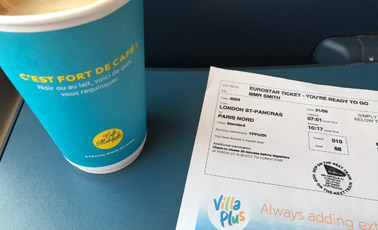
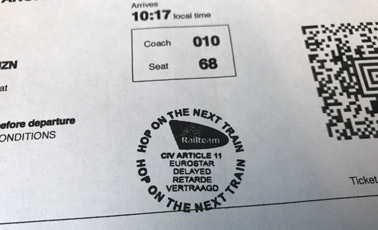
An example: I was travelling from London to Bordeaux on a Eurostar running 40 minutes late. It looked like I would miss my connection in Paris. An announcement was made that the train manager was in the bar car to help passengers with connections. He stamped my ticket and told me to go to the ticket office at Paris Montparnasse to get myself rebooked on a later train. In the event, I walked to the front of the train as we approached Paris, I had allowed a little more than the recommended minimum 60 minutes to cross Paris in any case, and I made my connection!
If you miss a Eurostar due to a delayed train
-
Eurostar have always been pretty good about re-booking people on later Eurostars from Paris or Brussels back to London, free of charge, if (for example) a train from Milan or Barcelona has been seriously delayed arriving in Paris. Eurostar are also very good about rebooking people on a later Eurostar from London if their UK train has been delayed into London. But you should allow plenty of connectional time in the first place.
If you miss a connection in Brussels
-
If you miss a connection in Brussels between Eurostar and an onward ICE or Eurostar (formerly Thalys) to Amsterdam, Cologne or Frankfurt for example, don't worry. Go to the SNCB international booking office, on the main concourse near the Eurostar terminal.
-
There's a queuing system, press the Railteam button which should give you priority. Explain the situation and ask for the Railteam stamp on your ticket that allows you to hop on the next train. It shouldn't matter whether the next train is an ICE or Eurostar (formerly Thalys), both are members of Railteam. Do not talk to Eurostar (formerly Thalys) staff, they sometimes incorrectly tell people that they need to buy another ticket.
-
Once you have the Railteam stamp, you can board the next train and show the ticket and stamp to the conductor. You may have to use the tip-up seats in the entrance vestibules on the Eurostar (formerly Thalys) if it's full, but it's not a long journey. Feedback appreciated! If your onward travel is by InterCity train to domestic Belgian destinations or to Luxembourg by IC train, you'd just get on the next train, no other action necessary as your ticket will be valid on any train in any case.
Your rights: CIV conditions of carriage
-
All European international train tickets are issued subject to the international conditions of carriage, called the CIV (Convention Internationale pour le transport des Voyageurs), see en.wikipedia.org/wiki/CIV_(rail_travel). You'll see CIV printed in a corner of your ticket.
-
Missed connection protection
Under the CIV, if you miss a connection due to a delay, you are entitled to be carried forward by the next available onward train, even if your ticket is train-specific and theoretically non-changeable. This applies whether the trains concerned are operated by the same or different train companies. And if you miss the last onward train of the day, you are entitled to a hotel room for the night.
-
But there's a great big loophole
Unfortunately, this CIV missed connection protection only applies within a single contract for carriage, in other words, within one ticket.
If you have a through ticket from A to C changing at B, your connection at B is protected if there's a delay.
If you have a ticket from A to B and a separate ticket from B to C, your connection at B is not protected by the CIV as this is two separate contracts for carriage and CIV does not apply between contracts. These days, many journeys have to be made using separate tickets.
For example, there are no through tickets between London and Germany, so if you book a journey from London to Berlin, even as one transaction on one website, you'll get a London-Brussels Eurostar ticket and a separate Brussels-Berlin DB (German Railways) ticket. This is two separate contracts for carriage and CIV does not protect you for a missed connection in Brussels, between the two tickets.
The CIV were written when through tickets were the norm for almost all European journeys, these days many through journeys have to be made using multiple tickets. Frankly, the CIV are no longer fit for purpose. I have spoken at the EU Parliament in Brussels on this subject!
But don't despair, in practice staff will usually help you out even where CIV does not apply, and there are two other inter-operator arrangements which may cover you even if you have separate tickets: Railteam/HOTNAT and Agreement for Journey Continuation.
Railteam & HOTNAT
-
There's an alliance of high-speed train operators called Railteam, www.railteam.eu. If you miss a connection between any two high-speed trains run by Railteam members at a designated Railteam hub station, you will be allowed to Hop On The Next Available Train (HOTNAT) to your destination, without needing to change your ticket, sitting in any available seat. See www.railteam.eu.
-
The Railteam members are Eurostar, SNCF (French Railways), DB (German Railways), SNCB (Belgian Railways), NS (Dutch Railways), SBB (Swiss Railways) and ÖBB (Austrian Railways).
-
The Railteam hub stations include Lille Europe, Brussels Midi, Frankfurt (Main) Hbf and the principal Paris termini (even if your connection involves changing stations in Paris).
-
Passengers can take the next available high-speed train leaving from the same station as originally planned when a Railteam member’s high-speed train is delayed or cancelled and they are unable to make their original connection, subject to the following conditions:
The connection that was missed must be between two high-speed trains of Railteam members. HOTNAT only applies at the station at which the passenger originally planned to change trains. HOTNAT is subject to the available capacity on board each train and seats are not guaranteed. It's worth remembering that German intercity trains & French Intercités are not high-speed so not covered by HOTNAT, and that Trenitalia & Renfe are not Railteam members.
Agreement on Journey Continuation (AJC)
-
In 2017, 14 national rail operators signed an agreement which means in the event of a delay and missed connection, they will allow you to travel onwards by a later train at no charge even if you have separate tickets for each train and those trains are run by different operators.
In other words, these operators agree to apply the CIV missed connection protection even between separate contracts for transportation.
-
The signatories to the AJC are:
SNCF (French Railways), DB (German Railways), ÖBB (Austrian Railways), Trenitalia (Italian Railways), Renfe (Spanish Railways), SBB (Swiss Federal Railways), BLS (Bern-Lötschberg-Simplon Railway), CD (Czech Railways), SNCB (Belgian Railways), NS (Dutch Railways), CFL (Luxembourg Railways), DSB (Danish Railways), SJ (Swedish Railways), SZ (Slovenian Railways), ZSSK (Slovakian Railways).
Eurostar signed up to the AJC in 2023, as did MAV (Hungarian Railways), PKP (Polish Railways), HZPP (Croatian Railways) & European Sleeper.
LTG Link (Lithuanian Railways), Swedish private operator Snälltåget and Hungarian operator GYSEV are also signatories.
-
The AJC doesn't currently cover some open-access operators such as Italo, Westbahn, Regiojet, Leo Express.
The AJC also doesn't cover Britain's National Rail operators.
Unfortunately, the AJC also doesn't cover Trenitalia France (who run Frecciarossa trains Paris-Turin/Milan & Paris-Lyon-Marseille), as they are a separate company from their parent Trenitalia.
-
To qualify for help under the AJC:
Both trains have to be run by signatories to the agreement.
You have to be making an international journey, not a domestic one.
You must have allowed reasonable period of time between trains, meaning at least the minimum applied by official journey planners.
You may need to get proof of the delay from the delayed operator, which they are obliged to give you.
Onward travel has to be on the same operator on the same route. It is either the station staff or the train manager for the onward train you gives you permission, you should ask at the interchange station.
-
Remember that the AJC is a commercial agreement between operators, it's not a passenger right you can claim. So politely remind staff about it if they don't seem to know about it. There's more at en.wikipedia.org/...wiki/Agreement on Journey Continuation.
A traveller's report
-
A traveller reports: "I got to my local station and there were no trains going anywhere! There had been an emergency that stopped all trains for half an hour or so in the early morning rush hour, just when I needed to get to London for the 8.30am Eurostar to Paris and TGV down to Toulon, with train-specific tickets all the way. So what do you do? I just went to the ticket office when I reached London - they had the emergency flagged up on their computer screens and just wrote me a docket/stamped and signed it and on I went. At St Pancras, I did the same - went to the Eurostar ticket office and they stamped the unused tickets, issued new ones and off I went. At Gare de Lyon, I went to the ticket office, showed them all the dockets, stamped, stapled and initialled tickets and again they just issued me a ticket for the next train."
Holidays & tours by train
-
If you want a holiday to Europe by train, but want someone else to organise all the train tickets & hotels for you with no hassle, several good specialist companies do just that.
Railbookers ,
railbookers.co.uk
,
railbookers.co.uk
-
Railbookers can custom-make a holiday or short break by train to most European countries for you, with train travel & carefully-chosen hotels, for however long you like, leaving on any date you like. If you tell them what you want, they'll advise you on the best trains, routes & hotels and sort it all out for you. They look after their customers well and get a lot of repeat business.
 UK call 0207 864 4600,
www.railbookers.co.uk.
UK call 0207 864 4600,
www.railbookers.co.uk. US call free 1-888-829-4775,
see
website.
US call free 1-888-829-4775,
see
website. Canada call free 1-855-882-2910,
see website.
Canada call free 1-855-882-2910,
see website. Australia call toll-free 1300 971 526,
see website.
Australia call toll-free 1300 971 526,
see website. New Zealand call 0800 000 554 or
see
website.
New Zealand call 0800 000 554 or
see
website.
 Byway,
byway.travel
Byway,
byway.travel
-
Byway (Byway.travel) is a UK-based eco-holiday firm with a 5-star TrustPilot rating. If you're nervous about booking train travel yourself, they'll book European trips for you as a package including hotels, starting from any British station. Byway includes package protection, a 100% Covid refund guarantee, free disruption & re-planning and on-demand WhatsApp support while you're away.
To see pre-configured packages from the UK to various destinations, use the journey planner on their website.
Tip: First book a one-way outward journey to your destination city on your outward date. Then change the direction of the arrow and book an inward journey on your return date. The journey back to the UK can be from a different location if you like, for example if you plan to travel around a bit before your return to the UK.
Or they can build a trip to your requirements, call 020 4652 0805 (open 09:00-17:00 Monday-Friday, from outside the UK call +44 20 4652 0805) or email them or use this contact form. Please say you heard about them from Seat 61.
Guidebooks
 There are several good guidebooks specifically
to help you travel by train to and around Europe. My own book revised in 2010 is now
too long in the tooth, but there are two
newer books I'd recommend.
Flight Free Europe, packed
with ideas for short breaks & longer holidays in Europe by train rather than
air (it even includes a picture of yours truly in a text box about seat61.com a
few pages in, but don't let that put you off!).
Europe by Rail
combines city guides with train information for train-based tours of Europe.
There are several good guidebooks specifically
to help you travel by train to and around Europe. My own book revised in 2010 is now
too long in the tooth, but there are two
newer books I'd recommend.
Flight Free Europe, packed
with ideas for short breaks & longer holidays in Europe by train rather than
air (it even includes a picture of yours truly in a text box about seat61.com a
few pages in, but don't let that put you off!).
Europe by Rail
combines city guides with train information for train-based tours of Europe.
General country guidebooks
People sometimes think a guidebook is an unnecessary expense, but it's a tiny fraction of what you're spending on your whole trip. You will see and understand so much more if you have a decent guidebook. For the independent traveller, I think the best ones out there are either the Lonely Planet or the Rough Guide. Both guidebooks are excellent, and you won't regret buying one!
Click the images to buy at Amazon.co.uk or buy in the USA at Amazon.com




Hotels in Europe

 Backpacker
hostels
Backpacker
hostels
www.hostelworld.com: If you're on a tight budget, don't forget about the backpacker hostels. Hostelworld offers online booking of dorm beds or ultra-cheap private rooms in backpacker hostels in most European cities at rock-bottom prices.
Car hire
Car hire comparison: www.carrentals.co.uk
-
The award-winning website www.carrentals.co.uk compares many different car hire companies including Holiday Autos. That means not only a useful price comparison, but a wider choice of hire and drop off location.
Travel insurance & other tips
|
|
|
|
|


Always take out travel insurance
You should have travel insurance with at least £1m or preferably £5m medical cover from a reliable insurer. It should cover trip cancellation and loss of cash & belongings up to a reasonable limit. An annual policy is usually cheapest even for just 2 or 3 trips a year, I have an annual policy with Staysure.co.uk myself. Just don't expect travel insurance to bail you out of every missed connection, see the advice on missed connections here. Here are some suggested insurers, I get a little commission if you buy through these links, feedback always welcome.
www.staysure.co.uk
offers enhanced Covid-19 protection and gets 4.7 out of 5 on
Trustpilot.
www.columbusdirect.com is also a well-know brand.
 www.staysure.com/ie if you live in Ireland.
If you live in the USA try
Travel Guard USA.
|
|

Get an eSIM with mobile data package
Don't rely on WiFi, download an eSIM with a European mobile data package and stay connected. Most newer mobile phones can download a virtual SIM including iPhone 11 & later, see device compatibility list. There's no need to buy a physical SIM card! Maya.net is a reliable eSIM data retailer with a 4.5 out of 5 Trustpilot rating and a range of packages including unlimited data.
|
|

Get a VPN for safe browsing. Why you need a VPN
When travelling you may use free public WiFi which is often insecure. A VPN encrypts your connection so it's always secure, even on unsecured WiFi. It also means you can select the geographic location of the IP address you browse with, to get around geoblocking which a surprising number of websites apply. See VPNs & why you need one explained. ExpressVPN is a best buy with a 4.7 out of 5 Trustpilot ranking which I use myself - I've signed up as an ExpressVPN affiliate, and if you go with expressvpn.com using this link you should see a special deal, 3 months free with an annual subscription. I also get some commission to help support this site.
|
|

Get a Curve card for foreign travel
Most banks give you a poor exchange rate then add a foreign transaction fee on top. A Curve MasterCard means no foreign transaction fees and gives you the mid-market exchange rate, at least up to a certain limit, £500 per month as I write this. The money you spend on your Curve card goes straight onto one of your existing debit or credit cards. And you can get a Curve card for free.
How it works: 1. Download the Curve app for iPhone or Android. 2. Enter your details & they'll send you a Curve MasterCard - they send to the UK and most European addresses. 3. Link your existing credit & debit cards to the app, you can link up to two cards with the free version of Curve, I link my normal debit card and my normal credit card. 4. Now use the Curve MasterCard to buy things online or in person or take cash from ATMs, exactly like a normal MasterCard. Curve does the currency conversion and puts the balance in your own currency onto whichever debit or credit card is currently selected in the Curve app. You can even change your mind about which card it goes onto, within 14 days of the transaction.
I have a Curve Blue card myself, it means I can buy a coffee on a foreign station on a card without being stung by fees and lousy exchange rates, just by tapping the Curve card on their card reader. The money goes through Curve to my normal debit card and is taken directly from my account (in fact I have the Curve card set up as payment card on Apple Pay on my iPhone, so can double-click my phone, let it do Face ID then tap the reader with the phone - even easier than getting a card out). I get a little commission if you sign up to Curve, but I recommend it here because I think it's great. See details, download the app and get a Curve card, they'll give you £5 cashback through that link.
|
|

Carry an Anker powerbank
Tickets, reservations, hotel bookings and Interrail or Eurail passes are often now held on your mobile phone. You daren't let it run out of power, and you can't always rely on the phone's internal battery or on being near a power outlet. I always carry an Anker powerbank which can recharge my phone several times over. Buy from Amazon.co.uk or buy from Amazon.com.
Touring cities? Use hill walking shoes!
One of the best things I've done is swap my normal shoes for hill-walking shoes, in my case from Scarpa. They're intended for hiking across the Pennines not wandering around Florence, but the support and cushioning for hiking works equally well when you're on your feet all day exploring foreign cities. My feet used to give out first and limit my day, now the rest of me gives up before they do!