|
Whether you use a rail pass or
point-to-point tickets, trains are easily the best way to travel
around Europe, no contest. Here's why:
 |
|
 |
|
 |
|
 |
|
Speed &
convenience |
|
Space and comfort on board
the trains... |
|
Scenery & the experience... |
| European
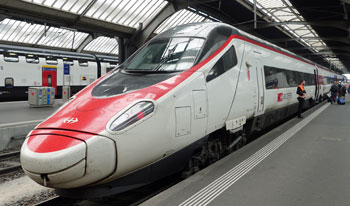
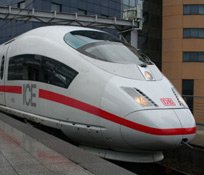
trains run almost everywhere, at up to 186mph, often faster than flying because it's city
centre to city centre, no remote airports,
no check-ins and no security
strip-searches! |
|
...trains are low-hassle
and low-stress. You get space to move around,
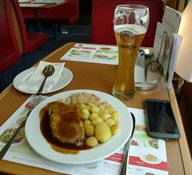
lots of legroom (remember that?) and often a café, bar
or even restaurant on board.
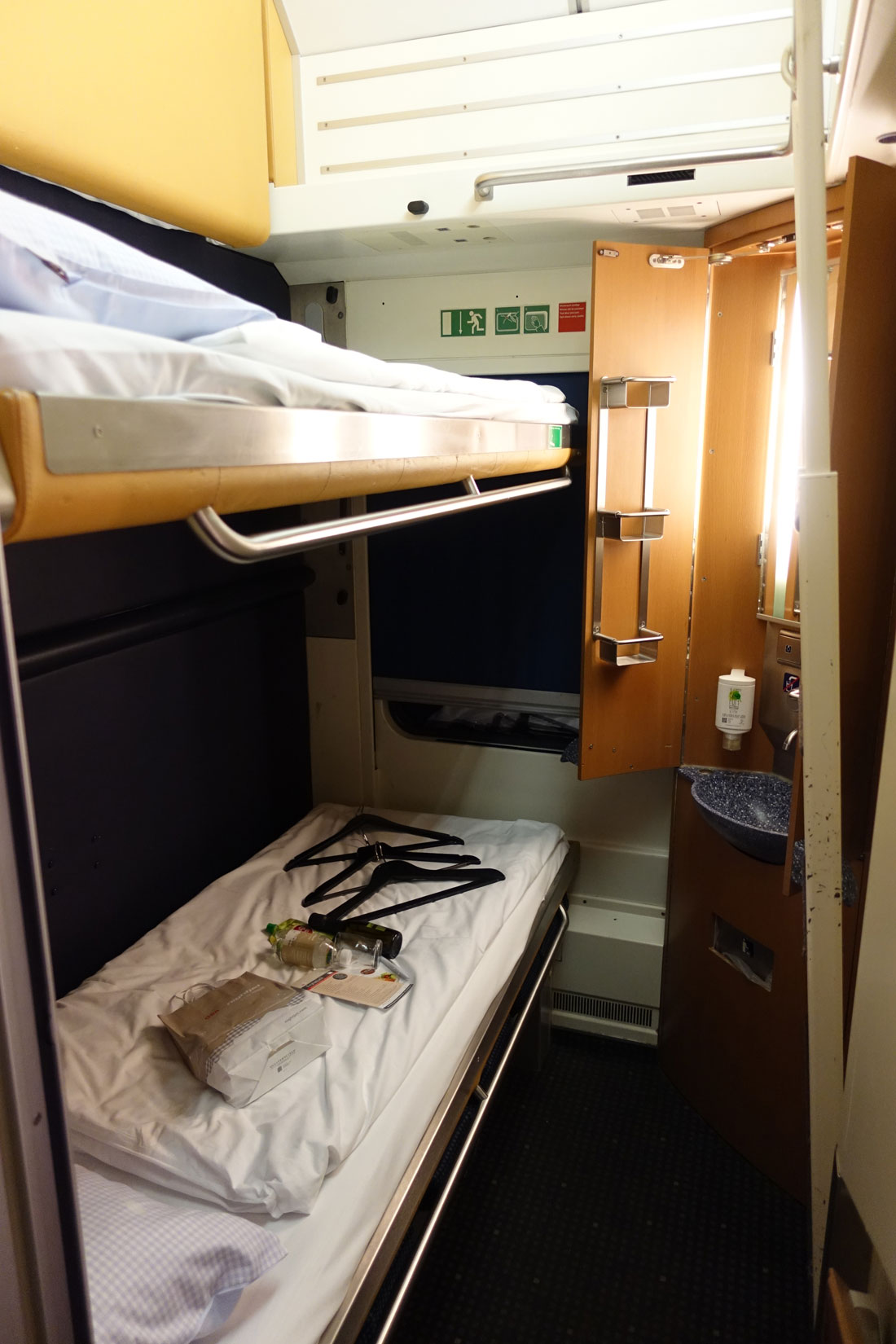
Overnight sleeper trains cover huge distances such as
Paris-Rome or Barcelona-Milan, city centre to city
centre, in effect faster than flying, and it saves hotel bill, too... |
|
...and often there's superb scenery.
Train travel is an integral part of the European experience, and the
journeys become part of your holiday, something
to enjoy in their own right. |
Trains, planes &
automobiles...
Plane:
Planes leave
from remote airports at least half an hour out of town by
taxi or bus or local train. A
2-hour check-in
is now recommended even for a 1-hour
flight, with lengthy security hassles. So even a
short flight will take up 4 or 5 hours from city
centre to city centre. It's
high-stress travel and you miss out on the relaxing scenic overland journeys across Europe which should be
an integral part of every European holiday. You must
generally arrange all your flights in advance on a no-refunds,
limited-changes basis to get affordable fares, and this
is restrictive and inflexible.
And the
environmental damage caused by unnecessary short-haul flights must also be
considered.
Car hire: Hiring a car is great for
exploring a rural area, such as Tuscany or the Dordogne,
in fact it's often the best option and I'd recommend it. But if you're
keen to see the great cities, such as Paris, Rome,
Barcelona, or Florence, then definitely don't hire a car.
In Europe, cars and city centres simply don't mix!
Driving long distances in foreign countries can be very
tiring. Car hire companies are often reluctant to let cars
cross international frontiers even within the EU, so bear this in mind.
Long-distance bus: Long distance buses like
Eurolines or tourist buses like Busabout tend to use
ugly motorways which destroy the scenery they pass
through. At a mere 60mph, a journey that's 3
hours by train could take a nightmare 8 hours on a
motorway by bus. You are
stuck in a cramped bus seat for hours on end, there's no
restaurant car or bar to go to, and on overnight buses
you have to sleep slumped in your seat, a horrible
experience. Buses generally only serve the very
largest cities, and on many long routes there's just one
bus a day or less, which is restrictive and inflexible.
You're not allowed to bring your own food and drink on
board, and there's certainly no alcohol permitted!
Train: Trains run all over Europe, linking
almost every town and city on a regular basis, even
running every hour on major routes. Trains run at
up to 186mph, and are even faster than flying for many
inter-city journeys such as Paris to to London or Paris
to Amsterdam. Overnight sleeper trains have beds
to sleep in, an experience in itself, and they cover
huge distance while you sleep, such as Paris-Barcelona,
Paris-Rome or Amsterdam-Zurich, city centre to city
centre and saving both a hotel bill and the 4-5 hours of
daytime travel that flying would use up. Trains
run city centre to city centre, low-hassle, zero stress.
There's loads of legroom, you can get up and wander to
the bar or restaurant car if you like. Feel free
to bring your own picnic and even your own bottle of
wine or beer if you want, no problem, it's allowed..!
In other words, whether you use a rail pass or buy normal tickets,
the train is definitely the way to see Europe, there's simply no
contest. As well as speed, convenience and comfort, train
travel is part of the European way of life, the way we Europeans
travel, and an experience in
itself. If you're from overseas, you might even get to meet
some of us Europeans...
A rail pass gives you unlimited
train travel, so you can travel around freely and explore as
much as you like.
You have two simple decisions to make:
-
Should you buy a rail pass or
would normal point-to-point tickets be cheaper?
Answer below...
-
If you go for a rail pass, which
type of pass should you buy?
Answer below...
This page will help you answer these questions, help you choose
the right rail pass and explain how to use it. You may also want general
information about train travel in Europe:
-
To plan your route and train times, use the all-Europe
online timetable at
www.bahn.de. It covers almost all of
Europe, and it comes highly recommended. If you only
remember one European rail resource, make it this one!
-
For information about couchettes and
sleepers on overnight trains, with an explanation of what
the difference is, see the sleeper & couchette
page.
-
For general information about
European train travel, such a luggage arrangements, food on
trains, and so on, see the
Europe general information page.
Don't assume you need a rail pass...
In fact, I'll be quite categoric: You should always assume that point-to-point tickets
will be cheaper than a railpass, unless you can show
otherwise.
Many overseas visitors, especially (if you'll forgive me for
saying so) Americans,
appear genetically programmed to ask for a $500 Eurail pass
just for one or two $50 train rides.
Boy-oh-boy is rail pass marketing good in the States! For a simple
train trip from A to B, or even A to B to C and back to A, normal point-to-point tickets will
almost always be cheaper than any rail pass, especially if you are
prepared to book in advance on a no-refunds,
no-changes-to-travel-plans basis, with a budget-airline-style cheap
fare now offered on many routes in western Europe. In
fact, even a tour involving several train trips can often be
made more cheaply with tickets like these if you pre-book.
So let me spell it out for you again: Always assume point-to-point tickets will be cheaper
than a rail pass unless you can demonstrate otherwise.
...but for some types of trip a rail pass can be just the
ticket.
On the other hand, if you are going to do a lot of
travelling to see a lot of Europe, if you want complete
flexibility (so cheap advance-purchase tickets that allow no
refunds and no changes to travel plans won't do), if you are making lots of longer journeys or
one really big trip (for example, Paris to Istanbul) a rail
pass can be the best option.
So which would be best for me, point-to-point tickets or a
pass?
People seem to think there's a simple answer, such as 'a
rail pass is always cheaper than normal tickets if you're
going to Switzerland, but normal tickets are always cheaper
than a pass if you're going to Italy or Spain or eastern
Europe'. It's true that some rail passes (like the
excellent Swiss pass) are better value than others (like
virtually any pass for Italy or eastern Europe where fares
are so cheap anyway), in that you have to clock up more mileage
in Italy to justify buying a pass, whereas it doesn't take
much in Switzerland to make a Swiss Pass worthwhile.
But it always depends on how much travelling you plan to do,
and on what point-to-point ticket you compare it with.
Do you want flexibility with a full-fare ticket, or are you
prepared to book a fixed itinerary in advance to get a cheap
deal? A $70-a-day railpass (even with a $10 reservation fee on
top) is cheaper than a $150 fully-flexible buy-it-on-the-day
point-to-point ticket, but much more expensive than a $45 cheap train
ticket bought in advance online on a
no-refunds-no-changes-to-travel-plans basis. So
there's no simple answer without working it out for
yourself.
OK, so how do I work it out?
Here is a step-by-step guide to checking whether a pass will
actually save you money over normal tickets. If you
find this too difficult, or time is more critical than money
and you can't afford to spend half an hour working things
out, no problem, skip it and go straight to the
How to choose the right
railpass section. But if you're on a tight budget
and are keen to do a little legwork to check that normal
tickets wouldn't be cheaper, here's how:
-
Decide where you want to go:
First, decide which countries and
which cities you want to visit. This is the fun
bit! Decide what interests you, and use a good
European guide book like the
Lonely Planet Guides or Rough
Guides. If possible,
sketch out a rough itinerary. It doesn't have to
be detailed, though you can use the invaluable online timetable at
http://bahn.hafas.de to plan train times if you
like.
-
Decide
which railpass best fits this itinerary: Look for
the rail pass that most closely fits your trip, see
what rail pass should I
buy?
-
Work out the 'pass-price-per-day':
Divide the rail pass price by the number of days train
travelling you expect to do, to get a 'pass price per
day'. This will be your yardstick.
-
Allow for railpass supplements:
Remember that for most long-distance trains in western
Europe, you have to pay for a reservation and/or small
supplement when using a railpass. Overnight couchettes and sleepers also
require a supplement (though they also save a hotel
bill). To get an idea of what the supplement is
for key routes in Europe, see
do I need to make reservations
or pay supplements?. Add an appropriate additional
budget for supplements to the cost of the pass.
-
Find out what the point-to-point fares would be:
See
how
can I find out what the point-to-point fare would be?.
The point-to-point fares produced by the journey
planners on railway websites will include any
supplement or reservation charge, so no supplement
worries here. You will need to
decide if you want flexibility and the ability to vary
your itinerary and be spontaneous (in which case, you
should compare the rail pass price with the most
expensive fully-flexible fare shown in the journey
planner search results) or if you are
prepared to commit to specific trains on specific dates,
to take advantage of cheapest advance-purchase fares.
-
And compare the two:
Compare the pass price per day with the typical
point-to-point fare for the sort of journeys you expect
to make. If you've planned an itinerary, compare the
cost of the pass with the cost of normal tickets for
those journeys.
-
Don't forget that a rail pass is more flexible,
usually allows you to hop on and off trains
spontaneously, saves you time queuing at ticket offices,
and may cover additional trips that you didn't expect to
make (for example, if you plan to spend a few days in
Paris, it will cover a daytrip to Versailles).
Even if a rail pass is a bit more expensive, it can still
be better to buy one.
The two examples below show that it pays to do your research.
Don't assume that a rail pass is always the most economical
option. In fact, your working assumption should be the exact
opposite: Assume that normal
point to point tickets are the cheapest option unless
you can prove that a rail pass will save you money.
Common railpass mistakes: Italy...
-
Many people buy a railpass to tour Italy. A
railpass typically costs the equivalent of 40-45 euro
per day (this is the total pass price in $ or £
converted into euro and divided by the number of days
for which it is valid). Perhaps this at first
sounds good value. But all fast trains in Italy
now require a reservation even with a pass, so there's
no 'convenience factor' in having a pass, you still have
to queue up at the ticket office. The reservation
costs an additional 5 euro per journey for an InterCity
train or around 15 to 20 euro for the high-speed
Eurostar Italia AV trains.
-
They then travel from Rome to Florence on day 1, a
journey which only costs 29 euro for a full fare
point-to-point ticket including high-speed train
reservation, bought at the ticket office even on the day
of travel. Next day they do a day trip to Siena, a
16 euro return ticket. Then they go from Florence
to Venice, a 25 euro ticket. Venice to Verona is
less than 20 euro. Even Venice to Rome is only 45
euro. So why buy a pass? You can check
normal ticket prices for Italy at
www.trenitalia.com. You want 'Standard' fares,
although if you pre-book in advance you can buy an Amica
fare which saves 20% even over the fares I've quoted
here.
-
Conclusion: A railpass seldom makes any
sense at all for Italy (unless you plan to commute between
Milan and Sicily of course!), as passes are overpriced relative to
the very cheap Italian point-to-point fares.
Eastern Europe is also cheap, so be careful about
buying a pass for those countries, too.
Switzerland is just the opposite, where high
point-to-point fares and good-value railpasses make
railpasses a good bet.
Common railpass mistakes: Eastern Europe...
-
Many people buy a railpass to tour eastern Europe.
But as with Italy, normal fares in that part of Europe
are so cheap anyway it hardly makes sense to use a pass.
Bought at the ticket office when you're there, you can
often find cheap deals too, making point-to-point even
cheaper.
-
For example, an InterRail pass (for Europeans) costs
around £48 per day. The normal fully-flexible fare
from Prague to Krakow is only 1,068 koruna (£35) if you
buy it at the station in Prague, but usually they can do
you a cheaper fare of 855 koruna (£29). So why buy
a pass?
-
It's often difficult to buy tickets online (or even just
find out the real ticket-office fare) for journeys in
eastern Europe, but it's easy to buy tickets at the
station when you're there. Bear in mind that
tickets for eastern European journeys bought from UK, US
or Australian agencies are usually more expensive than
the price you'd pay at the ticket office when you're
there.
Common railpass mistakes: Budget train fares for
Spain...
-
A railpass typically costs the equivalent of 40-45 euro
per day (the pass price converted into euro and divided
by the number of days validity). But remember that
every single long-distance train in Spain now requires a
reservation even with a pass, and passholders have to
pay a supplement of around 10 euro per train ride.
-
If you insist on flexibility, a pass will probably save
money on balance over full-fare buy-on-the-day tickets
for long-distance journeys. For example,
railpass-per-day + supplement = 45 + 10 = 55 euro.
A full-fare Madrid-Seville ticket costs around 75 euro.
The pass saves 20 euro on this trip.
-
But if you're prepared to book in advance and commit to
a fixed itinerary, you can buy cheap 'Web' fares online
at www.renfe.es, in
this case Madrid-Seville costs only 28 euro, saving 27
euro over using a railpass. These blow railpasses
out of the water price-wise. And less queuing at
the ticket office as you print out your own ticket and
breeze onto the train!
-
Conclusion: Cheap book-ahead online 'web'
fares are a better bet for travel around Spain, if
you're prepared to pre-book on a 'no refunds, no changes
to travel plans' basis. Remember to budget for the
supplements which apply to all fast trains in Spain
Common railpass mistakes: Budget train fares in
western Europe...
-
Passholders now have to make a reservation and pay a
special passholder fare (typically 5 to 15 euro) before
boarding most international trains in western Europe, so
passes have lost their convenience factor. You can
no longer just hop on and show your pass, you need to
queue up at the ticket office to make the reservation
-
The same trains have adopted airline-style
point-to-point fares, with cheap fares if you book in
advance on a 'no refunds, no changes to travel plans'
basis, and much more expensive fares if you buy a
fully-flexible ticket on the day of travel.
-
Let's take a typical example. Paris to Geneva,
Bern, Basel or Lausanne in Switzerland by high-speed TGV
starts at £23 one-way for a cheap point-to-point ticket
if you book in advance, rising to £80 for a fully
flexible buy-on-the-day ticket. This compares with
an InterRail pass (for Europeans) costing around £48 per
day plus an £8 passholder fare or a Eurail pass (for
non-Europeans) costing maybe 45 euro per day plus a 10
euro passholder fare.
-
So if you insist on flexibility, railpasses may save
money over normal full-fare tickets for long-distance
trips. In our example, the pass cost was £48 + £8
= £56, the fully-flexible fare was £80.
-
However, if you're prepared to commit to a fixed
itinerary, the cheap book-ahead train fares blow
railpasses out of the water price-wise. £23 using
a cheap point-to-point ticket versus £56 using a pass,
half the cost! Of course, maybe the £23 tickets
have sold out for your date of travel, so maybe you end
up paying £33 or £43 instead, whatever, but it's still
cheaper than buying the pass. And you can easily
buy the cheap point-to-point ticket online with no
booking fee, whereas the railpass and supplement cannot
be booked online direct from the train companies, you
will probably have to buy them from an agency, and the
agency will no doubt add a booking fee or postage charge
on top. So why bother with the pass, just go
online and snap up that cheap ticket!
-
A particular example to note are the Paris-Madrid,
Paris-Barcelona, Zurich-Barcelona &
Milan-Barcelona overnight 'trainhotels'.
For travel in a 4-berth sleeper, a special
point-to-point fare of around 70 euro (£60) is easy to
get on almost all trainhotels up to a few weeks before
departure, when the fare goes up to the fully-flexible
fare of 130 euro (not a very sophisticated fare
structure, I grant you!). When I go to Spain from
the UK, this £60 sleeper fare is what I always buy.
An InterRail pass costs around £48 per day (or, for
non-Europeans, a Eurail pass maybe 45 euro per day),
then you have to pay a 70 euro (£60) supplement for the
same 4-bed sleeper. That's right, the supplement
is £60/70 euro, exactly the same price as the book-ahead
fare that everyone in their right mind pays without a
pass. So why bother buying the pass? I
certainly don't bother with a railpass for any
international trips I make from the UK to Spain,
Switzerland or Italy.
-
Also worth quoting as an example are the City Night Line
sleeper trains on routes such as Amsterdam-Prague,
Amsterdam-Vienna, Paris-Berlin, Paris-Munich and so
on. Their budget fares start at 49 euro including
a couchette, whereas with a pass you have to pay a 20
euro couchette supplement plus the cost of the pass.
Again, if you're prepared to pre-book an can get the
cheapest rates, passes don't make sense.
-
Conclusion: 'Budget train fares' have
arrived, as train operators copy budget airlines and
offer very cheap point-to-point deals if you book in
advance. If you're prepared to pre-book your
itinerary a couple of months in advance on a
'no-refunds, no-changes-to-travel-plans' basis online
direct from a European train operator (as opposed to
buying from an overseas booking agency), these cheap
fares blow railpasses out of the water price-wise.
There's advice on how to book which train tickets on the
How to buy European
train tickets page.
-
There's one other problem with railpasses that can
occasionally raise its head, especially at busy times
and especially (it seems) on TGV services in France and
on trains between Paris & Italy, Paris & Switzerland,
Paris & Belgium/The Netherlands. I'm not sure how
often it happens, as it's only cropped up in people's emails to
me once or twice - but perhaps many railpassholders are
simply told the train is full, and go away thinking it
really is full when if you're paying cash there's lots
of seats left.
-
Here's the problem: In the old days, if you had a
railpass you were treated as having a normal 2nd class
ticket, on an equal footing with other passengers.
So if there was one seat left on the train and you were
first in the queue to make a seat reservation on that train
with your railpass, then you got it and the person
behind you didn't. But many trains in western
Europe are now yield-managed, meaning that the number of
seats sold at each price is controlled by a quota held
in the
reservation system, and there's a separate quota for
railpassholders. At busy times this quota can be
very small or even zero. So now, if there's one
seat left on the train, a railpass holder is told "Sorry,
the train is full" (in other words, there are no
passholder places available), and the seat is sold to the passenger behind you
willing to pay cash. They already have your money
after all, as you've already paid for the railpass!
Personally, I think this is sharp practice, though as I
say it may not be a problem except on certain trains at
very busy times. But you should be aware of how
things work. If you need to be on a specific train
on a specific date, a normal point-to-point ticket
booked on that train guarantees you a place, whereas
simply holding a railpass and expecting to make a
reservation at the station on the day may not, even if
there are seats available! Of
course, you could buy any mission-critical reservations
along with the pass from the same agency in the same
phone call, so you only buy the pass if the reservations
are OK.
|
|