


How to travel overland between Europe & China or Japan
A journey on the Trans-Siberian Railway should be on everyone's bucket list. It's safe, comfortable & affordable. On this page I'll explain the routes, trains, classes, prices, answer your questions, and help you plan & book your trip. Page last updated March 2022
IMPORTANT UPDATE 2026: All travel to Russia inadvisable. All international Trans-Siberian trains between Russia & China have been suspended since February 2020, originally due to Covid-19. They remain suspended until further notice, although a weekly Irkutsk-Ulan Bator train resumed in late 2022 and a weekly Ulan Bator-Beijing train resumed in mid-2025. All international trains between western Europe & Russia are suspended because of the war with Ukraine and sanctions. Russian domestic trains are running including Moscow-Vladivostok. The Foreign Office advises against all travel to Russia because of the war, see www.gov.uk/foreign-travel-advice/russia. I have left this page as was pre-pandemic, but various companies including Real Russia are no longer trading. But basically Russia is now no-go.
In the unlikely event you need a Russian train ticket, you can buy Russian train tickets including Moscow-Vladivostok at www.railrussia.com. The official Russian Railways site www.rzd.ru is geo-blocked and unavailable and RealRussia.co.uk has ceased trading.
 |
|
|
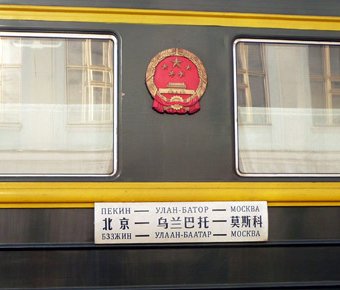
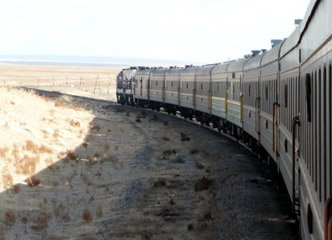
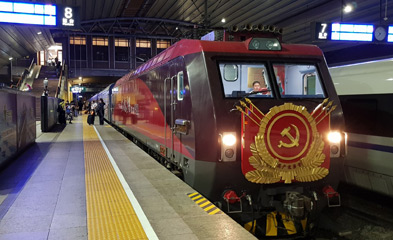
Train 4, the Moscow to Beijing Trans-Mongolian Express. 4,735 miles, 3 countries, 6 days. |
|
 |
|
|
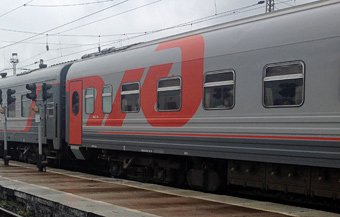
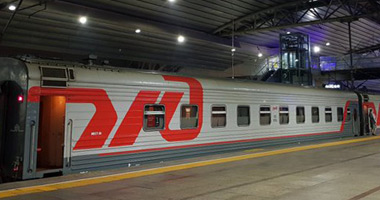
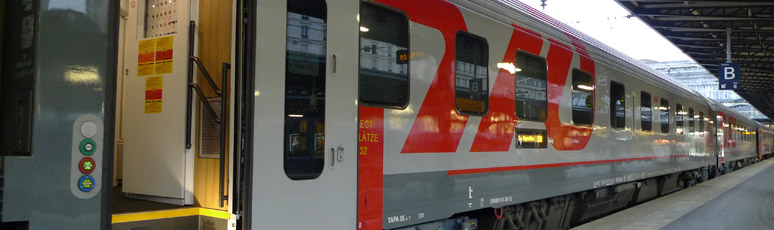
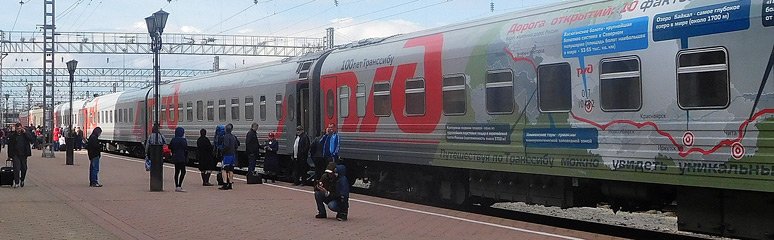
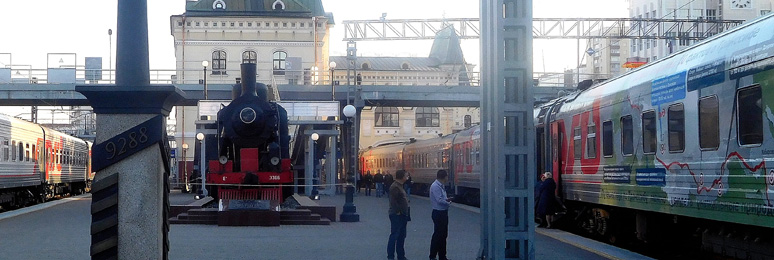
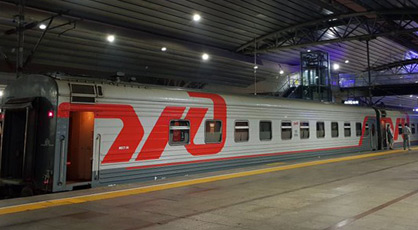
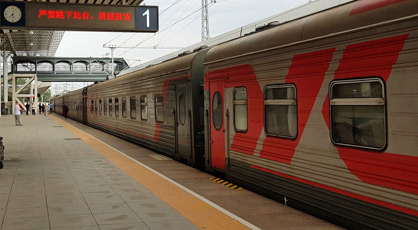
Train 2 Rossiya, on its 7-day 5,752-mile journey from Moscow to Vladivostok. The cars are now in RZD Russian Railways corporate red & grey, no longer red, white & blue. Photo courtesy of Nicholas Stone. |
Trans-Siberian trains, fares, tickets
 Route map: Where does the Trans-Siberian go?
Planning & booking a trip, a step-by-step guide
Trans-Siberian
timetable - eastbound
Trans-Siberian
timetable - westbound
Check Trans-Siberian times & fares online
Tips & FAQ: Security, food,
bikes, stopovers...
A journey in pictures from
Moscow to Beijing
A brief history of the Trans-Siberian
Railway
The luxury option:
Trans-Siberian by private train
Recommended Trans-Siberian guidebooks
Connecting trains & ferries
Trains between London, Paris, Berlin &
Moscow
Trains between Beijing & other Chinese
cities
Trains between Beijing & Hong Kong
Trains between
Beijing & Hanoi, Vietnam
Connections
to/from Bangkok & Thailand
Ferry between Vladivostok, South Korea & Japan
Ferries between China & Taiwan
What is the Trans-Siberian Railway?
The Trans-Siberian Railway is just one part of the massive Russian railway network, transporting passengers and freight safely at affordable prices. It connects the European rail network at one end with either Vladivostok or the Chinese rail network at the other. Take a look at the route map below to see where the Trans-Siberian Railway goes. You can use it to travel overland in either direction between London, Paris or anywhere in Europe and China, Japan, Korea or even Southeast Asia...
Interactive map: Trans-Siberian, Trans-Mongolian, Trans-Manchurian
Showing connecting trains & ferries. Click on a route to see train times, fares & information.
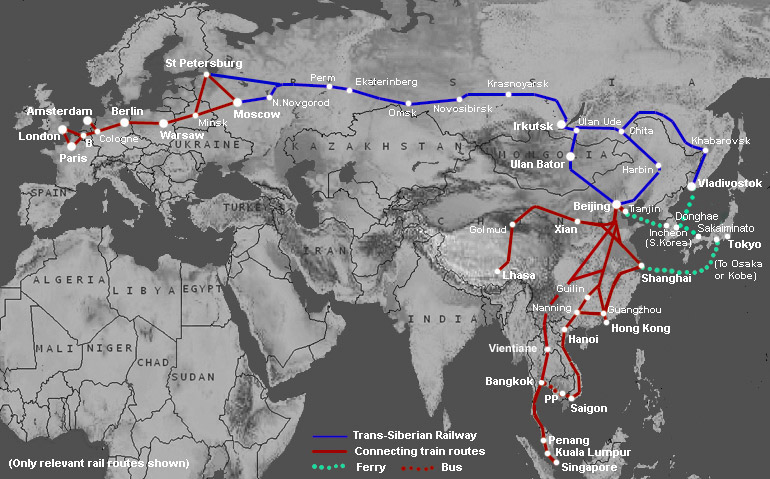
There's also a less well-travelled route to China via Kazakhstan, sometimes known as the Silk Route, for details click here.
An overview of the 3 routes
Moscow to Vladivostok: Every day, the Rossiya (the Russia, train number 2 eastbound, train 1 westbound) leaves Moscow on its 9,259 km (5,752 mile) journey to Vladivostok, taking 8 nights/7 days. In addition, 3 times a week you'll also find un-named train 61 westbound & 62 eastbound which link Moscow with Vladivostok with fewer stops in just 7 nights/6 days. This is almost the longest train ride of them all, 9,259 km or 5,752 miles. Trains 1/2 & 61/62 have 2nd class 4-berth compartments called kupé, open-plan bunks called platskartny & a restaurant car, see the photos below. There are no longer any 2-berth spalny vagon sleepers on these trains, at least not at the moment, but if you like you can pay for 4 tickets to get sole occupancy of a 4-berth sleeper for one, two or three people. These trains now have dynamic pricing, one-way fares from Moscow to Vladivostok start at around 11,500 rubles ($170 or £140) in kupé with a bed in a 4-berth sleeper, more if booked through an agency. See a brief account of the journey. There is a weekly ferry from Vladivostok to South Korea & Japan taking 2 nights & 1 day, although this was discontinued in February 2020, it has been resurrected by another company using the same ship, and should start taking passengers when borders reopen after the pandemic.
Two routes to China: Although the main Trans-Siberian line runs from Moscow to Vladivostok, most western travellers head for China on one of two branches, the Trans-Mongolian line (completed in the 1950s) or the Trans-Manchurian line (built around 1900), see the route map. There are two direct trains each week between Moscow & Beijing, train 3/4 via Mongolia using Chinese coaches and train 19/20 Vostok via Manchuria using Russian coaches.
Moscow to Beijing via Mongolia: This is arguably the most interesting Trans-Siberian route to take. The weekly Trans-Mongolian train (train 4 eastbound, train 3 westbound) leaves Moscow for Beijing every Tuesday night. The 7,621 km (4,735 mile) journey takes 6 nights. This train crosses Siberia, cuts across Mongolia and the Gobi desert, then enters China. Westbound, it leaves Beijing every Wednesday morning. This train uses Chinese rolling stock and has deluxe 2-berth compartments (with shared shower), 1st class 4-berth compartments & 2nd class 4-berth compartments. Booked through a local Russian agency, journey costs around $805 or £555 one-way in 2nd class 4-berth or $1130 or £780 in 1st class 2-berth. See an illustrated account of the journey.
Moscow to Beijing via Manchuria: The weekly Trans-Manchurian train (the Vostok, train 20 eastbound, train 19 westbound, using Russian rolling stock) leaves Moscow on Saturday nights for Beijing via Manchuria, taking just over six days to cover the 8,986km (5,623 miles). Westbound, it leaves Beijing every Saturday night. There are 2-berth 1st class compartments (spalny vagon) and 4-berth 2nd class compartments (kupé). Prices are similar to the Chinese train.
Other Trans-Siberian trains: These aren't the only Trans-Siberian trains. Far from it! Many other trains run over parts of these routes. There's even a slightly slower Moscow-Vladivostok train, train 100 taking 7 nights instead of 6... See the Trans-Siberian timetable below.
 |
|
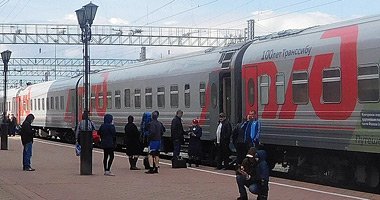
Train 2, the Rossiya from Moscow to Vladivostok, 6,152 miles in 8 nights. Courtesy of Hubert Horan |
 |
|
Train 4 from Moscow to Beijing via Mongolia. Courtesy of Tony Willis |
 |
|
Train 20, the Vostok from Moscow to Beijing the weekly Russian Trans-Manchurian train, at Ulan Ude. Each carriage proudly carries the lettering 'MOSKVA-PEKIN'. Or did. This train too is now appearing in corporate RZD grey and red! 6 days, 5,623 miles... Photo courtesy of David Smith |
Recommended guidebooksThe kilometre-by-kilometre guide in Bryn Thomas' Trans-Siberian Handbook makes it particularly useful... |
|
|
Planning your trip
|
|
|
|
Train 2, the Rossiya from Moscow to Vladivostok, 6,152 miles in 8 nights. Train 62 does the same run in 7 nights Photo courtesy of Hubert Horan |
|
|
|
|
|
Train 4 from Moscow to Beijing via Mongolia. Courtesy of Tony Willis |
|
|
|
|
|
Train 20, the Vostok from Moscow to Beijing the weekly Russian Trans-Manchurian train. This train too is now appearing in corporate RZD grey and red! 6 days, 5,623 miles... Photo courtesy of Helmut Uttenthaler. |
|
 |
|
|
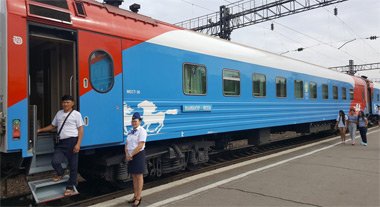
Train 6 from Moscow to Ulan Bator, freshly re-equipped with modern air-conditioned Mongolian Railways cars in 2017, similar to the cars now used on the Rossiya. Note the galloping horses logo! The thrice-weekly Irkutsk-Ulan Bator version of train 6 uses modern Russian Railways cars. Photo courtesy of Philip Dyer-Perry. |
|
|
guidebooks... The kilometre-by-kilometre guide in Bryn Thomas' Trans-Siberian Handbook makes it particularly useful... |
1. When to go? Eastbound or westbound? Is it safe?
Yes, the Trans-Siberian is perfectly safe, even for families or solo females. It's the way Russian families and women travel, after all.
You can go at any time of year as the Trans-Siberian Railway operates all year round. Naturally, the summer months from May to September have the best weather and the longest daylight hours so are the most popular. In winter it's easier to get tickets, the trains are warmly heated and the Siberian landscape beautiful in the snow, but the hours of daylight will be shorter and stretching your legs at stations or visiting the cities will be chillier. In many ways it's the slushy thaw around April that's least attractive.
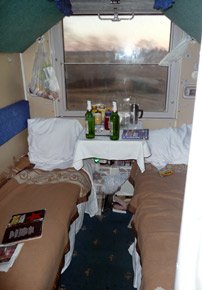
On board the trains, Kupé 4-berth sleepers (2nd class) is the usual comfortable choice for most westerners. 2-berth Spalny Vagon (1st class) is now quite rare, but you can pay for 4 tickets in kupé to get sole occupancy or a 4-berth compartment if you like.
You can travel the Trans-Siberian Railway either eastbound or westbound, it's up to you, although eastbound tends to be more popular with westerners, perhaps because going out by rail from your local station and flying back is more romantic than starting your trip with a flight. On this page I cover both directions, remember that any comments written from an eastbound perspective usually apply westbound too!
See the Trans-Siberian travel tips for more advice & answering all your FAQs.
2. Decide on your route & final destination
The Trans-Siberian Railway doesn't just go to Vladivostok. It links Europe with China, Japan, Korea, even Vietnam and South East Asia. How about going to Beijing? Shanghai? Hong Kong? Tokyo? Tibet? See the Trans-Siberian route map to open your mind to all the possibilities which the Trans-Siberian Railway offers. You can even reach Hanoi, Saigon, Bangkok or Singapore overland from London.
Vladivostok is an interesting place for a day or two if you're passing through before catching the ferry to Japan or Korea, but probably not worth a 7 day journey from Moscow just for its own sake. Beijing is a far better choice of destination as it's an absolutely amazing city that's well worth the overland trip from Europe.
The Trans-Mongolian is easily the most interesting of the three routes, even though it means an extra visa, there are superb views of the Gobi desert and a chance to stop off in Mongolia on the way.
But why end your trip in Beijing? Shanghai or Xian are just a few hours high-speed train ride away. There are trains from Beijing to Hong Kong. How about Japan? There are ferries from Shanghai to Osaka. There's even a twice-weekly direct train from Beijing to Hanoi in Vietnam taking 2 nights, 1 day (see the Vietnam page), then you can take daily trains to Saigon, a bus to Phnom Penh and on to Bangkok, then a train to Malaysia & Singapore, see the Cambodia & Thailand pages.
3. Do you want to stop off?
You cannot buy an open ticket and hop on and off, as the Trans-Siberian is an all-reserved long-distance railway where everyone gets their own sleeping-berth and every ticket comes printed with a specific date, train number, car & berth number. However, you can easily arrange stopovers along the way using a separate ticket for each train, easily pre-booked especially if you use the Trans-Siberian Trip Planner.
The varied scenery and camaraderie on board the direct Moscow-Beijing trains makes non-stop travel on these trains an enjoyable option and maximises your time in China. On the other hand, travelling to Vladivostok non-stop in 7 days can be tedious (I should know) and it's better the break up the journey and see something of Siberia. And even if you're heading for China, there's lots worth stopping off for on the way if you have time.
The obvious stopovers are Irkutsk in Siberia for Lake Baikal and Ulan Bator in Mongolia, for a side trip into the Gobi desert. If you have more time, Ekaterinberg & Ulan Ude are also worth a stop.
To help decide where to stop off, buy a copy of Bryn Thomas' excellent Trans-Siberian Handbook, with journey planning information, town guides, the history of the line, and best of all, a mile-by-mile guide to the sights you can see from the train, which really helps you get the most from the trip. The Lonely Planet Trans-Siberian Railways guide is also good.
Most western travellers pre-book all their tickets, but if you have lots of time and are determined to stay flexible and buy tickets at stations as you go, read this section about buying tickets at the station.
4. Plan your Trans-Siberian trains
There is no such train as the Trans-Siberian Express but a whole range of trains across Siberia, including countless Russian domestic trains plus a handful of direct international trains to Mongolia and China. Plan your trains using the Trans-Siberian timetable below or the Trans-Siberian trip planner. Within Russia, there are both faster quality trains & slower cheaper trains, it's your call which you take.
So for example, if you chose to travel from Moscow to Beijing straight through without stopovers, you'd obviously book one of the weekly direct Moscow-Beijing trains, trains 4 or 20. But if, say, you wanted to go from Moscow to Beijing with stopovers at Irkutsk and Ulan Bator, you might first take any regular daily Russian domestic train from Moscow to Irkutsk, and it might be nice to ride the Moscow-Vladivostok Rossiya for this bit unless a cheaper ticket for a slower lower-quality train better suited your budget. Then you might take train 6 from Irkutsk to Ulan Bator 4 times a week, as this is easier to get berths on and more frequent than waiting for weekly train 4. Then you might pick up trains 4 or 24 from Ulan Bator to Beijing. Browse the Trans-Siberian timetable or use the Trans-Siberian trip planner.
5. How much will it cost? How long does it take?
To give you a rough idea, the cheapest trip put together yourself would include a Moscow-Beijing 2nd class train ticket from around £442 or $590, plus a London-Moscow train ticket for around £200. You'll also need at least 1 night in a hotel in Moscow, and of course you need to budget for visas for Russia, China and possibly Mongolia and Belarus, plus travel insurance. But it all depends on what you want to do, and how economically or luxuriously you want to travel.
Fares are shown in the fares section below, although what you actually pay depends on how you buy your tickets as the various booking agencies add differing mark-ups. You can use the Real Russia Trans-Siberian trip planner to get a good idea of cost including stopovers.
In terms of time, London to Beijing with a one day stopover in Moscow takes around 10 days, London to Beijing with 2-days in Irkutsk and 3 days in Ulan Bator in Mongolia would take 15 days. London to Tokyo or Hanoi with stopovers in Moscow and Vladivostok takes about 14 days. You could reach Bangkok in around 20 days. But where and how long you stop off is up to you. I suggest sketching out an itinerary and budget using the method explained on the How to plan an itinerary & budget page.
Booking your trip
Step 1, buy your Trans-Siberian train tickets
-
When you have planned your journey, the first thing to arrange are your Trans-Siberian train tickets. There are several ways to buy tickets, some cheaper but more effort, others easier but more expensive. See the how to buy tickets section below for an explanation of all the options, but I'd recommend the Real Russia Trans-Siberian trip planner as arguably the best compromise between cheapness & simplicity for arranging your tickets.
Step 2, book connecting trains, ferries & flights
-
After booking your Trans-Siberian train ticket, book any onward trains within China, the Beijing-Hanoi (Vietnam) train, a China-Japan ferry, the Vladivostok-Japan ferry or a ferry to South Korea. You may also need to book a one-way flight if you are going one way by train, the other by air.
Step 3, book your hotels
-
To find & book hotels in Moscow, Beijing, Vladivostok or in cities along the way, I usually use www.booking.com, as you can usually book their hotels with free cancellation, so you can safely book your accommodation as soon as you decide on your travel dates without any risk of losing money, before confirming your train tickets or visas. Any hotel with a review score over 8.0 will usually be great.
Step 4, arrange your visas
-
Once you have booked the Trans-Sib train, you need to arrange your visas. You can apply for a visa for Russia 6 months or less before your date of entry, although for other countries it's usually 3 months or less. See the visa section below for details of how to do this.
Step 5, book your train from London to Moscow
-
Finally, arrange travel from London to Moscow to connect with the Trans-Siberian, see the London to Russia page. You can also travel to Moscow by direct sleeping-car from Paris, Berlin, Vienna, Prague, Helsinki and many other places, to find train times, use int.bahn.de. Bookings for European trains typically open 3 months before departure, you can't book until reservations open, so do this bit last.
Step 6, don't forget insurance
-
Remember to take out travel insurance, ideally immediately after you've booked the first part of the trip, as cancellation cover starts as soon as you buy the insurance. You might also want to get a VPN for safe browsing on public WiFi during your travels, and perhaps a Curve card to save on exchange rates & foreign transaction fees. See the section on insurance, Curve card & VPNs.
Don't fly to Moscow!
Flying to Moscow to pick up the Trans-Siberian Railway is like entering a marathon and then accepting a lift in someone's car for the first hundred yards... Don't cheat! If you're going to go overland to the Far East, do it properly, starting at London St Pancras and staying firmly on the ground. It's easy to travel from London to Moscow by train, click here for train times, fares & how to buy tickets. How about starting your Trans-Siberian trip with Eurostar from London to Paris and then a ride on the excellent Paris-Moscow Express?
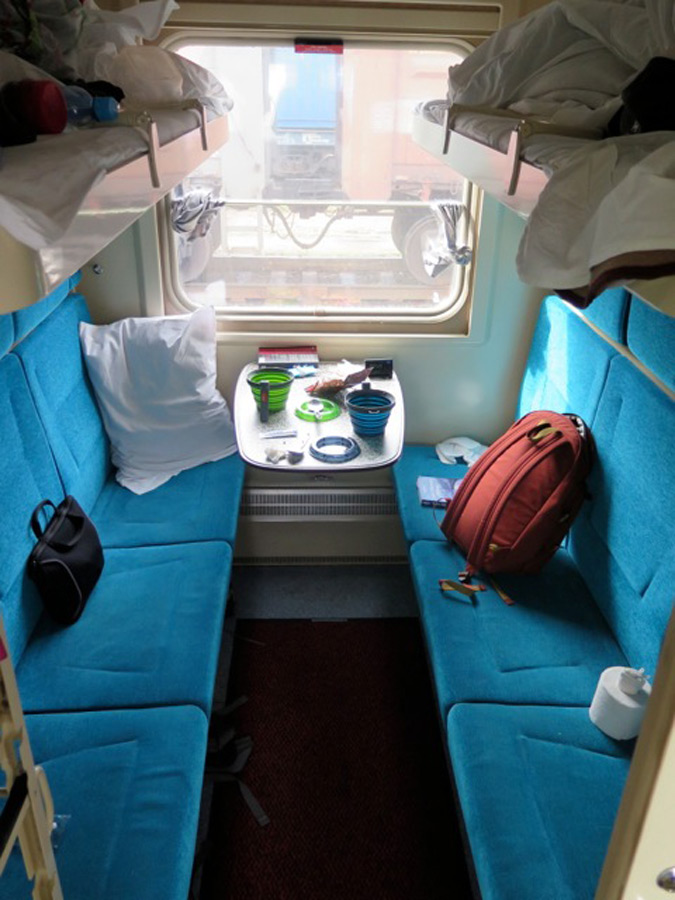
The Trans-Siberian Railway is a regular railway, a means of transport vital to the people living along it. It's not run for tourists, so you won't find bar cars with pianos or deluxe suites with en suite showers (although one or two tourist cruise trains now operate on the Trans-Siberian from time to time, details here). However, all passengers get a proper flat berth to sleep in, provided with all necessary bedding, convertible to a seat for day use. There are washrooms and toilets along the corridor, and a restaurant car for meals. Whichever train you take, the Trans-Siberian is a safe and comfortable way to reach China and the Far East. You'll find more details about food, showers & toilets in the Travel tips & FAQ section.
A request: If you get any good current interior or exterior photos to illustrate trains 1/2, 3/4, 5/6, 56, 61/62, 305/306, 23/24, please let me know!
Trains 1 & 2, the Moscow to Vladivostok Rossiya
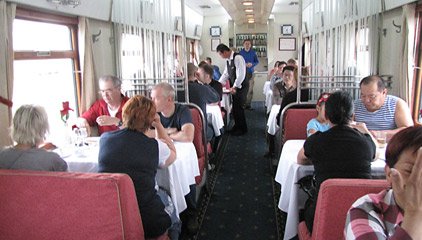
The famous Rossiya (the Russia) runs from Moscow to Vladivostok every day all year round, 9,259 km (5,752 miles) in 8 nights. It has 2nd class 4-berth 2nd sleepers (called kupé), 3rd class open-plan sleeper bunks (called platskartny) and a restaurant car. There are no longer any 1st class 2-berth sleepers (called SV or spalny vagon), at least not at the moment, but you can pay for 4 tickets in kupé to get sole occupancy of a 4-berth compartment for 1, 2 or 3 people.
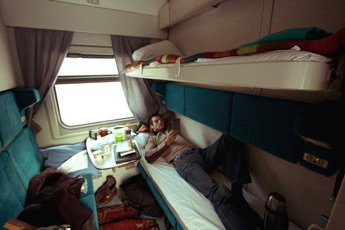
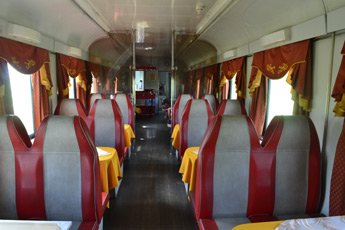
It's a very comfortable train, re-equipped with the latest air-conditioned sleeping-cars in July 2020 featuring power sockets & USB ports for every passenger, a mini-combination safe for valuables for each passenger and a hot shower in each car. The bunks convert to seats for daytime use. There are toilets & washrooms at the end of the corridor, room for luggage under the lower berths and above the door to the corridor. Compartment doors lock securely from the inside. The new cars are shown here: www.tvz.ru/catalog/passenger/item_detail.php?ELEMENT_ID=1374.
Changes in July 2020: Train 1/2 Rossiya has always been the fastest train between Moscow & Vladivostok, taking 7 nights. Until July 2020 it only ran every two days and there was a second slower train between Moscow & Vladivostok, train 99/100 leaving every day, making around 70 more station stops than the Rossiya and taking 8 nights. Train 99/100 was gradually re-equipped with the very latest cars, and from 9 July 2020 this slower train 99/100 was renumbered 1/2 and became the Rossiya, whilst the former faster train 1/2 was renumbered 61/62.
So travellers now have a choice between riding the famous Rossiya, train 1 westbound & train 2 eastbound with daily departures and the latest rolling stock, but taking 8 nights, or riding nameless train 61/62 running only 3 days a week with slightly older rolling stock, but with 70 fewer stops, taking only 7 nights from Moscow to Vladivostok and saving a whole day & night. Personally, I'd take the Rossiya, for the name as well as the hot shower in every car!
The photos below show the Rossiya pre-July 2020, courtesy of Yves Goovaerts, David Smith, Nicholas Stone & Hilary Onno. It's possible that this rolling stock is now used on train 61/62, whilst even newer stock is used on train 1/2 Rossiya.
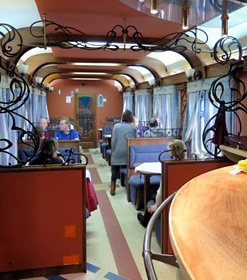
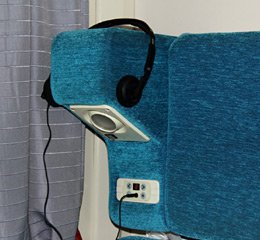
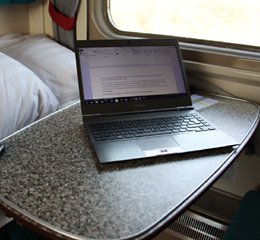
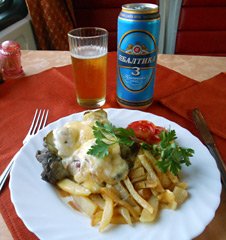
What's the journey to Vladivostok like?
The Man in Seat 61 says: "A journey from Moscow to Vladivostok on the Rossiya was a totally different experience from a previous journey from Moscow to Beijing on train 4. Travelling to Japan via Vladivostok, my 1st class 2-berth car was comfortable, spotlessly clean and even air-conditioned. I usually ate in the restaurant car, and by the end of the trip Mischa in the kitchen would have my ham & eggs in the frying pan for breakfast as soon as I appeared in the restaurant. In contrast to the vibrant international community on board train 4 to Beijing, on train 2 I was the sole Westerner aboard until Irkutsk. And also unlike the Moscow-Beijing train where almost everyone is making the complete journey, very few passengers on the Rossiya are going all the way to Vladivostok. The Rossiya is used for all sorts of shorter intermediate journeys, with Russians getting on and off at every station. I had a compartment all to myself on leaving Moscow, then shared it with a professional Russian ice hockey player from Yaroslavl to Perm, on his way to trial for the team there. His place was taken by a Russian lady from Yekaterinburg to Irkutsk who said very little. In Irkutsk two professors from Alabama joined the train and became my meal companions in the restaurant. The train stops several times a day, usually only for 10-20 minutes, but you can stretch your legs and take photographs. Arrival in Vladivostok was a full two minutes ahead of schedule, seven days after leaving Moscow. The ocean terminal is adjacent to the station, but you may need to spend a night in Vladivostok to be sure of a safe connection. Vladivostok is an interesting city, and a day or two spent there will not be wasted. Overall, the Moscow-Vladivostok route is 7 days of Siberia on a train with few fellow westerners and indeed few Russians making the whole trip. This makes for a much less interesting journey that the Moscow-Mongolia-Beijing train, and one that it would be good to break up with stopovers rather than make in one go."
Trains 3 & 4, the Moscow to Beijing Trans-Mongolian Express
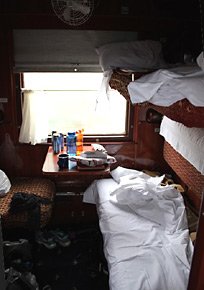
Trains 3 (westbound) and 4 (eastbound) link Moscow & Beijing once a week all year round, taking the shorter and most interesting route via Mongolia and the Gobi desert, 4,735 miles in 6 nights. The train is Chinese, and has Chinese carriage attendants. Using the correct Chinese terminology it has deluxe soft sleepers (2-berth), soft sleepers (4-berth) and hard sleepers (also 4-berth). Most westerners are content to use the fairly comfortable & economical 4-berth hard sleepers, which are essentially the equivalent of 4-berth kupé on the Russian trains. The 4-berth soft sleepers are not worth the extra money as they are virtually identical to the 4-berth hard sleepers, just slightly larger, though not so as you'd notice without getting your tape measure out. However, the 2-berth deluxe soft sleepers are definitely worth the extra cash if you can get one, as they have upper & lower berths and an armchair in one corner, a small table and access to a compact en suite washroom with shower head shared with the adjacent compartment, see the deluxe sleeper photo here. Don't expect too much of the shower head though! There are both western and squat toilets at the end of each car, along with washrooms. A Russian restaurant car is attached whilst the train is in Russia, a Mongolian one in Mongolia and a Chinese one whilst it is in China, see food details here.
What's a journey to Beijing like? Click here for an illustrated account...
How to avoid confusion over classes... Remember that this train is Chinese, not Russian. Deluxe soft sleeper, soft sleeper & hard sleeper are usually translated for westerners as 1st class 2-berth, 1st class 4-berth & 2nd class 4-berth, certainly by agencies at the Chinese end. In my opinion that's an appropriate translation as the Chinese 4-berth hard sleepers are equivalent to 4-berth kupé sleepers on Russian trains, and so can safely be thought of as 2nd class, not 3rd. However, some Russian agencies including the reliable Real Russia booking system translate the deluxe soft sleeper, soft sleeper & hard sleeper on this Chinese train as 1st, 2nd and 3rd class, where 2nd class means a 1st class 4-berth soft sleeper that's not worth the extra money and 3rd class means a comfortable 4-berth hard sleeper which is more accurately thought of as 2nd class and which I would recommend for most budget travellers. I hope that's clear! Oh, and train 4, train 004, train 004Z (or in Cyrillic, what is often mistaken for 0043) are all the same train, train 4...
Train 5 & 6 Moscow - Ulan Bator
Train 5 westbound, train 6 eastbound, uses modern air-conditioned Mongolian Railways (MTZ) sleeping-cars, newly-delivered in 2017. It has 4-berth kupé (2nd class) compartments and spalny vagon (1st class) 2-berth compartments. These new Mongolian cars have similar interiors to the cars on train 1 & 2 Rossiya. A Russian restaurant car is attached whilst in Russia.
Trains 19 & 20 Vostok, the Trans-Manchurian train between Moscow & Beijing
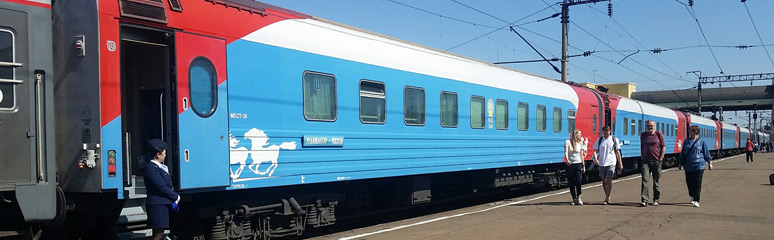
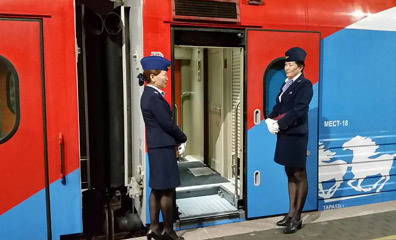
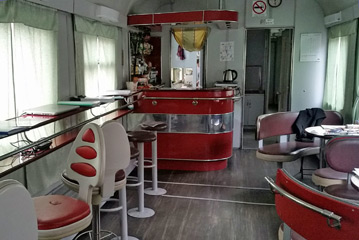
Train 19 westbound, train 20 eastbound, the Vostok is the Russian train linking Moscow and Beijing once a week. It by-passes Mongolia, crossing directly from Russia into China via the older and slightly longer route through Manchuria, 8,986km (5,623 miles) in 7 nights. The name Vostok simply means 'East'. The Vostok was given a makeover in 2012-2013, and the photos below show the new red and grey colour scheme and smart refurbished interior. The train has Russian-style 2-berth & 4-berth sleepers, and a restaurant car - a Russian restaurant when in Russia and a Chinese one when in China. There are power sockets for laptops, cameras or mobiles in every compartment. Unlike the Chinese 2-berth sleepers on train 3/4, the Russian 1st class 2-berths on this train are of the Russian spalny vagon type with two lower berths, think of it as a 4-berth with the upper berths removed, but no washbasin or adjacent washroom, as in the 4-berth sleepers there are toilets and washrooms at the end of the corridor. For an account of this journey, see Angie Bradshaw's blog here.
Here is a summary of all the most important trains on the Trans-Siberian Railway. Make sure you read the notes! The times shown are departure times unless it says otherwise, at most stations you can assume the arrival time will be 5 to 15 minutes before departure. There are other slower trains not shown here, simply use the Real Russia online system here to find train times for all possible trains, or to confirm these times.
All times shown below are local time... Russian trains used to run to Moscow time whilst in Russia, even if local time was 7 hours ahead of Moscow. However, but RZD Russian Railways ended this century-old practice from August 2018 and now use local time in all their timetables and booking systems.
Fun with time zones... Russia made Daylight Saving Time (DST) permanent in 2011 making Moscow GMT+4 all year round but in 2014 they changed their minds and abolished it altogether, so Moscow is now GMT+3 all year round. So China is now permanently 5 hours ahead of Moscow as they too have no DST. Mongolia was also permanently 5 hours ahead of Moscow and on the same time as Beijing, until the Mongolians changed their minds and reintroduced DST in March 2015 making them GMT+8 (Moscow +5, Beijing+0) in winter but GMT+9 (Moscow+6, Beijing+1) in summer. But in 2017 they've changed their minds again and have once more abolished DST so Mongolia is now GMT+8 or Moscow time +5 all year round. Until someone changes their mind again, of course.
IMPORTANT UPDATE 2026: The timetable below is the pre-pandemic, pre-war-in-Ukraine timetable, for information only.
Eastbound timetable
* Mongolia reintroduced Daylight Saving Time in March 2015. The times with an asterisk will therefore be approx one hour later from late March to late September.
** Moscow-Beijing is 7,622 km (4,735 miles) via Ulan Bator or 8,986 km (5,623 miles) via Harbin. Map of Moscow showing Yaroslavsky station
Time zones: Moscow time is GMT+3 all year. Mongolia is GMT+8 from late September to late March or GMT+9 from late March to late September. China is GMT+8 all year. Mongolia re-introduced daylight saving time in 2015, whilst Russia made DST permanent in 2011 then abolished it in 2014. Do keep up!
Trains stop for only 1 or 2 minutes at small stations, but 15-50 minutes at major stations, long enough to stretch your legs.
Note A: Rossiya. High-quality train, see here for photos & more information. Runs daily (increased from running every 2 days from 9 July 2020). Uses the latest air-conditioned cars with a hot shower in every car, 2nd class 4-berth kupé sleepers, 3rd class platskartny berths & restaurant car. There are now no 1st class 2-berth spalny vagon sleepers, but you can pay for 4 tickets to have sole occupancy of a 4-berth compartment for 1-3 passengers.
Note B: Moscow-Beijing Trans-Mongolian express, see here for photos & information & see here for an illustrated account of the journey. Leaves Moscow every Tuesday eastbound, leaves Beijing every Wednesday westbound. Operated with Chinese coaches & staff. 1st class 2-berth, 1st class 4-berth, 2nd class 4-berth. Russian restaurant car whilst in Russia, Mongolian restaurant in Mongolia, Chinese restaurant in China. Note that if you're trying to buy a ticket from Ulan Bator to Beijing, berths on train 4 can only be booked within 24h of departure from Ulan Bator, so you'll find it much easier to use train 24 instead. Train 4 can be shown online variously as train 4, train 004, train 004Z or with a Russian letter Z as a suffix so it looks like train 0043. They all mean train 4. And similarly for train 3.
Note C: Train 6 runs from Moscow on most Wednesdays, train 5 runs from Ulan Bator on most Fridays. It has modern Mongolian Railways spalny vagon (1st class) 2-berth sleepers and kupé (2nd class) 4-berth sleepers. A restaurant car is attached in Mongolia & in Russia. It runs every week between late May & late September, but only on alternate weeks off-season, check departure dates using the Real Russia online system. See here for photos & more information
Note D: Vostok. Moscow-Beijing trans-Manchurian express. Leaves Moscow every Saturday. Westbound, leaves Beijing every Saturday. Operates with Russian coaches & staff. 2-berth spalny vagon, 4-berth kupé. There is a Russian restaurant car whilst in Russia and a Chinese restaurant car in China. From December 2017 it runs in the similar timings to the Rossiya between Moscow & Ulan Ude and when running days of both trains coincide it will be coupled to the Rossiya.
Note E: Runs daily. Fast high-quality train with spalny vagon 2-berth sleepers, kupé 4-berth sleepers, platskartny (open-plan bunks) between St Petersburg & Ekaterinberg. The St Petersburg-Irkutsk Baikal was discontinued in 2013. Train 71/72 is now the principal direct link between St Petersburg & Siberia unless you go via Moscow.
Note F: Train 61/62 is a faster, but un-named alternative to the Rossiya, taking 7 nights rather than the Rossiya's 8, but only running 3 times a week and using slightly older rolling sock, probably that formerly used by the Rossiya pre-2020. The carriages are still modern and air-conditioned, but without a shower in every car, for example. Train 61/62 has 2-berth spalny vagon, 4-berth kupé, open-plan platskartny bunks and a restaurant car.
Note G: Train 305/306 runs 3 times a week, check dates using the online system. It has 4-berth kupé sleepers on all departures, but only the Monday & Friday departures from Irkutsk have 2-berth spalny vagon sleepers. The Mongolians claim all 3 departures per week have spalny vagon in the other direction, but I suspect the Monday departure from UB may not have 2-berth spalny vagon if the Wednesday departure in the other direction doesn't. The Mon & Fri departures from Irkutsk and the Tues & Sat departures from UB use older non-air-con Russian cars, the Wednesday departure from Irkutsk & the Monday departure from UB use Mongolian cars. All together, trains 3/4, 5/6 & 305/306 link Irkutsk & Ulan Bator 4 or 5 times a week. There's no restaurant car so bring your own provisions.
Note H: Runs once a week all year, twice a week in summer. This train is operated by the Mongolian Railways one year and Chinese Railways the next year, switching over each year at the end of May when the days of operation also change. Assuming the pattern continues, this is how it should work...
From May 2017 to May 2018 and from May 2019 to May 2020, Chinese Railways run the main all-year-round service with train 23 from Beijing to Ulan Bator running every Tuesday, train 24 from Ulan Bator to Beijing running every Thursday. The Mongolians then run an additional weekly departure in summer from late June to early September, train 24 Ulan Bator to Beijing also running on Saturdays, train 23 Beijing to Ulan Bator also running on Mondays.
From May 2018 to May 2019, Mongolian Railways run the main all-year-round service with train 23 from Beijing to Ulan Bator running every Saturday, train 24 from Ulan Bator to Beijing running every Thursday. The Chinese then run an additional weekly departure in summer from late June to early September, train 24 Ulan Bator to Beijing running additionally on Fridays, train 23 Beijing to Ulan Bator running additionally on Tuesdays.
The Chinese train has deluxe soft sleeper (2-berth), soft sleeper (4-berth) & hard sleeper (4-berth). The Mongolian train has spalny vagon (1st class 2-berth) & kupé (2nd class 4-berth).
Note that's it's much easier to buy a ticket from Ulan Bator to Beijing on train 24 than to get a berth on train 4 coming through from Moscow. There are alternative, less convenient but more frequent ways to get from Ulan Bator to Beijing, with changes of train, click here for details.
Trains 3/4, 5/6 & 19/20 between Moscow, Ulan Bator & Beijing are mainly for passengers making international journeys e.g. Moscow to Beijing, Irkutsk to Beijing or Moscow to Ulan Bator) although they may offer berths for domestic Russian journeys. But if you want to stop off at Ekaterinberg or Irkutsk for example, you would normally take a Russian internal train between Moscow, Ekaterinberg & Irkutsk such as the Rossiya or train 100 as these run more frequently.
Westbound timetable
Connecting trains & ferries
-
For trains between Moscow and London, Paris, Amsterdam, Berlin or Warsaw, see the London to Russia page.
-
For trains within China between Beijing and Shanghai, Hong Kong, Tibet, Xian or the Great wall at Badaling, see the Train travel in China page.
-
For the trains between Beijing and Hanoi in Vietnam, see the Vietnam page.
-
For the weekly ferry linking Vladivostok with South Korea & Japan, see the information below.
-
For ferries between China and Japan, see the ferries section on the China page.
-
For ferries between China and Korea, see the South Korea page.
Alternative transport between Ulan Bator & Beijing, if you can't get a berth on trains 3/4 or 23/24
If you're trying to do the Trans-Mongolian route flexibly, buying tickets as you go, this is relatively easy between Moscow & Ulan Bator as there are a whole range of domestic trains every day between Moscow, Irkutsk & Ulan Ude and you'll usually find places available even on the day of travel, even if not always on your first choice of class or train. There's then a daily train between Irkutsk or Ulan Ude and Ulan Bator, although only one carriage of this train goes through to/from Ulan Bator, but there's often places available at short notice.
The real pinch-point is between Ulan Bator and Beijing where there are just two or three direct trains per week. And one of those is train 4 coming through from Moscow on which only limited berths are available for passengers joining at UB and these are only released for sale 24 hours before departure from UB. However, there are alternative Mongolian domestic trains between Ulan Bator and the Chinese border, so you're very unlikely to be stranded. Here are the alternative trains, which are not shown in the timetable above:
-
Southbound: Ulan Bator to the Chinese border & onwards to Beijing: (1) There is a daily overnight sleeper train (number 276) from Ulan Bator to Zamin Uud on the Mongolian side of the Chinese border, just 10km from the Chinese border post at Erlian. It leaves Ulan Bator at 17:20 and arrives Dzamin Uud at 07:07 next morning, the fare in a soft sleeper is around 40,000 Mongolian Tugrik ($22). (2) Local buses or taxis are available to Erlian - a taxi will cost around 40-50 RMB, about $7. (3) There is then at least one daily train from Erlian to Jining South (Jining Nan) taking 6h50, fare for a hard seat around $7. (4) There are then various daily trains from Jining South to Beijing, journey between 5h00 and 9h30 depending on the train, fare about $12 for a hard seat. You can check train times for China using the planner at www.chinahighlights.com.
-
Northbound: Beijing to the Chinese border for a train to Ulan Bator: (1) Take one of the various daily trains from Beijing to Jining South (= Jining Nan), journey 5h00-9h30 depending on the train, fare in a hard seat around $12, you can find train times using the planner at www.chinahighlights.com. (2) Then use www.chinahighlights.com again to find a train between Jining South and Erlian, there's at least one per day taking 6h50, fare for a hard seat around $7. (3) Erlian is the Chinese border post, so you'll need to take local transport such as a local taxi the 10km or so across the border to Dzamin Uud on the Mongolian side. (4) From Dzamin Uud, train 275 runs to UB daily leaving Dzamin Uud at 18:20 and arriving Ulan Bator at 08:55 next morning. The fare in a soft sleeper is around 40,000 Mongolian Tugrik ($22).
-
Alternatively, on Mondays & Fridays, a hard class sleeper train (train 34) leaves Ulan Bator at 20:50 arriving Jining South (Jining Nan) around 19:00 next day - the train's final destination is Hohhot. There are then several daily trains from Jining Nan to Beijing, journey 9 hours, fare about $7 with soft class seat. www.chinahighlights.com/china-trains will confirm train times for any journey within China, just be aware that trains 3, 4, 23, 24 aren't daily.
-
On Thursdays & Sundays, a hard class sleeper train (train 22) leaves Ulan Bator at 20:50 for Erlian, just on the Chinese side of the border, arriving next morning. There are daily trains from Erlian to Jining Nan (Jining South) then a number of daily trains from Jining Nan to Beijing. Use www.chinahighlights.com/china-trains to find trains within China.
You can check current times for all these Mongolian trains - international and domestic - using the Mongolian Railways website ubtz.mn - English button top right. If you have more information on these alternative UB-Beijing journey, please e-mail me!
In a nutshell...
-
As little as £492 or $686 buys you a one-way train ticket from Moscow to Beijing on train 4 including a bed in a 4-berth sleeper, pre-booked through a reliable agency such as Real Russia. For almost 5,000 miles of travel, a bed for 6 nights and a memorable world-class travel experience, that's a bargain! If you want a bed in a 2-bed sleeper, make that around £787 or $1,097.
-
Moscow-Vladivostok is an even greater bargain, 7 or 8 nights and 9,000km from as little as 14,500 rubles, about $210 or £170 with a bed in a shared 4-berth sleeper. You can buy 4 tickets to get sole occupancy of a whole 4-berth compartment for 1, 2 or 3 of you.
-
If you want to stop off at places on the way, that increases the ticket price a bit, but not hugely.
-
Add train tickets from London to Moscow for around £250 and you're all set for an epic journey from the UK to China.
-
You should budget for at least one night in a hotel in Moscow, £40 upwards depending on how classy a hotel you want.
-
Don't forget visas. This could add £140-£240 depending on which visas you need. Russia, China, possibly Mongolia & Belarus.
The full story...
-
First, a reality check. People expect me to tell them 'the fare' between Moscow and Vladivostok or Beijing. It ain't like that! True, the Russian have a set international tariff for trains to China, which may or may not be the same as the Chinese Railways international tariff for journeys westbound to Russia. But the direct international trains often leave fully-booked, at least in summer, so you usually have to buy through an agency, and these agencies know that demand exceeds supply and resell tickets with whatever mark-up or added fees the market will bear. So you have to shop around for quotes, rather than expecting to pay the official price. And then there are both international and domestic tariffs. So if you're stopping off in Russia, the fare for a domestic train will be different from the international rate, and will vary significantly by time of year and how high-quality the train in question is. It's a bit of a black art, but I'll guide you through the jungle...
-
The good news is that a Trans-Siberian journey needn't be expensive if you travel independently rather than with an inclusive tour. It's a real railway with regular fares, not an expensive tourist attraction. But what you pay varies significantly depending on:
-
Which class you choose. Most western travellers go 2nd class 4-berth (kupé). 1st class 2-berth (spalny vagon ) is nice if you can afford it, but twice the price of kupé so only worth it if money is no object. 3rd class (platskartny open-plan bunks) is a bit basic for most western travellers and not available on every train, but some adventurous low-budget travellers go for it.
-
Which train quality you choose: For journeys wholly within Russia, you can travel on a firmeny fast quality train (recommended) such as train 2 Rossiya or a slow unnamed lower-quality train such as trains 240, 340 or 100 which have cheaper fares. As a general rule, low train numbers are quality trains, slower low-quality trains have three-digit train numbers. When you contact an agency, make sure you know what specific train number you're being quoted a fare for so you compare like with like.
-
Whether you travel independently (cheaper) or book an all-inclusive tour (more expensive).
-
How you buy: If travelling independently, you can buy your ticket through a Russian travel agency like Real Russia (cheaper, recommended, easy to use with English language after-sales service), or a western travel agency (more expensive), or book direct with Russian Railways at rzd.ru (fiddly, but works and accepts most people's credit cards) or at the ticket office (cheapest, but not always practical if you need to be sure of being on a certain train on a certain date).
-
If booking through an agency, which agency you use. Demand for the two weekly Moscow-Beijing trains exceeds supply, Russian Railways sells off tickets to travel agencies before bookings open to the public, and these agencies sell tickets to tourists for whatever price they can get for them. So you need to shop around!
-
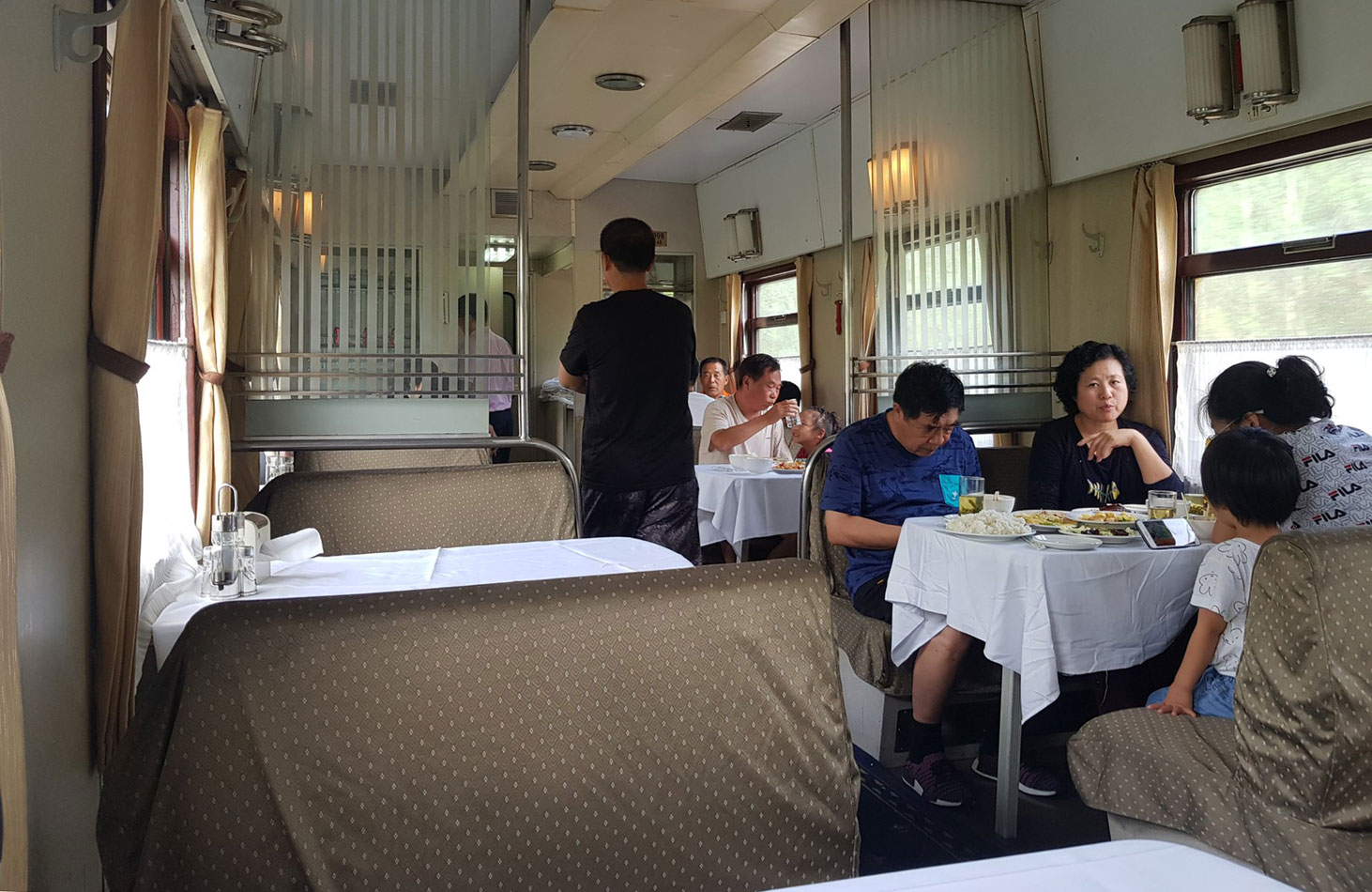
Some quality trains such as the Rossiya offer tickets with or without 'services'. 'With services' just means that one or more cooked meals is included in the price, either served in your compartment or eaten in the restaurant car, like the meal shown in these photos. A number shows the number of meals you get on the whole trip. It might just be one meal, even on a 7-day journey! Other meals you'll need to pay for in the restaurant, or bring your own supplies.
Prices if you buy tickets at the ticket office in Moscow
-
Here are typical fares charged by Russian Railways, taken from the Russian Railways website www.rzd.ru. In the search results, 2-cl sleeping compt. = kupé 4-berth. 3-cl sleeping = platskartny. Russian fares for key trains now dynamic, so vary according to demand like air fares. www.rzd.ru also lets you buy Russian domestic train tickets online, but not tickets for the international trains to Mongolia or China, and it may struggle with some overseas credit cards.
-
With or without services? On the best trains you can buy tickets without services meaning without any meals, or with services meaning with some meals included, either served in the restaurant or in your compartment. On the Real Russia booking system, a knife & fork logo with a number against that class (with a У1, У4, and so on appearing if you hover over it) in the class column indicates a 'with services' price where the number shows the number of meals provided. On www.rzd.ru a 'with services' carriage is shown with a У1, У4 and so on against it in the category column - no 'У' and no number means without services. Don't get too excited: On the Moscow-Vladivostok Rossiya a 'with services' ticket means you get just one meal, even on a 7 day trip!
Prices if you buy tickets from Real Russia or other Russian agency
-
Unless you have lots of time and can afford to take pot luck when you get to Moscow, you should book your trains in advance. Most westerners buy tickets through a travel agency, either a local Russian one such as the excellent Real Russia or other reputable Russian agencies (recommended) or a specialist western agency (sometimes less hassle, but significantly more expensive). Different agencies charge completely different prices for the same journey, so shop around for the best deal. However, to give you a rough idea, here are the prices charged by Real Russia, including their agency mark-up. 'Shopping around' means emailing each agency for a specific quote, not just looking at their website, as some agencies don't update their sites when prices rise - and Russian & Chinese railways have imposed some big fare rises in recent years. When emailing an agency, be specific about which train you want, and remember to ask about their delivery charges & credit card fees. I've seen websites quote very competitive prices for (say) Moscow-Irkutsk which turn out to be for a low-quality slow train, and the price they charge for a quality train such as the Rossiya is much higher and less competitive. When you get quotes, make sure you compare like with like! And some agencies charge credit card fees of up to 12% on top of their advertised fares (Real Russia charge 2.5%), so make sure the quote explains these. How to buy tickets from Russian travel agencies.
Where did I get these fares? How can you check current fares & fares for other journeys? See the Real Russia Trans-Siberian trip planner.
Prices if you buy tickets from a western travel agency
-
There are various western agencies who specialise in Trans-Siberian travel. They can sell you a package tour or arrange a tailor-made tour for you, but they can also sell just a train ticket if you like. Their prices vary enormously, so shop around. With higher overheads to support, a western agency will charge much more than a local Russian agency. More about arranging your trip through a western tour agency.
Prices if you buy at the ticket office in Ulan Bator
-
Ulan Bator to Irkutsk costs around 109,500 togrog ($54) in 4-berth soft sleeper on train 263 or 137,500 togrog in 4-berth soft sleeper on train 5.
-
Ulan Bator to Beijing costs around 178,050 togrog (about $90) in a 4-bed sleeper on train 24.
Prices if you buy tickets in Beijing or from www.chinahighlights.com
-
You can buy tickets in person at Beijing main station or via the Chinese state tourist agency CITS, or arguably most easily online from reliable China-based agency www.chinahighlights.com/china-trains with ticket delivery to any hotel or address in China, Hong Kong or Macau. see the full story below about how to buy westbound tickets from Beijing.
Children
-
In Russia, children under 5 sharing a berth with an adult go free, children 5 to 10 travel at half the adult fare.
Note that even though under 5s travel for free if they share a berth, you must still book a free-of-charge ticket for them with their name on it. If you want to give them their own berth, you simply pay for a child ticket.
-
On the Trans-Manchurian and Trans-Mongolian international trains (trains 3, 4, 19, 20), children under 4 go free if they share a berth, children 4 to 11 (inclusive) travel at 75% of the adult fare.
-
For journeys wholly within China, children under 120cm tall travel free, 120-150cm tall travel for half fare, over 150cm tall pay full fare (new child height limits since December 2010).
Check Trans-Siberian train times & prices online
Use www.realrussia.co.uk/Trains to check train times & prices and buy tickets for any individual train on the Trans-Siberian Railway.

How to buy tickets
There are several ways to book a trip on the Trans-Siberian Railway, each with advantages & disadvantages:
-
Option 1, buy tickets at the station: Cheapest, feasible for Russian domestic trips, but international trains can get fully-booked weeks ahead;
-
Option 2, buy tickets online using the Real Russia trip planner: Easiest, inexpensive, reliable, good after-sales service, often the best option;
-
Option 3, buy tickets through a local Russia, Mongolian or Chinese agency - usually pretty easy to do, also inexpensive, also a good option;
-
Option 4, buy tickets from rzd.ru: Bit fiddly, but no fees or mark-up. Can't do Ulan Bator to Beijing or westbound tickets from Beijing or UB.
-
Option 5, let a specialist western travel agency arrange everything for you: Least hassle of all, but significantly more expensive.
Option 1: Buy tickets at the station
Is buying tickets at the station a practical proposition?
-
If you have a definite itinerary and limited time, and want to be sure of confirmed reservations, you should go straight to option 2 below to pre-book your tickets in advance through a reputable agency. However, if you have lots of time, want to stay free and flexible, and are willing to take pot luck on what places you find available, it is indeed possible to buy your tickets at stations as you go along, at least for journeys wholly within Russia. It's not usually difficult to get a ticket for a Russian internal journey a day or two before departure, for example Moscow-Ekaterinberg, Moscow-Irkutsk or even Moscow-Vladivostok, assuming you can be flexible about your exact departure date, time and class of travel. The daily Irkutsk-Ulan Bator train is not too difficult to book at the ticket office, either.
-
But for travel between Russia and Mongolia or China, here's a reality check: Demand exceeds supply for the two weekly Moscow-Beijing Trans-Mongolian & Trans-Manchurian trains (trains 4 & 20), also the weekly Moscow-Ulan Bator train (train 6), at least in the busy May-September peak summer season. Russian Railways opens bookings 60 days before departure, and Russian travel agencies buy up all the tickets to resell them at a mark-up. Station staff might tell you that these trains are all sold out even if you went to the station soon after bookings opened to the public, although you may be able to buy tickets if you called one of the agencies. If you want to use these trains, you should pre-book through an agency as shown in option 2 or 3 below. Ulan Bator to Beijing is also a pinch-point, as there are only 2 trains a week, so this too is best booked in advance through an agency.
How to buy tickets in Moscow & Russia
-
You can go to the ticket office at any Russian station and buy a ticket for any journey in Russia, including the Trans-Siberian Railway. This is the cheapest way to book because you pay the real Russian Railways price with no mark-up or agency fee. Remember to take your passport.
-
To avoid language problems, it's a good idea to learn the Russian alphabet so you can write down your requirements to show to the ticket office staff. When writing dates, use roman numerals for the month, or example for '3 June 2013' write '3 VI 2013'.
-
Many big Russian stations now have a 'servis tsentr' (service centre) where you pay a small fee of around 100 rubles to buy your ticket in a relaxed air-conditioned environment, and it's well worth paying this small extra fee for the hassle it can save you. Russian railway reservations are computerised, so you can arrange any journey from any station, as long as the journey starts in Russia or one of the ex-Soviet states.
How to buy tickets in Ulan Bator
-
You can buy tickets in Ulan Bator at the international booking office which is now located on the 2nd floor of the building next to the station, see station & ticket office location map.
-
The office is open 08:00-20:00 Monday-Friday. At weekends use the normal booking windows. Credit cards are not accepted, but there is an ATM on the first floor of the building.
-
International trains to Irkutsk, Moscow and Beijing can be booked up to 30 days in advance, except for berths on the Moscow-Beijing and Beijing-Moscow trains 3/4, on which berths for passengers joining at UB are only sold 24 hours before departure.
-
If you are travelling to Beijing and find trains 4 & 24 fully-booked, don't worry, there are alternative trains from Ulan Bator to northern China, where you can change trains for Beijing, and indeed a daily overnight train from Ulan Bator to Dzamin Uud on the Chinese border from where you can easily reach Beijing any day of the week, see here for details of these alternatives.
 |
 |
||
|
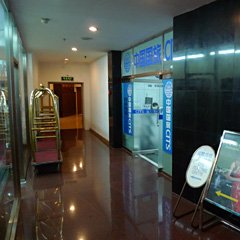
Buying Trans-Siberian tickets in Beijing: Go to the CITS office on the ground floor of the Beijing International Hotel, open 09:00-12:00 & 13:30-17:00 Monday-Friday, 09:00-12:00 weekends & holidays. See location map. |
|||
How to buy tickets in Beijing
-
You can buy westbound Trans-Siberian tickets in Beijing at one of the designated reservation offices, although not at any of Beijing's stations. The two weekly Beijing-Moscow trains often get booked up well in advance, so buy tickets as far ahead as you can. However, don't despair if you need to travel in the near future, as it's not impossible to get tickets from Beijing to Moscow a week or two ahead, certainly outside peak season. Westbound trains are generally easier to get berths on than eastbound trains, and it's easier finding a place in winter than in the May-September peak season. Train 3 to Moscow via Mongolia is often fully booked a couple of weeks in advance especially in summer, although it can be easier to get a berth on train 19 via Manchuria, which occasionally has berths available even a few days before departure, but obviously not always! So the basic message is this: If you positively have to be on a specific train on a specific date, forget booking at the ticket office, you should pre-book via CITS or some other agency and pay their extra fee. But if you're living in Beijing, or plan to be there for some time before leaving, and can be a bit flexible about exactly what date you leave, booking in person can be an option. You can buy Trans-Siberian train tickets in Beijing at:
-
The CITS international train booking office on the ground floor of the Beijing International Hotel. This is about 5 minutes walk north of Beijing railway station on Jianguo Men Nei Dajie, see location map. It's open 09:00-12:00 & 13:30-17:00 Monday-Friday, 09:00-12:00 on weekends and holidays. It's not well-signed, but simply go through the hotel's main entrance and turn left, looking for a passageway at the far left side if the reception desks. It's unlikely to be crowded. The staff speak basic English and leaflets are available with international train times & fares in English. See the section above for fares.
-
Alternatively, try BTG Travel & Tours who have various agency offices around the city.
-
You cannot buy Trans-Siberian tickets at Beijing stations.
Option 2: Buy tickets using the Real Russia Trans-Siberian planner
-
Most western travellers want their Trans-Siberian reservations confirmed in advance before they leave home. The best option is to buy tickets over the internet through a reputable local agency such as Real Russia, www.realrussia.co.uk. Real Russia have developed an online trip planner that makes planning a Trans-Siberian journey & ordering tickets easy, eastbound or westbound, with or without stopovers. In terms of price, simplicity & a sound reputation for customer care, they're one of the best agencies. The company was started by a Brit with links to Russia, hence the .co.uk. The prices shown on the Real Russia system are the Russian railways price plus a mark-up (all agencies mark up the base price). Their system is linked to the actual Russian Railways database for train times, prices & availability, orders are fulfilled manually when made online, with good English-language after-sales service if you need it.

Option 3: Other agencies who can arrange Trans-Siberian tickets
For journeys within or starting in Russia, use a Russian agency
-
Real Russia is one of several reputable Russian agencies who can arrange Trans-Siberian train tickets, here are the best of the rest...
Svezhy Veter (www.svezhyveter.ru)
Way to Russia (www.waytorussia.net)
Ost West (www.ostwest.com)
-
These agencies may keep their own waiting lists and will take Trans-Siberian bookings months ahead, well before the 60 day point when they can buy up the actual ticket, so contact a booking agency as far ahead as you can.
-
All these agencies have been recommended by Seat61 correspondents and are all reputable, although further feedback is always welcome. Booking through one of these Russian agencies is much cheaper than booking through a western travel agency, but prices vary enormously from agency to agency, so shop around. Make sure that you compare like with like, so any quote you get is inclusive of credit card fees, and you know whether it's for a slow low-quality train (3-digit train numbers) or one of the fast quality trains such as the Rossiya (one or two-digit train numbers & usually a name).
-
Tickets can be picked up at their offices in Moscow or sent to you for a courier fee. Some agencies (but not Real Russia) may ask you to fax them a photocopy of your credit card and/or passport, which sounds dodgy, but is not unusual when dealing with Russian companies. Be prepared for a 7%-12% credit card fee (Real Russia charge only 2.5%), but using a credit card is still a safer way to buy tickets than using a money transfer. These Russian agencies can also book hotels in Moscow and other Russian cities, and they can arrange a visa support letter for Russia (or use the recommended visa service at www.realrussia.co.uk).
-
For booking trains 3/4, 5/6 & 19/20 on the Trans-Mongolian and Trans-Manchurian routes, it helps to know how the system works: Russian Railways open up bookings for these trains 60 days before departure. Knowing that demand for these trains exceeds supply, Russian agencies buy up blocks of tickets, leaving few or none for sale at the ticket office. The agencies then re-sell these tickets for whatever price they can get, which may bear no relation to the face value of the ticket. Trans-Mongolian train number 4 is particularly popular, and 1st class deluxe 2-berth on this train can sell out very quickly indeed, with more travel agencies trying to fulfil orders from rich privacy-loving westerners for deluxe berths than there are deluxe berths on the train. So these particular trains should be booked well in advance. You'll sometimes be told by one agency says the train is full, but another agency has speculatively bought a block of tickets and has some left, or knows a rival agency that it can buy tickets from. So once again, the message is shop around!
-
Most of these agencies can also book journeys starting in China or Ulan Bator through their contacts in those countries, but as these contacts also take a 'cut' you'll usually find it cheaper to book journeys starting in Beijing direct with CITS as described below.
-
Remember that an agency cannot 100% confirm your reservation until Russian Railways opens reservations, 60 days ahead. However, travel agencies will take your booking (and money) several months ahead as they keep their own internal waiting lists for the most popular trains such as the Moscow-Beijing Trans-Mongolian & Trans-Manchurian trains. They will make your reservation with Russian Railways the moment bookings open, 60 days ahead. 99.9% of the time there's no problem, but very occasionally there are more tourists wanting berths than there are berths, especially for the deluxe 2-berth 1st class on Trans-Mongolian trains 3/4 as this is very popular with rich shower-loving westerners. If you're trying for the deluxe 1st class, tell your agency in advance that you'll accept a 1st or 2nd class 4-berth ticket (or that you're willing to pay for dual occupancy of a 4-berth compartment) if the deluxe 2-berth is sold out.
For journeys starting in Beijing, use www.chinahighlights.com/china-trains
-
To book Trans-Siberian trains which start in Beijing, whether you want a ticket all the way to Moscow or only as far as Ulan Bator or Irkutsk, one of the best agencies to use is is www.chinahighlights.com/china-trains. Their online system makes booking easier than with most other agencies including CITS, especially if there's any doubt about what days your train runs, you can pay by credit card, they are reliable and get good reports. They charge in US$ with a $20-$60 service fee and will deliver tickets to any hotel or private address in mainland China, Hong Kong or Macau. By all means shop around, but their prices are usually pretty competitive even compared to CITS, for example Beijing to Moscow on train 3 for $569 in a 2nd class (hard class) 4-bed sleeper. Chinahighlights can only arrange tickets starting in China, so if you wanted to stop off in Irkutsk for example, you'd need to buy the onward Irkutsk to Moscow ticket from Real Russia or a Russian agency. Feedback is always appreciated.
...or China International Travel Service (CITS)
-
CITS are the official Chinese state tourist agency, and they're usually one of the cheapest ways to buy westbound Trans-Sib tickets from Beijing. You can book trains from Beijing to Moscow, Irkutsk or Ulan Bator by emailing info@cits.com.cn or by calling CITS on + 86 10 6522 2991, lines open Monday-Friday 09:00-17:00 GMT+8. The CITS website is www.cits.net, direct link www.cits.net/china-tour/trans-siberian-trains. Expect to pay by bank transfer rather than credit card. Reports suggest they can't book Beijing-Irkutsk tickets on train 3, only Beijing-Krasnoyarsk and beyond, so by all means ask for Beijing-Irkutsk, but be prepared to accept an offer of a Beijing-Krasnoyarsk ticket and simply get off in Irkutsk (though their website shows Beijing-Irkutsk fares!). As with most other Chinese agencies CITS can only arrange tickets starting in China, so if for example you wanted to stop off in Irkutsk, you'd need to buy the onward Irkutsk to Moscow ticket from Real Russia or a Russian agency. Further feedback on the CITS booking situation would be welcome.
...or Monkeyshrine
-
Monkey Shrine (www.monkeyshrine.com) is an experienced China-based tour agency who can arrange a tailor-made itinerary with stop-overs and hotels along the way, plus help with visas. Monkeyshrine offer a good service, but are naturally more expensive than booking it all yourself via CITS or Chinatripadvisor. A key advantage is being able to arrange onward tickets, not just tickets starting in Beijing, and to arrange hotels or tours along the way. They charge €649 (about $850) for a one-way Beijing to Moscow ticket in 4-berth on train 3.
For journeys starting in Ulan Bator, use a Mongolian agency...
-
To reserve tickets starting in Ulan Bator from outside Mongolia, try www.traintomongolia.com or www.mongoliatraintickets.com, two competing Mongolian train travel agencies that have both been recommended by seat61 correspondents.
-
Alternatively, contact a local hotel, guesthouse or travel agency in Ulan Bator for example, www.discovermongolia.mn or www.legendtour.ru. If these approaches fail you can use the Real Russia online system or contact one of the Russian agencies as most have contacts in Mongolia who can arrange tickets starting in Ulan Bator.
Option 4: Buy online at www.rzd.ru
-
You can now buy Russian train tickets online using the RZD (Russian Railways) website www.rzd.ru, with no fees or mark-up. You usually print your own ticket. It now has an English version. It's a bit fiddly and not as user-friendly as Real Russia, but it does work if you persevere. It accepts some overseas credit cards, but can struggle with others. It sells all Russian domestic tickets including Russian domestic Trans-Siberian trains, also some international trains, but it cannot sell eastbound tickets from Ulan Bator to Beijing or westbound tickets from Beijing or Ulan Bator into Russia. Rzd.ru may reject some US-issued cards.
Option 5: Let a specialist western agency arrange your whole trip
-
The most hassle-free way of arranging a Trans-Siberian trip, but the most expensive, is to arrange a tailor-made itinerary through one of the western travel agencies who specialise in independent travel to Russia. There are various agencies in the UK, USA, Canada, Australia, New Zealand, and so on. They can arrange your Russian visa, your hotel in Moscow, your Trans-Siberian train reservation, stop-overs and tours if you want them in places like Irkutsk or Mongolia, connecting trains in China and even the ship to Japan. You can go in either direction, as they can make all the necessary arrangements through contacts in each country. Here are some top agencies to contact for a quote...
-
Real Russia, www.realrussia.co.uk. This is a well-respected UK-Russian company, originally doing just visas, then Russian train tickets, and now inclusive Trans-Siberian tours. You can use them wherever you live. Real Russia really know what they're doing, and have tours with better class of hotels and more feature-laden itineraries, at cheaper prices than many other western operators, so I'd contact them first. Seat61 gets some commission if you use the www.realrussia.co.uk link, but feedback is always welcomed. Reports on Real Russia's service with visas and train tickets are always very positive.
-
Railbookers are an experienced rail holiday specialist with offices in the UK & USA, and they can custom-make the whole train journey from London St Pancras to Beijing, including Eurostar, 1 night in Berlin, sleeper to Moscow, 2 nights hotel in Moscow, 6 nights aboard the Trans-Mongolian express (train number 4) to Beijing, 1 night hotel in Beijing and British Airways flight back to London. They can extend the trip to Shanghai or Xian, or add extra nights in Beijing if you like.
 UK call 0207 864 4600,
www.railbookers.co.uk.
UK call 0207 864 4600,
www.railbookers.co.uk.
 US call free 1-888-829-4775,
www.railbookers.com.
US call free 1-888-829-4775,
www.railbookers.com. Canada call free 1-855-882-2910,
www.railbookers.com.
Canada call free 1-855-882-2910,
www.railbookers.com. Australia call toll-free 1300 971 526,
www.railbookers.com.au.
Australia call toll-free 1300 971 526,
www.railbookers.com.au.
 New Zealand call toll-free 0800 000 554 or
see
website.
New Zealand call toll-free 0800 000 554 or
see
website. -
The Russia Experience, www.trans-siberian.co.uk, call 0345 521 2910: Another reliable and experienced agency with good-value tours and tailor-made itineraries.

-
IntoRussia, formerly Intourist UK, www.into-russia.co.uk, call 020 7603 5045 (UK callers only): A well-established and experienced UK agency, IntoRussia is the descendant of the Russian tourist agency Intourist, they can arrange tailor-made Trans-Siberian itineraries. They can also book westbound Beijing-Moscow trains (which for some reason cost a few pounds more than eastbound), stopover tours along the Trans-Siberian Railway, the Vladivostok-Japan ferry and key trains in China. Getting to Moscow, hotels in China, visas and return trains/flights are extra - you can arrange these yourself or they can do this for you.
-
Vodkatrain www.vodkatrain.com: An Australian agency offering budget Trans-Siberian tours.
-
Trans-Sputnik, www.trans-sputnik.nl. This is a Dutch agency, but very good value so they are worth contacting even if you're not Dutch! They offer one-way Moscow-Beijing fares from €635 2nd class 4-berth or €945 1st class 2-berth on train 4, a bit more for train 20.
-
Sundowners, www.sundownersoverland.com: Sundowners offer all sorts of tours, including trips covering just train travel plus a night or two's hotel at each end. Sundowners offer Moscow-Beijing trips via Mongolia, with many options and stopovers available.
-
Flower Travel Pty (Australia), www.trans-siberian.com.au, an Australian agency. A whole range of Tans-Siberian trips is offered, with visas and tickets and hotels all arranged for you.
-
Monkey Shrine (www.monkeyshrine.com) is a long-established China-based tour agency who can arrange Trans-Siberian trips and tours with stopovers to your specification.
How to arrange tickets for connecting trains & ferries
Train tickets London - Moscow
-
The Trans-Siberian Railway starts at St Pancras station in London, so don't cheat by flying the first few hundred miles! It's easy to travel from London to Moscow using Eurostar to Brussels or Paris, a connecting train to Frankfurt and the daily Russian sleeping-car direct from Frankfurt to Moscow, see the London to Russia page. You can only book European trains a maximum of 2 or 3 months in advance, so wait to buy your train tickets to Moscow after you've arranged everything else. Decide which service you want using the London to Russia page, then buy tickets by phone or online as shown on that page.
-
Alternatively, you can book westbound train tickets from Moscow to many European cities from a Russian agency such as the four agencies listed in option 4 above, though the final Eurostar leg to London will need to be booked separately online. See the London to Russia page for train information from Moscow to London.
Train tickets Beijing - Shanghai, Xian, Hong Kong, Vietnam
-
You can book trains in China yourself at the ticket office when you get there, or you can easily pre-book them online using www.chinahighlights.com. For train times, fares and how to buy train tickets in China, see the Train Travel in China page. Train times and fares for the twice-weekly train from Beijing to Hanoi are shown on the Vietnam page.
Ferry tickets Vladivostok - Korea - Japan
-
If you book through a UK travel agency, they may be able to book the Vladivostok to Korea & Japan or Shanghai to Japan ferries for you. However, it's cheapest to book these ferries yourself by e-mailing or calling the ferry company. See the Vladivostok-Korea-Japan ferry section below for the sailing schedule and how to buy tickets.
Ferry tickets between China & Korea or Japan
-
See the China page for Shanghai-Japan sailing schedule and how to buy tickets.
If you want a one-way flight
-
Check flight prices at www.opodo.com...
-
Use Skyscanner to compare flight prices & routes worldwide across 600 airlines...

How to arrange visas
After sorting out your Trans-Siberian tickets, you need to get your visas.
How to arrange a Russian visa
You will need a Russian visa. Always check the latest visa information, as it changes from time to time. But here's a quick run-down of the arrangements:
Tourist, transit or business visa? A tourist visa allows stays of up to 30 days, and is usually what you need. A business visa allows a longer stay, but is more expensive. A transit visa allows up to 10 days in transit, but you aren't allowed to spend time in Moscow, as most Trans-Siberian travellers do, so a tourist visa is usually better.
When to apply? Visas are now issued 6 months or less before your intended date of entry to Russia, you can't apply before then. Ideally, allow at least month for the visa processing, but if you have less time than this, don't panic, various agencies offer 'express' services that will help you get a visa much quicker.
Letters of invitation & visa support: A hangover from Soviet times is that to get a visa you need supporting documentation, usually just called 'visa support'. In theory, this is a letter of invitation from your travel agency setting out confirmed travel & accommodation arrangements for your entire stay in Russia or (for independent travellers) an accommodation voucher issued by your hotel(s) showing confirmed accommodation for each and every night you plan to spend in Russia. Having to pre-book all this would be ridiculously restrictive, so here's how it really works: You go to an agency such as www.realrussia.co.uk or one of the Russian agencies listed above and they sell you the necessary visa support for a small fee, which allows you to get a visa without any genuine hotel bookings, so you can travel around freely just as you would in any other country, buying tickets and finding hotels as you go. Behind the scenes, the agency usually has an arrangement with a local hotel, they make a dummy 'reservation' for the period you want to be in Russia so they can legally issue the visa support, though of course you don't pay for the hotel and everyone knows (apart from the Russian government) that you have no intention of ever using that hotel room. Crazy, eh?
The easy way to get a Russian visa: The easiest, quickest & least-hassle way to get a Russian visa is to ask www.realrussia.co.uk to get it for you (to use their service, you need to be a UK resident, or at least resident in the UK for over 90 days before the application). Real Russia is a reliable UK agency based in Russia which arranges Russian visas simply and cheaply, with all the necessary visa support included in the price. They have been recommended by several seat61 correspondents. Seat61 gets a small commission if you buy through www.realrussia.co.uk using this link. www.realrussia.co.uk can also arrange visas for Belarus, Mongolia & China, and arrange train tickets too. If you have feedback on their service, please email me. If you're a resident of the USA, try similar US-based agency www.russia-travel.com.
Dates of entry & exit: Make sure you get these right. It should be obvious, but I've known people date their visa for the date they arrive in Moscow, then get thrown off their sleeper train when it arrives at the Russian frontier the night before, as their visa wasn't valid for entering Russia until the next day. Your date of entry into Russia is the date you physically enter Russian territory, in other words the date your train rolls across the frontier, not the date you reach Moscow, which is irrelevant. Similarly, your date of exit is the date you physically leave Russian territory, which on a westbound sleeper train could be the day after you leave Moscow. Double-check train times to see when it reaches the frontier, and double-check that the embassy have given you the right dates when you get your passport back with the visa.
Arranging a Russian visa in Beijing: It's reported that the Russian embassy in Beijing will not issue tourist visas for Russia to anyone except Chinese residents, although a more recent report says that they now will, at least to Dutch passport holders, so by all means ask them. However, they can certainly provide you with a transit visa, valid up to 10 days. It costs around £70 and can be obtained in 1 day. This will get you home, but will not allow you to stop off anywhere, other than as necessary to change trains in Moscow.
More information: The Russian embassy in London website is www.rusemb.org.uk. www.waytorussia.net has good information on Russian visas.
How to arrange a Belarus transit visa
-
You'll need a Belarus transit visa if you are travelling between London & Moscow on the direct London-Cologne-Berlin-Warsaw-Moscow route, as all the direct trains from Cologne, Berlin or Warsaw to Moscow or St Petersburg pass through Belarus. However, getting a Belarus transit visa is relatively straightforward. You'll need a tourist visa if you plan to stop off in Belarus.
-
You will need to get your Russian visa before applying for the Belarus one, although you can apply for both together if you go through www.realrussia.co.uk.
-
Cost: The Belarusians increased visa fees to silly levels in 2007 and 2008, but have fortunately lowered them again by 2015. A Belarus transit visa now costs £15 one-way or £25 return if you arrange it yourself direct with the embassy, or £42 one-way or £52 return arranged through www.realrussia.co.uk. It takes 6 working days, or there's an extra-fee express option which takes 2 days.
-
For official visa information see the Belarus embassy website, www.uk.belembassy.org or call 020 7938 3677. The embassy address in London is 6 Kensington Court, London W8 5DL
The simple way to get a Belarus transit visa: If you live in the UK, the easiest and quickest way to get a Belarus visa is to use www.realrussia.co.uk. Real Russia is a reliable UK agency which arranges visas simply and cheaply, including all necessary visa support included in the price shown on their site. They have already recommended by one seat61 correspondent. Seat61 gets a small commission if you buy through www.realrussia.co.uk using this link. www.realrussia.co.uk can also arrange Chinese and Mongolian visas, and train tickets too. If you have feedback on their service, please email me!
-
Should you avoid Belarus? Some people get worked up about trying to avoid Belarus, and with the new higher visa fees you might want to try. Just remember that if you pay the visa fee, you can travel quickly and simply from western Europe to Moscow on a direct train through Belarus saving time and expense. Avoiding Belarus by travelling via the Baltic states means an awkward and time-consuming relay race of trains and buses, taking at least 48 hours longer, with two extra hotel nights. Going via Ukraine (Ukraine no longer requires EU citizens to buy a visa) is quicker, but will still take at least an extra 24 hours, changing trains in Kyiv and with no easy way to pre-book the Kyiv-Moscow train before you get to Kyiv. In other words, the detour might be interesting if you have the time and particularly want to see Ukraine or Lithuania/Latvia on the way, but it will take longer and in the end cost more than simply buying the visa and travelling direct.
-
Getting a Belarus transit visa in Moscow: If you're travelling westward, here's how to arrange a Belarus visa in Moscow. The Belarus embassy is at Maroseika 17⁄6, 101990, Moscow. It's a couple of blocks from Kitai Gorod or Lubyanka metro stations. You will need photocopies of your passport, your Russian visa & your train ticket through Belarus, one passport photo, US$45 for same day visa issue or US$36 for next day visa issue (for British & EU citizens), payable in Russian rubles (US dollars no longer necessary or accepted). The visa office is open 10:00-12:00 Mon, Tue, Thur & Fri - allow plenty of time - and you pick up your passport & transit visa between 16:00-16:30 on those days. There's also a Belarus consulate in St Petersburg at 8/46 Naberezhnaya Robespiera, Apt. 66. US passport holders are currently charged $177 for a same-day visa, because of charges imposed by the USA on Belarusians. Visa regs & costs change from time to time, the above is current at the time of writing.
How to arrange a Mongolian visa
-
UK & many EU citizens citizens didn't need a visa for a trial period from June 2014 until 31 December 2015, but need a visa again as from January 2016. For more info see www.embassyofmongolia.co.uk. You can arrange your Mongolian visa most easily through www.realrussia.co.uk, alongside your Russian, Belarus and Chinese visas.
-
US citizens have been able to enter Mongolia visa-free since 2001 for stays of up to 90 days, see http://mongolianembassy.us
-
Canadian citizens can enter Mongolia visa-free for up to 30 days, and citizens of Singapore for up to 14 days.
-
Australian citizens need a visa to enter Mongolia, see www.mongolianembassy.org.au.
-
The Mongolian embassy in London is at 7-8 Kensington Court, London W8 5DL. Open Monday-Friday 10:00-12:30, see www.embassyofmongolia.co.uk & click 'visa'.
How to arrange a Chinese visa
-
You'll need a Chinese visa if you're visiting China.
-
You should apply for a visa at least a month before you leave, but less than 3 months before entering China.
-
In the UK, the Chinese embassy (www.chinese-embassy.org.uk) has outsourced visa issuing, and UK citizens should apply for a visa via www.visaforchina.org. Alternatively, you can use a visa service agency such as www.realrussia.co.uk.
-
Chinese visa requirements were tightened in 2008 for the Olympics, to require confirmed tickets into and out of China, plus confirmed hotel bookings for every night in China. They were relaxed again afterwards, but tightened up yet again in November 2011, so always check current requirements with the local Chinese embassy. You may now need hotel reservations for every night you plan to spend in China to get the visa, but you can easily make hotel bookings at a site like www.booking.com which can be cancelled at zero cost up to a day or two before the stay. Feedback is always appreciated!
-
No Chinese visas in Moscow: The Chinese embassy in Moscow has reportedly only been issuing Chinese visas to Russian citizens not to westerners, so don't plan to get your Chinese visa there unless you have checked with them and they say it's OK.
-
Reduced visa validity period: Note that the validity window (the period for which a visa is valid when issued) has reduced to just a couple of months, so don't plan on months & months of travelling around before you reach China, as your visa will have expired by then!
Travel tips & FAQ
When should you go?
 Trans-Siberian in winter: This is the old Baikal to Irkutsk in November. You can travel all year-round. Courtesy of Sascha & Manuela Dubach |
|
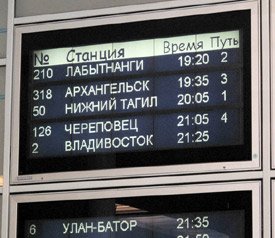 Worried about finding your train if you don't speak Russian? Here's the departure board at Moscow Yaroslavski station. Learn the alphabet and you can easily read the destinations. You can see that train 318 to Archangel leaving at 19:35 will depart from platform 3. The platforms for train 2 to Vladivostok (the Rossiya) departing 21:25 and train 6 to Ulan Bator departing 21:35 are not yet shown as they are not ready for boarding. Learn the Russian alphabet here. Photo courtesy of Daniel Brewster. |
The Trans-Siberian Railway runs all year round, so you can go at any time of year. May to September are the peak months for foreign tourists, with the warmest weather and the longest hours of daylight. This makes booking a specific date more difficult (you need to book well ahead) but you might like the party atmosphere amongst like-minded travellers on Moscow-Beijing trains 4 and 20. On the other hand, Siberia in winter is a sight to see - the trains are well heated, warm and cosy, you'll just need to wrap up well when you get off for a stroll at station stops! Traveller Rebecca Day reports from a February trip from Ulan Bator to Moscow: "The train was really warm and comfortable. For the outside I had snow boots, a jumper and a long wool coat, and this was fine most of the time. The temperature drops significantly once the sun goes down, but as long as I was wearing a hat and gloves I felt warm. I also brought a North Face down filled body warmer which was like a heater in itself! I ended up not wearing this most of the time, but it packs up really small and I'd probably bring it again if I were travelling in winter."
Should you travel 1st or 2nd class?
On the Russian internal trains there are normally 3 classes: Spalny vagon 2-berth compartments, often described as 1st class (and sometimes called myagky or lyux); kupé 4-berth compartments, usually described as 2nd class; and platskartny open-plan dormitory cars, sometimes described as 3rd class. The Russian Trans-Manchurian train (trains 19 & 20) only has spalny vagon 2-berth and kupé 4-berth, there's no platskartny. Kupé is the way most travellers go, and can be considered the normal class of travel. Spalny vagon gives you much more privacy, with 2 people instead of 4 in the same size compartment, but it costs twice as much. The choice is yours. Platskartny is a bit rough for most western travellers, but some budget-minded backpackers enjoy it. The Chinese Trans-Mongolian train (trains 3 & 4) has 1st class deluxe 2-berth, 1st class 4-berth and 2nd class 4-berth. 1st class deluxe 2-berth is expensive but worth the extra if you can afford it as it has two beds, an armchair, and a private washroom with showerhead shared with the next door compartment. It gets booked out very quickly! However, 1st class 4-berth on train 3/4 is virtually identical to 2nd class 4-berth (see for yourself in the photo gallery!) and is probably not worth the extra.
What do you do on a train for 6 or 7 days?
This is the question most people ask. Well, you put your feet up and relax. You read, watch the scenery, look out for the sights listed on your Trans-Siberian Handbook, go to meals in the restaurant car, sleep in your own comfortable bed at night, meet people, talk, play chess, drink tea, drink vodka, get off at station stops and take photographs.... The Moscow-Mongolia-Beijing route is arguably the most interesting because of both the people on board and the sights and scenery on the way. You are unlikely to be bored - the time just goes!
-
The Trans-Siberian Handbook has a kilometre-by-kilometre account of the sights to look out for from the train. Highly recommended, as this helps you get the most from your journey. You can tell where you are from the black and white kilometre posts all along the line, usually on the south side of the tracks.
-
Take plenty of reading books - Tolstoy's War and Peace is the most predictable title, but it's a great read. The funny thing is, you probably won't finish it - there's so much else to do!
-
The Moscow to Beijing journey page shows what there is to see along the way, even if you don't stop off.
Is not speaking Russian a problem?
No, it isn't. Very few western travellers on the Trans-Siberian Railway can speak Russian or for that matter, Chinese or Mongolian. I certainly can't, and everybody manages just fine. However, even if you don't speak Russian, it is definitely worth learning the Cyrillic (Russian) alphabet as you will then be able to read place names and understand many Russian words. For example, 'PECTOPAH' is pronounced 'restoran' and means (surprise surprise) 'restaurant'. 'ABTOБYC' is pronounced 'avtobus' and means 'bus'. You'll also realise that 'CCCP', the old acronym for the Soviet Union, is not 'see see see pee' but 'SSSR'. You can learn the Cyrillic (Russian) alphabet here.
What about food?
 |
|
|
Typical meal in a Russian dining-car, this one on train 19 en route from Beijing to Moscow... Courtesy David Smith. |
|
 |
|
|
Typical meal in a Mongolian dining-car. You'd better like rice and mutton! Photo courtesy of Tom Woods. |
|
 |
|
|
Typical meal in a Chinese dining-car, this one on train 23 from Beijing to Ulan Bator... Photo courtesy of Tom Woods. |
All the main Trans-Siberian trains have a restaurant car, a Russian one when in Russia, a Mongolian one in Mongolia and a Chinese one in China. Few people go to Russia for the cuisine, but contrary to what you might have heard, Russian restaurant car food is quite edible and not expensive. The prices shown here are from 2013, further feedback is always appreciated.
-
Russian restaurant cars: A soup (chicken or meat borsht) costs around 350 rubles (£7.50 or $12), a main course of steak or fish with rice or potatoes costs around 480 roubles (£11 or $17). Don't expect an extensive menu or everything shown on the menu to be available! Typical meals include ham and fried eggs for breakfast, schnitzel and potatoes for lunch or dinner, with soups and salads for starters. The restaurant car also sells beer, Russian champagne and (of course) vodka, chocolate and snacks. You can pay in rubles, although they may also accept euro or dollar notes. See sample menu.
-
Mongolian dining-cars usually offer rice and mutton, and they accept euros, US dollars, Russian Rubles & Chinese RMB as well as Mongolian currency. Fried rice costs RMB 40 (£4 or $6), a beer RMB 10 (£1 or $1.50). See sample menu.
-
Chinese dining cars have a selection of excellent Chinese dishes, each for around RMB 15-20 (£1.50-£2 or $2-$3), but check if your ticket includes meals on the Chinese section of route, as it's reported that some tickets do. A beer costs around RMB 10 (£1 or $1.50).
-
If you don't want to buy food & drink from the restaurant car, you can also buy food from the many vendors or kiosks on station platforms when the train stops. But don't venture far from the train, as stops aren't long.
-
Don't forget that on almost all Trans-Siberian trains, unlimited boiling water is available free of charge from the samovar at the end of each coach, so remember to bring a mug, spoon, coffee and a selection of cuppa soups. You can save money on restaurant car meals by bringing dried pasta or noodles, for example. My personal favourite is water-based drinking chocolate for a relaxing night-time drink each evening...
What about security? Is it safe for families or women travelling alone?
The Trans-Siberian is a very safe way to travel, even for families and women travelling alone. After all, the train is full of Russian families and women travelling alone, it's how the Russians themselves get around! Just use common sense as you would anywhere else, lock the compartment door at night and don't leave your wallet or camera lying unattended in your compartment while you go to the toilet or the restaurant car. In addition to the normal lock on the compartment door, Russian 'Spalny Wagon' and 'kupé' compartments have a security latch which stops the door opening more than an inch or two, and which cannot be released from outside even with a staff key. There's also a safe place for your bags at night - if you have a bottom bunk, there is a metal box underneath the bunk which you can only get to by lifting up the bunk. In other words, for anyone to get to your bags, they will have to shift you off your bunk first! Your carriage attendants may also lock the access doors at each end of the corridor at night to prevent intruders. So don't worry, you'll be safe and snug. Men and women share the same compartments, but on some routes you can now ask for a ladies-only compartment. If you're a woman travelling alone and do happen to find yourself sharing with men who make you uncomfortable, ask the carriage attendants if they can move you to another compartment and they normally will, without too much problem.
Do the trains have power sockets & WiFi?
Suddenly, no westerner can travel anywhere without a whole array of electrical gadgets, cameras, PDAs, iPods and mobile phones that need charging. The situation varies by train. All Russian, Mongolian & Chinese trains have shaver sockets in the corridor and washrooms which can be used to recharge things with the right adaptor. Some trains have one or two similar sockets in the corridor that can be used to recharge things if you keep an eye on them. The very latest Russian trains including train 1/2 Rossiya and Trans-Manchurian train 19/20 have a power socket in each compartment for charging laptops, mobile phones or digital cameras, although train 3/4 doesn't. Your carriage attendant may be willing to charge items using the socket in their own compartment, for a small tip.
Your default assumption should be that there's no WiFi on Trans-Siberian trains, although you'll find WiFi in hotels and other public places along the route. If you plan to use WiFi, consider getting a VPN. There's data reception along much of the route, so contact your mobile network provider about data packages for Russia, Mongolia and China.
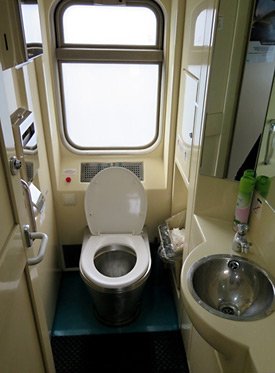 Just to reassure you! This is a clean & modern toilet in a 2nd class 4-berth car on a trains 1 & 2, the Rossiya. Courtesy of Hilary Onno. |
|
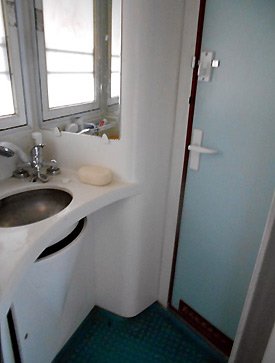 En suite washroom with shower hose attached to a deluxe 2-berth sleeper on Moscow-Beijing trains 3 & 4. It's shared with the 2-berth compartment next door. The photo is taken standing in the doorway from one compartment, looking towards the door to the compartment next door. The frosted window is between the washroom and the corridor. Water pressure in the shower head is minimal, you may have to kneel to get any sort of shower, but the washroom is useful for washing plates! Courtesy of Alan Wilson |
Toilets & showers
Each sleeping-car has at least two western-style toilets and a washroom with sinks. The carriage attendants (provodniks) will keep the toilet clean during the journey. How clean depends on both the provodniks and the passengers in your car(!), but there's normally no problem, especially on high-quality 'firmeny' trains like the Rossiya, see the photo on the right. There are no showers on Trans-Siberian trains, with two exceptions: On the Trans-Mongolian Moscow-Beijing train (train 3/4), there's a shower hose in the small private washroom shared between each adjacent pair of deluxe 1st class 2-berth compartments (see the photo below right), but don't expect much in terms of water pressure. There may now be a shower in one of the cars on the Moscow-Vladivostok Rossiya (train 1/2), which you have to pay for. Remember that the need to take a shower every single day is a relatively recent western social trend, not a human necessity. Remember that not so many generations ago, Sunday night was bath night, whether you needed it or not! Just lock yourself into the washroom half way across and make good use of the sink and a cup of water.
Smoking
If you're a rabid anti-smoker, don't worry. There isn't a problem in the compartments, corridor or restaurants which are all non-smoking. But if you're a smoker, don't worry either. You can grab a smoke in the vestibules between the cars or on station platforms.
Do Trans-Siberian trains run on time?
Within Russia, the trains are remarkably punctual. My train from Moscow arrived in Vladivostok two minutes ahead of schedule. However, on international trains you should expect an hour or two delay when crossing frontiers. For example, on the Trans-Mongolian route it is not unusual to arrive in Ulan Bator perhaps 1 or 2 hours late and in Beijing 2 to 5 hours late. Allow for this when planning any connections.
Can you stop off on the way?
All Trans-Siberian trains stop at stations every few hours for between 5 and 20 minutes, enough time to get off the train, stretch your legs, take photos and buy something from the vendors on the platform. But not enough time for a tour of the town!
Many people travel all the way from Moscow to Beijing or Vladivostok all in one go on one of the direct trains. Other people prefer to stop off along the way, breaking up the long journey and seeing something of Siberia or Mongolia. Yekaterinburg, Irkutsk (for Lake Baikal) and Ulan Bator (Mongolia) are the most usual stop-overs.
On the direct Moscow-Beijing trains, the varied scenery and friendly atmosphere on board make travelling straight through without stopovers perfectly bearable and indeed, fun. There are usually lots of westerners on board as well as Russians, Chinese and Mongolians, almost all of them making the whole trip, like yourself. However, on a Moscow-Vladivostok train, you might be the only westerner on board for much of the journey, the whole trip is made within Russia, and relatively few of your fellow-travellers will be making the whole journey to Vladivostok. It may be better to break up this trip with one or two stopovers, perhaps at Yekaterinburg or Irkutsk.
Remember that Trans-Siberian trains are 'reservation obligatory'. Every time you step on board a train you must have a confirmed sleeping-berth reservation for that specific journey on that specific train on that specific date - you cannot hop on and off trains spontaneously without a reservation. So if you want to travel from, say, Moscow to Beijing stopping off at Irkutsk you need a ticket/reservation from Moscow to Irkutsk and a second separate ticket/reservation for the train you want to take from Irkutsk to Beijing. Think of these as two separate journeys, not one. You can arrange all the tickets and reservations before you go.
If you are stopping off, remember that the weekly direct international trains 4 & 20 from Moscow to Beijing are primarily for passengers making international journeys from Moscow to Mongolia or China, although it is possible to use them for domestic trips within Russia if you can get a berth. In practice, a typical trip from Moscow to Beijing with stopovers at Irkutsk and Ulan Bator is best made using the Rossiya or another Russian domestic train such as train 100 from Moscow to Irkutsk, then the 4 times-a-week train 6 from Irkutsk to Ulan Bator and then the weekly Ulan Bator-Beijing train, see the Trans-Siberian timetable section for train times.
In theory, the Russian railways have a system whereby if you hold a ticket/reservation from A to C, and get off the train at B, you can get the ticket endorsed by the station manager, then make a second reservation and pay a small reservation charge when you want to resume your journey. However, this does not work with international tickets. The Russians themselves don't often use this facility, so Russian railway staff may not be familiar with it. I recommend buying separate tickets/reservations for each leg of your journey before you go, but if you want to try this, you had better practice your Russian language skills!
Can you take a car, bike or motorcycle?
Believe it or not, this gets asked from time to time. Trans-Siberian passenger trains do not carry cars or motorbikes, full stop. However, you can take bicycles with you, zipped up in a bike bag with pedals removed and the handlebars turned, free of charge as hand luggage. Bear in mind that it will take up space in your sleeping compartment, so it may be less anti-social to book a berth in a more spacious 2-berth compartment than to inflict your bike on three fellow travellers in a 4-berth compartment.
Is this the longest train ride in the world? No. Well... Sort of...
You'll sometimes hear Moscow-Vladivostok in 7 days on the Rossiya referred to as the longest train ride of them all. It isn't. Nor is going Moscow-Vladivostok on the on the slightly slower daily train 100. Once a week or so the Rossiya conveys two through sleepers from Moscow to the North Korean border. This is detached at Ussuryisk just an hour or so before Vladivostok, then it heads south all the way to Korea, making this a longer continuous train ride than Moscow-Vladivostok. But this isn't the longest train ride either. There is a through train from Donetsk and Kharkov in Ukraine to Vladivostok, and this appears to be the longest scheduled continuous train ride of them all. Unless you know differently, of course!
A brief history of the Trans-Siberian Railway
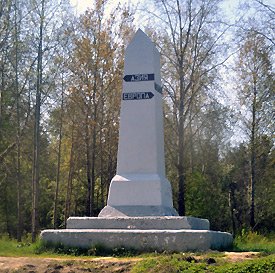 |
|
|
The Europe-Asia obelisk: Approaching Yekaterinburg (Sverdlovsk) at the kilometre post exactly 1,777 km from Moscow, the Rossiya passes the obelisk marking the boundary between Europe & Asia, right by the track. Some trains pass this in darkness, including Moscow-Beijing train 4. Courtesy of David Smith. |
In the late 19th century, Japan, Britain and America all managed to gain footholds on the Chinese coast as bases for their trade with China and the Orient. Russia too needed to secure her foothold on the east as well as securing the vast expanses of Siberia, so in 1891 Tsar Alexander III approved a plan for a trans-continental line linking Moscow and St Petersburg with Vladivostok on the Pacific coast, as this was the only year-round ice-free port on Russian territory.
A railway had been built as far as Ekaterinberg as early as 1878, and this was steadily extended Eastwards. Omsk was reached in 1894, Irkutsk and Lake Baikal in 1898. The Trans-Siberian Railway finally reached Vladivostok in 1901, but for several years passengers had to cross Lake Baikal by ice-breaking ferry to connect with a second train on the other side - only in 1904 was the line around Lake Baikal completed and the whole journey from Moscow to Vladivostok possible on a single train. Until 1916, the eastern end of the journey involved cutting across China, over part of what is now the Trans-Manchurian route - you can see how the Trans-Manchurian line initially heads towards Vladivostok on the Trans-Siberian route map above. The Russians secured the right to build and maintain this route across China thanks to a treaty signed after they made a generous loan to China to help them pay off their debts to Japan. From 1916, the complete journey could be made from Moscow to Vladivostok within Russia, taking the route followed by today's 'Rossiya' and skirting the Chinese border to the north via Khabarovsk. The Trans-Mongolian line is a relatively recent addition to the Trans-Siberian network - construction started in 1940, it reached Ulan Bator in 1949, and it was completed into China by 1956.
The Trans-Siberian Railway today...
Today, the Trans-Siberian Railway is a key part of the massive Russian railway system. It is not a tourist line - it is a real, working railway, carrying a huge amount of freight and passenger traffic. It is double-track and electrified all the way from Moscow to Vladivostok, and on some parts of the line freight trains rumble past every few minutes. It is not the only line in Russia - on the contrary, if you saw a map of Russian railways you would be hard-pressed to decide which of the many routes Trans-Siberian trains actually take for the first few thousand miles East of Moscow. There is in fact now a second route across Siberia to the north of the Trans-Siberian to Sovetskaya Gavan on the Pacific coast, called the BAM (Baikal-Amur-Maestral railway). Started in the 1930s, it was only completed in 1991. However, this route is of little interest to most Western travellers.
The best resource for further information about the Trans-Siberian Railway is www.transsib.ru/Eng/.
|
|
|
The Europe-Asia obelisk: Approaching Yekaterinburg (Sverdlovsk) at the kilometre post exactly 1,777 km from Moscow, the Rossiya passes the obelisk marking the boundary between Europe & Asia, right by the track. Some trains pass this in darkness, including Moscow-Beijing train 4. Courtesy of David Smith. |
Trans-Siberian web resources
These sites are very useful in planning a Trans-Siberian train journey:
-
www.transsib.ru/Eng/ - the Trans-Siberian web encyclopaedia.
-
www.trans-siberia.com - an independent site, based on a traveller's experiences.
-
www.myazcomputerguy.com/everbrite/Page9 - excellent advice from Ruth Imershein, an experienced and regular traveller to Russia.
If cost isn't an issue, you can ride the Trans-Siberian Railway in luxury with deluxe accommodation and 3-course meals with stopovers & tours included, using one of these two of privately-run deluxe cruise trains. Expect fares of quite a few thousand pounds per person!
Golden Eagle cruise train: Moscow - Mongolia - Vladivostok in 15 days
The luxurious Golden Eagle links Moscow with Vladivostok roughly once a month May to August, with a side trip to Mongolia.
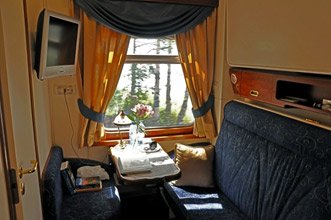
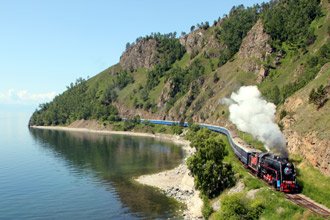
The Golden Eagle is sold by a number of travel agencies who can put together accommodation and travel to and from Moscow by train or air. Here are two reliable agencies well worth contacting:
Railbookers - for trips on the Golden Eagle
-
Railbookers is a train travel specialist who can arrange train travel from the UK to Moscow, a trip on the luxury Golden Eagle train from Moscow to Vladivostok or Moscow to Beijing, and flights back to the UK. A 15-night trips costs from around £5,300 from Moscow to Beijing or £9,700 from Moscow to Vladivostok, excluding flights, visas and travel to Moscow.
UK call 0207 864 4600,
www.railbookers.co.uk.
US call free 1-888-829-4775,
www.railbookers.com. Canada call free 1-855-882-2910,
www.railbookers.com.
Australia call toll-free 1300 971 526,
www.railbookers.com.au.
New Zealand call toll-free 0800 000 554 or
see
website.
Lernidee cruise train: Moscow - Mongolia - Beijing in 15/16 days
-
Roughly once a month May to September, this luxury train links Moscow with China in either direction, with stopover & tours included on a 15 or 16 day itinerary. It can also be used for shorter sections. You can book this train direct with the operator at www.transsiberian-travel.com or through Railbookers (UK 0207 864 4600, US/Canada toll-free 1-888-829-4775, Australia toll-free 1300 971 526.
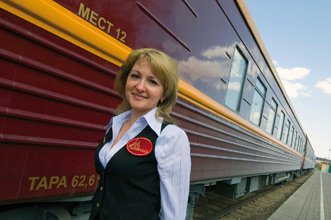
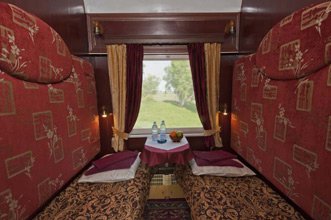
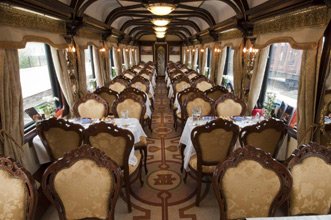
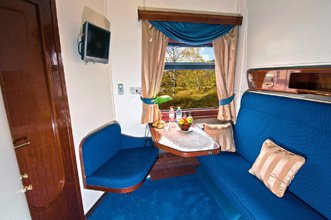
Vladivostok to Korea & Japan by ferry
Ferry m/v Eastern Dream
|
|
|
|
|
The m/v Eastern Dream at Vladivostok. Photo courtesy of David Smith |
Update late 2022: The time-honoured weekly ferry run by Russia's Far East Shipping Company (FESCO) fell victim to the recession in late 2009. A new company called DBS started a year-round weekly ferry from Vladivostok to South Korea & Japan that same year using a modern ship called the Eastern Dream. Unfortunately, DBS suspended this ferry in November 2019 and discontinued it in February 2020. A new company called Duwon Shipping then chartered the Eastern Dream and it started sailing again between Vladivostok, South Korea & Japan, although only carrying freight due to the pandemic. The service was suspended again in February 2021, but in 2022 it's operating again, only between Vladivostok and South Korea, not Japan. Please contact them to check the latest situation.
If you find you are unable to travel to Korea or Japan using this ferry from Vladivostok, you can of course take the Trans-Siberian Railway to Beijing and take a ferry from China to Japan or South Korea.
Eastbound: Vladivostok ► Pohang (South Korea) ► Maizuru (Japan)
If & when running, the ferry sails from Vladivostok on Tuesdays, arriving Pohang Port (South Korea, just north of Busan) on Wednesdays, and Maizuru Port (in Japan, on the north coast opposite Kyoto) on Thursdays. Exact sailing times are not known.
When DBS ran this service there was a departure tax to pay from Vladivostok, around 560 roubles, which wasn't mentioned anywhere on their website, so don't let this come as a surprise.
Westbound: Maizuru (Japan) ► Pohang (South Korea) ► Vladivostok
If & when running, the ferry sails from Maizuru Port (in Japan, on the north coast opposite Kyoto) on Thursdays, sailing from Pohang Port (in South Korea, just north of Busan) Saturdays, arriving Vladivostok on Sundays.
How much does it cost?
When DBS ran this service, the cheapest fare from Vladivostok to Japan or vice versa is US$235 one-way or $435 return, that's in economy class with a berth in a shared open-plan sleeping area. Sharing a 2-berth cabin the fare rises to $485 one-way or $825. Deluxe suites also available. New fares under Duwon Shipping are not yet known.
How to buy ferry tickets
Due to the covid-19 pandemic, the ferry is not currently taking passengers. However, their website is www.dwship.co.kr and their email duwon@dwship.co.kr.
On board the m/v Eastern Dream
There are a range of comfortable cabins on board, a restaurant, shop and bar. You can spend Yen, Won, or US$ on board, but definitely not roubles. The ship remains on Vladivostok time until 22:00, then the clocks are put back 2 hours to Korean/Japanese time.
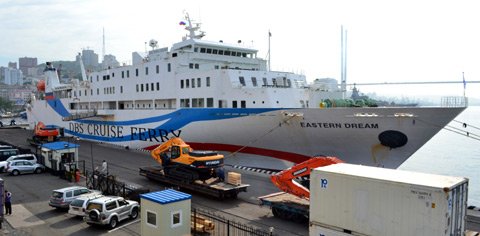
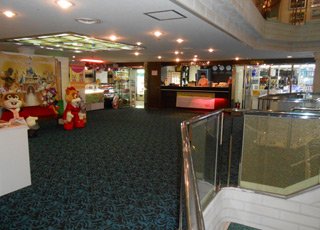
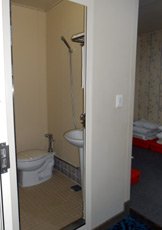
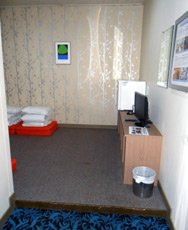
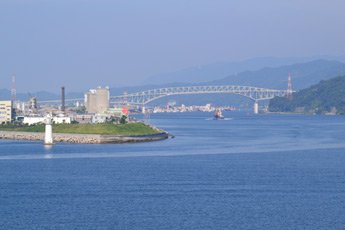
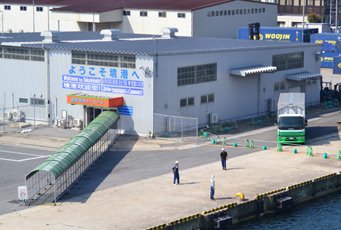
Traveller's reports
Traveller Matthew Woodward reports (from when the ferry was run by DBS): "I travelled on the ship in December 2014, and at this time of the year the published timetable was quite different from normal. There was no crossing at all the week before (owing to Christmas), and on my dates the ship stopped overnight in Donghae, allowing a night to be spent in South Korea. The cabins on board are quite expensive for what they are. I would recommend the third class dormitories which seemed more comfortable than the more expensive but rather claustrophobic second class 8 berth cabins (very hot). The ship has a good bar which serves snack food and a restaurant that serves a Korean buffet (buy tickets from the Purser's office). Do try the Korean "pizza" and the local rice wine drink called "Makgeolli" served in the bar. The ferry terminals in Vladivostok and Donghae are good and have shops selling food, hard currency and souvenirs. Rules were enforced when leaving Donghae that prohibited carrying even pocket penknives onto the ship. The gangplank is a narrow and steep climb, but the ship's crew will happily carry your luggage up for you if you ask." See Mathew's illustrated blog about the Eastern Dream at www.matthew-woodward.com/2014/12/kings-of-the-wild-frontier.html.
Recommended guidebooks
 Trans-Siberian Railway guides - buy at Amazon.co.uk
Bryn Thomas' excellent Trans-Siberian Handbook has journey planning information, town guides, train information, the history of the line, and most importantly, a mile-by-mile guide to the sights you can see from the train, to help you get the most from your trip. The Lonely Planet guide to the Trans-Siberian Railway is also highly recommended. Buying one or both of these Trans-Siberian guidebooks is well worth it, both for planning your trip and on the go.
Or buy from Amazon.com in the USA.
General country guidebooks - click the images to buy online
You should also take a good general guidebook for the countries you are visiting, and perhaps a Russian phrasebook, too. I think the Lonely Planets and Rough Guides are about the best ones out there for the serious independent traveller, with plenty of historical and cultural background as well as stacks of practical information on accommodation, places to eat, things to see, visas, transport, dangers and annoyances. You won't regret buying any of these..! If you buy anything at Amazon through these links, Seat61 gets a small commission which helps support the site.



Hotels & accommodation
Book a hotel in Moscow, Siberian cities or Beijing...

Tripadvisor hotel reviews...
www.tripadvisor.com is a good place to find independent travellers' reviews of the main hotels. It also has the low-down on all the sights & attractions too.
Backpacker hostels...
www.hostelworld.com: If you're on a budget, don't forget the backpacker hostels. Hostelworld has online booking of cheap private rooms or dorm beds in backpacker hostels in most Indian cities at rock-bottom prices.
Travel insurance & other tips
|
|
|
|
|


Always take out travel insurance
Never travel overseas without travel insurance from a reliable insurer, with at least £1m or preferably £5m medical cover. It should also cover cancellation and loss of cash and belongings, up to a sensible limit. An annual multi-trip policy is usually cheaper than several single-trip policies even for just 2 or 3 trips a year, I have an annual policy with Staysure.co.uk myself. Here are some suggested insurers. I get a small commission if you buy through these links.
www.staysure.co.uk
offers enhanced Covid-19 protection & gets 4.7 out of 5 on
Trustpilot.
www.columbusdirect.com
is also a well-know brand.
 www.staysure.com/ie if you live in Ireland.
If you live in the USA try
Travel Guard USA.
|
|

Get an eSIM with mobile data package
Don't rely on WiFi, download an eSIM with a European mobile data package and stay connected. Most newer mobile phones can download a virtual SIM including iPhone 11 & later, see device compatibility list. There's no need to buy a physical SIM card! Maya.net is a reliable eSIM data retailer with a 4.5 out of 5 Trustpilot rating and a range of packages including unlimited data.
|
|

Get a VPN for safe browsing. Why you need a VPN
When you're travelling you often use free WiFi in public places which may not be secure. A VPN encrypts your connection so it's always secure, even on unsecured WiFi. It also means you can select the geographic location of the IP address you browse with, to get around geoblocking which a surprising number of websites apply. See VPNs & why you need one explained. ExpressVPN is a best buy with a 4.7 out of 5 Trustpilot ranking which I use myself - I've signed up as an ExpressVPN affiliate, and if you go with expressvpn.com using the links on this page, you should see a special deal, 3 months free with an annual subscription. I get a small commission to help support this site.
|
|


Get a Curve card for foreign travel
Most banks give you a poor exchange rate, then add a foreign transaction fee on top. A Curve MasterCard means no foreign transaction fees and gives you the mid-market exchange rate, at least up to a certain limit, £500 per month at time of writing. The money you spend on your Curve card goes straight onto one of your existing debit or credit cards.
How it works: 1. Download the Curve app for iPhone or Android. 2. Enter your details & they'll send you a Curve MasterCard - they send to the UK and most European addresses. 3. Link your existing credit & debit cards to the app, you can link up to two cards with the free version of Curve, I link my normal debit card and my normal credit card. 4. Now use the Curve MasterCard to buy things online or in person or take cash from ATMs, exactly like a normal MasterCard. Curve does the currency conversion and puts the balance in your own currency onto whichever debit or credit card is currently selected in the Curve app. You can even change your mind about which card it goes onto, within 14 days of the transaction.
I have a Curve Blue card myself, it means I can buy a coffee on a foreign station on a card without being stung by fees and lousy exchange rates, just by tapping the Curve card on their card reader. The money goes through Curve to my normal debit card and is taken directly from my account (in fact I have the Curve card set up as payment card on Apple Pay on my iPhone, so can double-click my phone, let it do Face ID then tap the reader with the phone - even easier than digging a card out). I get a little commission if you sign up to Curve, but I recommend it here because I think it's great. See details, download the app and get a Curve card, they'll give you £5 cashback through that link.
|
|

Carry an Anker powerbank
Tickets, reservations, vaccination records and Interrail or Eurail passes are often held digitally on your mobile phone, so it's vital to keep it charged. I always carry an Anker powerbank which can recharge my phone several times over if I can't get to a power outlet. Buy from Amazon.co.uk or from buy from Amazon.com.
Touring cities? Use hill walking shoes!
One of the best things I've done is swap my normal shoes for hill-walking shoes, in my case from Scarpa. They're intended for hiking across the Pennines not wandering around Bangkok, but the support and cushioning for hiking works equally well when you're on your feet all day exploring foreign cities. My feet used to give out first and limit my day, now the rest of me gives up before they do!