


 |
|
|
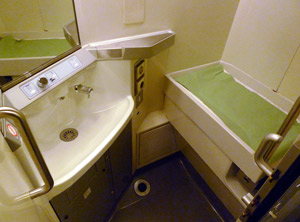
Baby-changing room on a Eurostar e300 in cars 1 & 18. Most modern trains now have these, usually a drop-down table in one or more toilets. |
|
 |
|
|
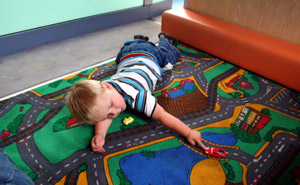
Play areas: You occasionally find trains with a small play area, for example French 'Téoz' intercité trains and some Swiss & Finnish InterCity trains. Here, Nathaniel is playing on a 125 mph French Téoz intercité train from Paris to Clermont Ferrand. Bring your own toy cars! |
Quality time with your kids...
Kids love trains, a train ride is quality time with your family away from doorbells, phone calls & distractions. And kids of all ages really love sleeper trains, bunk beds on a train. Taking your kids by train teaches them independence, too, rather than being ferried around passively by car. Video: What kids say about train travel.
 See infant & child age limits for
each country
See infant & child age limits for
each country
Babies & infants go free
-
Babies & infants travel for free, a major advantage over air travel. The age limit for an infant varies by country from under 4 to under 6, see the list of child age limits below.
-
They don't normally need a ticket, just bring them along free of charge. There are two major exceptions, on mainline trains in Spain & Russia you need to get them a zero-fare ticket in their name.
-
But they don't qualify for their own seat. In practice this isn't a problem on trains without seat reservations, meaning local trains or reservation-optional trains such as long-distance trains in Germany, Austria, Switzerland. You find some empty unreserved seats and plonk your infant down next to you. Only if the train got full & standing would you be expected to put your infant on your lap to free up a seat for an adult. However, on all-reserved mainline trains as in France, Italy or Spain the seat next to you will usually be reserved by another traveller, so you your infant or baby has to go on your lap, or squeezed next to you with the armrest raised - but read on...
-
If you want a reserved seat or berth for your infant or baby, you can pay the child fare. However, there are at least two useful exceptions:
TGV-Lyria trains from Paris to Switzerland offer a baby pass for €19 in 2nd class or €29 in 1st class which gives your wriggly 2 or 3 year old their own seat. A sound idea!
On French domestic TGV & Intercité trains you can buy a special ticket called a Billet Bambin for a fixed €9 per journey which gives your infant their own reserved seat, well worth it on a long trip. You'll automatically get a Billet Bambin if you buy your tickets at www.raileurope.com, www.thetrainline.com or www.sncf-connect.com and add your infant as a passenger with their correct date of birth/age.
On sleeper trains I recommend giving an infant their own berth - don't try to share a narrow berth with a wriggly 2 year old - the easiest option is usually to enter your infant as a 7 year old and pay for a child ticket. On Nightjets you can use your child's correct age and it'll ask you if they need their own berth.
Children travel at a reduced fare
-
Children pay a reduced fare
The age limit for children varies by country from under 12 to under 16 (and in one case, under 17), so see the list of child age limits below.
-
But the child rate isn't always 50% off the adult fare
Many high-speed trains in western Europe now have airline-style variable pricing, and you'll often find a fare structure like this: €120 full-fare adult, €65 full-fare child, cheap fares for anyone of any age €70, €50, €40, €30. In other words, if you booked in advance and found the €30 rate available, 2 adults and 2 children would pay 4 x €30, a nice cheap deal but in effect there's no child discount at all. On the other hand, if you needed to travel at short notice you'd pay 2 x €130 plus 2 x €65, so now the child discount becomes useful. But it varies by country and operator. Which leads on to the next very important point...
But watch out for these pitfalls
-
Is an adult fare cheaper than the child fare?
Watch out! In a few cases, you'll find trains on which the only fare that is officially designated 'child' is a Child Full Flex costing (let's say) €65, but there's a whole range of advance-purchase fares staring at (say) €29 for anyone of any age, but officially designated in the ticketing system as 'adult'. Some booking websites are intelligent enough to correctly offer the €29 adult fare for your child if that's the cheapest option, but others stupidly & unnecessarily apply the €65 child rate for your child. A child is perfectly entitled to travel on an adult ticket, just not the other way around! So keep your wits about you, make sure you spot it if the system charges more for your kids than for you, and if so try re-running the enquiry with all of you entered as adults.
-
Is your booking website applying the right age limits?
The German Railways website asks the age of each passenger and applies the correct age limits to your journey. However, French Railways websites such as www.sncf-connect.com always blindly apply the French Railways child age limits, even when booking (say) a train from Paris to Munich. So I strongly recommend using the German website rather than French for trains to, from, or within Germany, and be careful when using Rail Europe to book trains outside France. I wonder how many French people have been mis-sold a child ticket for their 5 year old on the sleeper train to Germany?
Tips & advice for travel with kids
-
Unaccompanied children
On Eurostar, all children under 12 must travel accompanied by an adult, and unaccompanied children from 12 to 16 require a consent form signed by their parent or guardian. See www.eurostar.com for details.
-
Baby-changing facilities
Most modern trains now have good baby changing facilities. Eurostar has baby-changing facilities, on their classic trains it's in 2nd class cars 1 & 18, at each end of the 18-car Eurostar train but on the new and refurbished trains there are more of them. The baby changing rooms have sink, soap, changing table and disposable changing table covers. In a sleeper, you can easily change nappies on the bottom berth (see picture!). Make sure you invest in a good changing bag with shoulder or back straps.
-
Family-friendly coaches
If you're travelling 2nd class on Eurostar or on French TGV trains, book seats in the family-friendly coach (cars 1 or 18 on a Eurostar e300, see the Eurostar seat maps). This has bays of 4 seats around tables at one end of the train, away from other passengers walking through to and from the bar, so it's better for children to play. It's also close to the baby changing room. A handful of trains (notably French Téoz trains and some Swiss & Finnish InterCity trains) even have a small children's play area, see the photo opposite.
-
Baby slings
Carrying a baby in a front-carry sling (under 6 months) or in a papoose on your back (over 6 months) is much easier than struggling with a baby buggy through the London Underground or Paris metro (with all the steps!), and on and off trains. However, if you really want to use a buggy, there's space to stow it with other large items of luggage at the end of the Eurostar coach. The classic choice of front-carry sling is the excellent Baby Bjorn. Once they're over 6 months, I recommend a MacPac papoose (Possum or Vamoose), see www.macpac.co.nz.
-
Portable bed for infants
For travelling overnight with a 0-18 month old, we used to use a Samsonite travel bubble which is no longer made, but a Deryan 3158 infant babybox is a similar lightweight sleeping box which fits on the floor in most couchettes or sleepers. It can then be used in your hotel room at your destination, much lighter than most so-called travel cots.
-
Portable bed for toddlers
For older toddlers from 18 months to 3 or 4 years, use an inflatable bed. This is lightweight, infinitely more so than most so-called 'travel cots'. It fits on the floor in ferry cabins and hotel rooms. Buy a girls 'Kitty' bed at Amazon.co.uk. Buy a boys 'Cars' bed at Amazon.co.uk.
-
Take a 'Trunki'
Give kids their own luggage to pull along or ride on, as seen on television in Dragon's Den. Buy a Trunki at Amazon.co.uk.
-
What baggage does the Man in Seat 61 take when travelling as a family?
You'll find your own way of travelling light and staying mobile even with kids, I'm sure. But here's what we did for longer stays when our kids were younger:
I take an Eagle Creek wheeled backpack for my clothes with an Eagle Creek daypack for my reading books, travel documents, charging leads, powerbank, phone and so on. My wife takes the same.
We then take two small holdalls, one for each kid. The holdalls either sit on top of the Eagle Creeks or can be slung over our shoulders whilst the Eagle Creek is pulled. The daypacks are worn on our backs. We don't usually bother with a buggy, the children walk. If I need to carry one of the children, Nicolette can pull both Eagle Creek roll-alongs - however we've generally found that the kids manage to stay awake (and excited) even for relatively late train arrivals, even the 21:50 arrival in Milan of the TGV from Paris.
As the Eagle Creek roll-alongs are only backpack-sized, all our bags fit on the overhead racks above our seats on any given train, so we can keep an eye on them and access them easily. Oh yes, and each of the kids now wears their own very small backpack with toys, colouring books, a Nintendo and other amusements! The only other tip is that splurging on taxis - both across Paris between stations and between destination station and hotel - makes a big difference when you've luggage and kids, compared to taking the metro or a long walk.
Child age limits on European trains
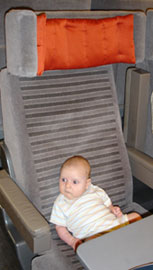 On board Eurostar: This train travel thing is child's play... Photo courtesy of Nathaniel |
In Britain, children under 5 go free, children from 5 to 15 (inclusive) travel at half the adult fare.
On Eurostar, children under 4 go free, and a special child fare (currently £25 single, £50 return to Paris or Brussels in standard class) applies to children from 4 to 11 inclusive. Children 12 & over travel at the youth fare (for ages 12-26). All children under 12 must travel accompanied by an adult, and unaccompanied children from 12 to 16 require a consent form signed by their parent or guardian. See www.eurostar.com for details.
On other European trains, age limits for children vary from country to country, so here's a summary. Just make sure you tell your booking agency how old your children are, and they will do the rest. Online booking systems will ask you the ages and will work out the fares for you. The child fare is normally 50% of the adult fare, although on international trains where special 'global fares' are charged, a special child fare applies. Note that these age limits are for the main national train operator, private open access operators may have different child age limits.
* Alleo is the consortium of French/German national railways running the Paris-Frankfurt/Stuttgart/Munich high-speed daytime trains. The French show child age limits as 4-12, the Germans apply their own 6-14 age limits, so even the operators can't agree which child limits apply! I suggest you book with the Germans if you have children aged 5, 13 or 14!
Watch the video: Why kids love train travel